




























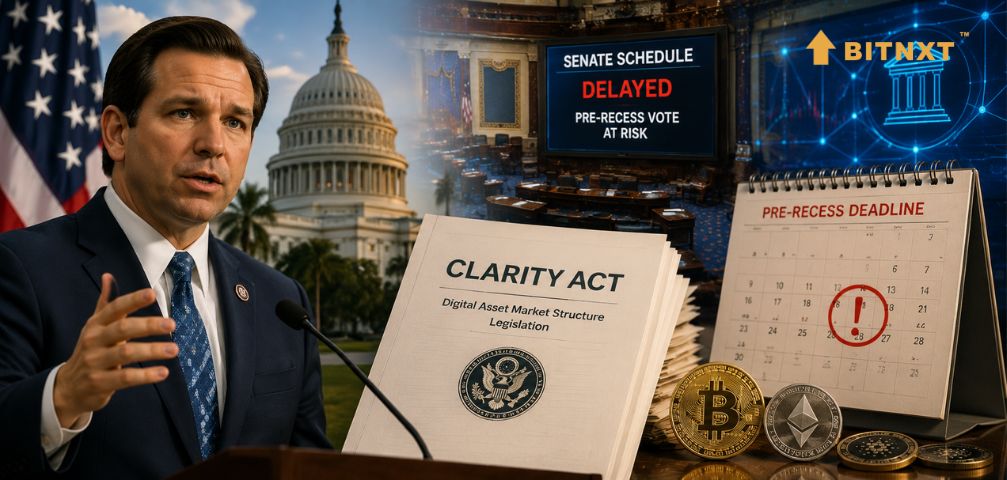
Florida Republican Rep. Mike Haridopolos is stepping up pressure on the Senate to move forward with the CLARITY Act, warning that continued procedural delays could push crypto businesses and investment capital out of the United States entirely — just as the bill's window for pre-August-recess passage keeps narrowing.
Haridopolos Frames the Bill as a Race for Global Leadership
Appearing on Fox Business' Mornings with Maria on July 28, Haridopolos — a member of the House Financial Services Committee — defended the legislation as essential to keeping digital asset activity anchored in the US rather than migrating overseas. He argued that the goal is straightforward: making sure American markets remain the world's premier venue for crypto activity, rather than ceding that ground to other jurisdictions. He also accused Senate Democrats of using procedural tactics to stall a bill he says has broad voter support.
Haridopolos previously voted for the House version of the bill in July 2025, when it passed with a notably bipartisan 294–134 vote, backed by 216 Republicans and 78 Democrats.
What the Bill Would Actually Do
At its core, the CLARITY Act aims to draw a clear jurisdictional line between the SEC and the CFTC, giving exchanges, token issuers, and blockchain developers a defined regulatory path to operate legally in the US — something the industry has been requesting for years amid ongoing regulatory ambiguity.
Why the Senate Timeline Keeps Slipping
Senate Majority Leader John Thune has temporarily redirected floor time toward confirming a batch of federal nominees and advancing the Lindsey O. Graham Russia and Iran sanctions bill, pushing CLARITY Act action to the back of the queue. With the Senate's summer recess set to begin after August 7 — followed by a state work period running through September 11 — realistic odds of a vote happening before lawmakers leave town are shrinking by the day.
Thune has signaled the Senate could still take some preliminary action before recess, but only once leadership is confident the votes are actually there. Under the current Senate math, the bill needs at least eight Democratic votes to clear procedural hurdles. It already cleared the Senate Banking Committee in May by a 15–9 vote, with two Democrats crossing over — though both made clear their committee-level support didn't guarantee a yes on the floor without further changes to the text.
Sticking Points: Ethics Rules and State Enforcement Power
Much of the current negotiation centers on how the bill treats elected officials' crypto dealings. The Senate draft would temporarily bar certain officials — including the president and vice president — from issuing or promoting crypto assets until January 2029, with enforcement resting solely with the Justice Department.
That enforcement structure has become a flashpoint: Democrats have pushed back because the current draft would block state attorneys general from stepping in if federal prosecutors decline to act. New York Attorney General Letitia James has raised a related concern, arguing the bill risks overriding state-level digital asset rules and weakening local efforts to combat crypto scams — a concern she's tied to a reported tripling of crypto-related complaints to her office over the past three years. James has called for the bill to include stronger anti-money-laundering, customer-identification, and cybersecurity requirements before moving forward.
What Staying Stuck Means for the Market
For now, the delay doesn't change the legal status of crypto assets, US exchange operations, or spot crypto ETFs — but it does prolong uncertainty over which regulator ultimately oversees token trading, fundraising, and digital commodity markets, a gap the industry has been vocal about wanting closed.
Industry backing remains broad: Coinbase, Ripple, the Digital Chamber, and other groups supported the House version, while Goldman Sachs CEO David Solomon has voiced support for advancing the Senate version too — despite calling it imperfect in its current form.
What Happens If the Senate Misses This Window
If lawmakers fail to act before the August recess, September becomes the next realistic opportunity. Even then, the Senate would still need to pass its own version, reconcile it with the House bill, and send unified final text back through both chambers — a multi-step process that, if not completed before the current Congress wraps up, could push the entire market-structure debate into 2027.
All CLARITY Act News here:
https://bitnxt.io/crypto-news/clarity-act-ethics-text-trump-doj-enforcement-crypto-rule
https://bitnxt.io/crypto-news/seven-senate-democrats-clarity-act-draft-falls-short
https://bitnxt.io/crypto-news/clarity-act-explained-five-key-crypto-provisions
https://bitnxt.io/crypto-news/goldman-sachs-backs-clarity-act-banking-split
https://bitnxt.io/crypto-news/goldman-sachs-backs-clarity-act-banking-split
https://bitnxt.io/crypto-news/clarity-act-lummis-white-house-ethics-talks-senate-vote-update
https://bitnxt.io/crypto-news/ethereum-price-clarity-act-etf-inflows-support-1830


