




























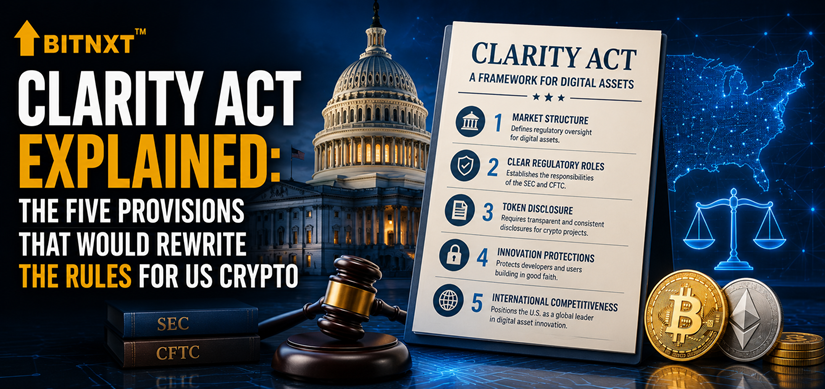
The fight over the Digital Asset Market Clarity Act has been consumed by one issue — the ethics provisions governing whether federal officials can profit from crypto. But the bill itself runs hundreds of pages, and the substance underneath the political battle is what would actually reshape how digital assets are regulated in the United States. Its central purpose is to clarify which agency oversees what, resolving years of jurisdictional ambiguity between the SEC and the CFTC that has slowed institutional adoption.
Here are the five provisions that matter most — and why each has drawn its own constituency of supporters and opponents.
1. Stablecoin Rewards — the Banks vs. Crypto Flashpoint
The most contentious non-ethics provision governs how exchanges and other crypto firms can pay rewards on dollar-backed stablecoins. The bill draws a line between two activities: it bans rewards on idle balances that closely resemble bank deposits, while permitting rewards tied to transaction-based activity, such as making a payment with a stablecoin. The SEC, CFTC, and Treasury Department would be required to issue joint rules implementing it.
Both sides are unhappy for opposite reasons. Banks argue the provision could pull deposits out of the regulated banking system. Crypto firms counter that barring third parties like exchanges from paying interest on stablecoins is anti-competitive. That tension — deposits versus tokens — is the deeper economic conflict running beneath the entire bill.
2. Anti-Money Laundering — Crypto Gets Bank-Style Obligations
The bill would treat all digital commodity exchanges, brokers, and dealers as financial institutions under the Bank Secrecy Act, subjecting them to anti-money-laundering, customer identification, and due-diligence requirements. In practice, that places crypto firms under substantially the same AML regime as banks — settling a long-running argument in which some firms maintained those rules simply didn't apply to them.
3. The SEC Fundraising Exemption
Crypto companies would be permitted to raise up to $50 million a year, and up to $200 million in total, without registering with the SEC as other companies must when fundraising. Tokens tied to investment contracts could still be sold under this regime, but with a materially lighter regulatory burden than conventional securities carry.
The strategic effect is significant: the exemption would curtail the SEC's ability to argue that most token sales are unlawful securities offerings — the position the agency took under the Biden administration and one that many courts upheld.
You might also like: Ethics Rules Weren't Enough: Seven Senate Democrats Say the New Clarity Act Draft ‘Falls Short’ — and They're the Votes It Needs
4. Defining “Decentralized” — With Teeth
Decentralized platforms have long argued they can't comply with bank-style rules, since those rules assume a legal entity sits between users and holds customer funds. The Clarity Act would settle the question by defining when a platform is sufficiently decentralized to qualify — and if it doesn't clear the bar, it would be treated as a financial institution required to monitor transactions and report suspicious activity.
The test is concrete rather than rhetorical. A platform would not count as decentralized if it can block users, or if it retains private permissions or hard-coded special privileges unavailable to everyone else. For DeFi builders, that turns architectural choices into regulatory outcomes.
5. Tokenization — Same Asset, Same Rules
Tokenization refers to converting financial assets like stocks, bonds, and real estate into crypto assets — an area where firms have been investing heavily ahead of expected SEC moves to permit blockchain-based stock trading. The bill's answer is straightforward: putting securities on a blockchain does not exempt them from securities laws.
It would also mandate that, for regulatory purposes, tokenized securities generally be treated the same way as the underlying securities they represent, and require the SEC to study their regulatory treatment further. Notably, that principle now has a real-world echo — SEC Commissioner Hester Peirce recently made essentially the same argument about DeFi vaults and onchain lending, warning that moving activity onchain doesn't move it outside the securities laws.
Why the Details Still Matter
These provisions have been the substance of the bill since the Senate Banking Committee unveiled its text and advanced it on a 15-9 vote, with only two Democrats joining Republicans. What has changed since is the politics, not the plumbing — the ethics section remains the obstacle, and the bill still needs 60 votes to clear the Senate floor.
For anyone tracking the outcome, that distinction is worth holding onto. If the Clarity Act ever passes, it won't be the ethics language that reshapes the industry day to day. It will be these five provisions — who can pay yield on a stablecoin, which firms carry bank-grade compliance duties, how tokens can be sold, what legally counts as decentralized, and whether a tokenized share is still just a share.
Source: Based on Reuters reporting (Hannah Lang) on the Senate Banking Committee’s Clarity Act text, with additional context from subsequent coverage. Bill provisions described reflect the committee text and remain subject to amendment. This article is for informational purposes only and is not legal or investment advice.


