























.jpg)

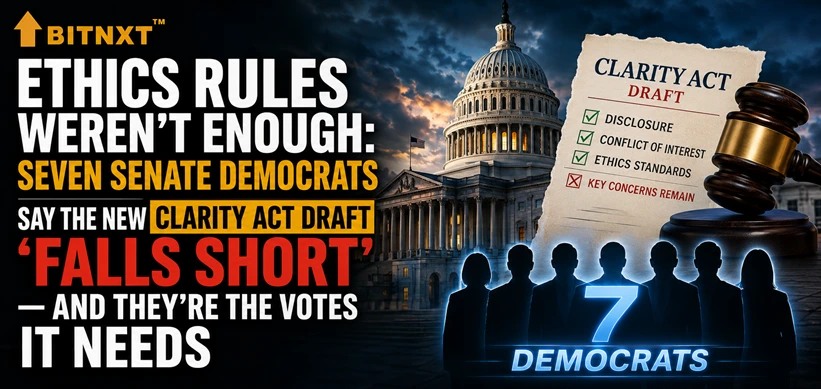
The ethics deal that was supposed to unlock the crypto industry's biggest legislative prize has run straight into the wall it was designed to remove. Hours after Senate Republicans published a new draft of the Digital Asset Market Clarity Act containing ethics language personally agreed to by President Donald Trump, a group of seven Senate Democrats — the exact bloc whose votes the bill requires — said the text falls short.
Who Signed the Statement
The names matter more than the language. Senators Angela Alsobrooks, Cory Booker, Catherine Cortez Masto, Ruben Gallego, John Hickenlooper, Mark Warner, and Raphael Warnock issued a joint statement saying the Republican-proposed text as it currently stands falls short, and that key provisions — covering ethics for elected officials, consumer protection, illicit finance, conflicts of interest, and market integrity — must be strengthened.
This is not the bill's opposition wing. Alsobrooks and Gallego were the only two lawmakers to vote for the Clarity Act in committee, and several others in the group have voiced support for it previously. These are the Democrats most likely to say yes — which is precisely what makes their objection so damaging. The senators added that they have worked in good faith with Republican colleagues for the past year and will keep doing so to get the bill over the finish line.
The Republican View: ‘Most Powerful Ethics Language in U.S. History’
Republicans see the same text very differently. Senator Bernie Moreno, one of the lead Republicans on the bill, wrote on X that the draft contained the most powerful ethics language in US history and urged people not to believe Democratic claims to the contrary.
The gap between those two readings is the whole story. Republicans believe they extracted a historic concession from a sitting president to constrain his own conduct; Democrats believe the concession is hollow where it counts — particularly around enforcement and scope. Both can be describing the same document accurately.
You might also like: Tesla Keeps Its 11,509 Bitcoin Untouched for a Fourth Straight Year — and Books a $112M Impairment Loss for the Quarter
Why the Ethics Fight Won’t Die
The provision has been an open wound for more than a year, tracing back to the Senate's work on the stablecoin-focused GENIUS Act. It gained fresh urgency in recent weeks after Trump's latest financial disclosure showed he earned more than $1.4 billion from his crypto ventures in 2025 — a figure that transformed an abstract conflict-of-interest debate into a concrete number Democrats can cite.
The Arithmetic and the Clock
The path forward runs through unforgiving math. The bill needs 60 votes to advance, meaning as many as 10 Democrats may need to support it — and seven of the most gettable just publicly said the current text isn't there yet. Majority Leader John Thune's office says he still plans to move forward in the coming days, but the Senate leaves town after August 7 for summer recess and has other business competing for floor time.
That leaves the crypto industry in an awkward position: closer than ever on paper, with a presidential sign-off and a published draft in hand, yet still short of the votes that actually decide the outcome. Unless the ethics text can be strengthened enough to satisfy senators who want to vote yes, the most consequential crypto legislation in years may simply run out of calendar.
Source: Reporting via CoinDesk (Nikhilesh De), based on a joint statement from Senate Democrats and public posts from Senator Bernie Moreno. Legislative details are fluid and this is a developing story. This article is for informational purposes only.


