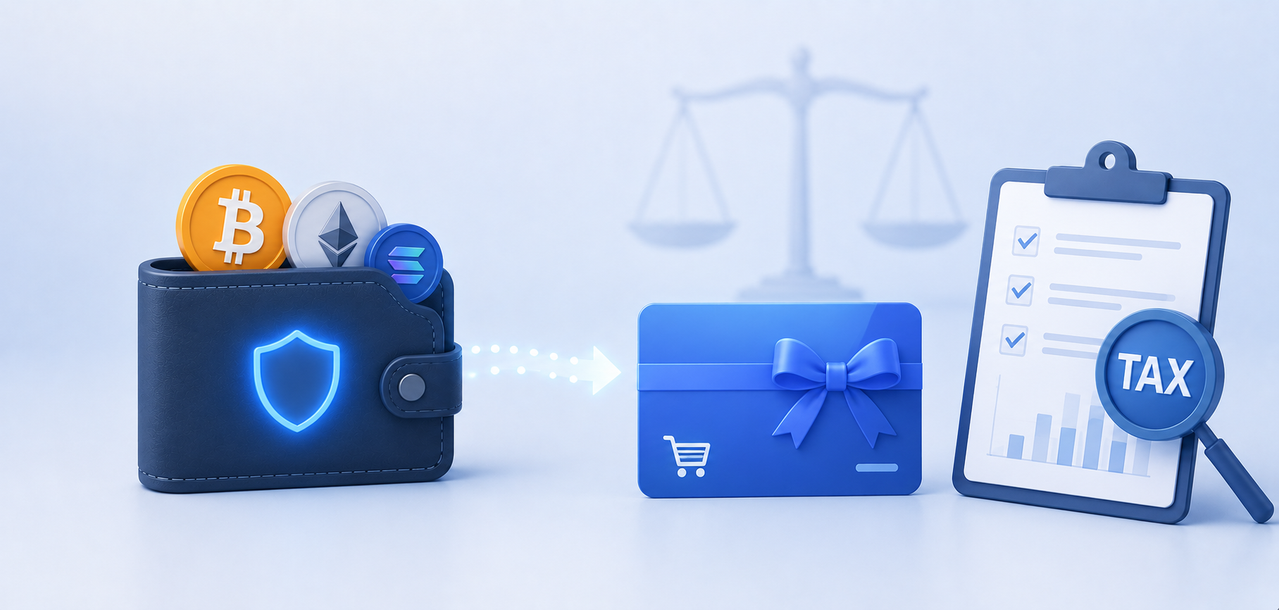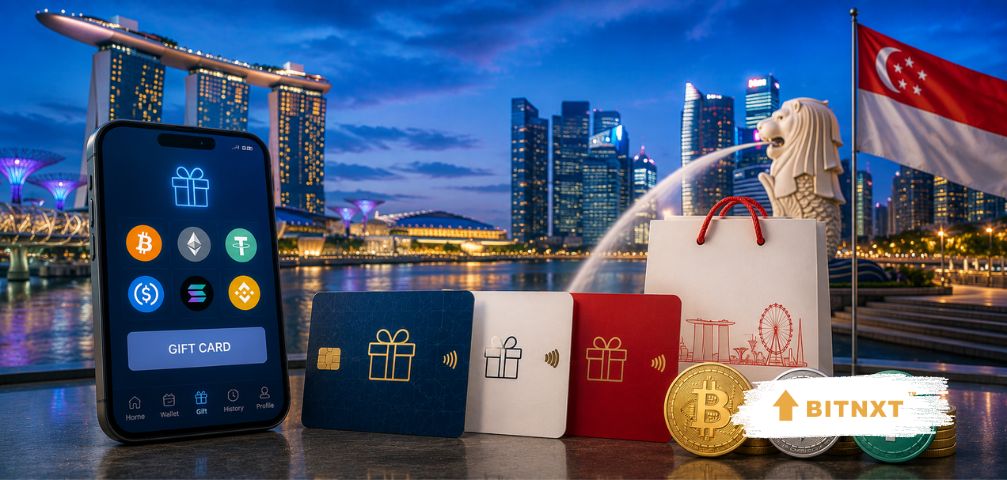
Singapore reached that position without writing a single crypto-specific exemption. It has never had a general capital gains tax, gains on shares and property are already outside the net for individuals, and IRAS simply extended the same logic to digital tokens.
There is a line, though, and unlike in some zero-tax jurisdictions it is a real one that IRAS actively applies. This guide covers where that line sits, the GST position, and which platforms serve the market.
The tax position
IRAS treats cryptocurrency as intangible property rather than as currency. Because Singapore imposes no general capital gains tax on individuals, profits from personal crypto investments held as capital assets fall outside the tax net entirely.
Buy Bitcoin at S$40,000, sell at S$60,000, and the S$20,000 gain is not taxed. Spend that same appreciated Bitcoin on a gift card and the analysis is identical — the disposal is not a chargeable event for an individual investor.
Activity | Taxable? | Notes |
|---|---|---|
Buying crypto with SGD | Not taxable | Keep the record anyway — it supports your investor classification later. |
Holding crypto | Not taxable | No wealth tax, no unrealised gains tax. |
Selling investment crypto for SGD | Not taxable | No capital gains tax for individuals. |
Spending crypto on a gift card | Not taxable | For an individual investor. This is the answer most readers came for. |
Crypto-to-crypto swap | Depends | Tax-free if investment. Taxable if the activity is trading. |
Trading as a business | Taxable | Income tax at resident rates up to 24%. |
Being paid in crypto | Taxable | Income at SGD fair market value when received. |
Staking or mining at hobby scale | Generally not taxable | Business-scale activity is taxable as income. |
Unsolicited airdrops | Generally not taxable | Taxable if received in return for services. |
Losses are equally irrelevant
The symmetry is worth stating. Because individual capital gains are not taxed, individual capital losses carry no tax benefit either. If your crypto falls and you spend it at a loss, there is nothing to claim.
For most people that is a fair trade. It is only a disadvantage relative to jurisdictions like the UK and Canada, where losses genuinely offset gains, and those jurisdictions tax the gains in the first place.
The line that matters: badges of trade
IRAS distinguishes personal investment from business activity using the badges of trade — a six-factor test that has existed in tax law for decades and is not specific to crypto.
If your activity is characterised as trading rather than investing, profits become taxable income at resident rates running from 0% to 24%. That is a substantial difference from zero.
Badge | What IRAS looks at |
|---|---|
Intent at acquisition | Did you buy to hold, or to flip? Contemporaneous evidence matters more than what you say afterwards. |
Frequency of transactions | Occasional disposals look like investment. Constant activity looks like trade. |
Holding period | Long holds support capital treatment. Rapid turnover undermines it. |
Nature of the activity | Systematic, organised operations with tooling and record-keeping resemble a business. |
Reason for disposal | Selling to fund a purchase differs from selling as part of a trading strategy. |
Surrounding circumstances | Your occupation, financing arrangements and overall pattern of dealings. |
No single factor decides it. The combination does, and the test is applied to the overall pattern of your dealings rather than to any one transaction.
For gift card buying specifically, this is comfortable territory. Someone spending crypto on groceries, food delivery or a phone top-up is disposing of an asset for personal consumption — close to the opposite of a trading pattern. The badges-of-trade risk sits with how you acquired and managed the crypto, not with how you spent it.
Where it becomes a genuine question is if you are buying discounted gift cards systematically in order to resell them. That is a commercial activity regardless of how it is funded, and it would be assessed as such.
The GST position
Singapore exempted digital payment tokens from GST with effect from 1 January 2020, correcting an earlier position that effectively taxed crypto twice.
Bitcoin, Ether, Litecoin, Dash, Monero, XRP and Zcash are among the tokens treated as digital payment tokens. Exchanging one for another, or exchanging one for fiat, is not a taxable supply.
One clarification worth making, because a lot of content gets it wrong. The exemption applies to the token leg of the transaction, not to whatever you ultimately buy. Paying with Bitcoin does not make the underlying goods GST-free — the GST on what you eventually purchase is priced into the gift card's face value in the normal way. What the exemption does is ensure the crypto payment itself does not attract a separate charge.
Regulation
Singapore regulates crypto service providers under the Payment Services Act, with digital payment token service providers requiring a licence from the Monetary Authority of Singapore.
The Digital Token Service Provider regime came fully into effect on 30 June 2025 with no transitional period, extending licensing obligations to providers serving overseas customers from a Singapore base. Several firms restructured or relocated as a result.
MAS also applies notable retail restrictions: no leverage for retail investors on licensed platforms, no credit card funding of crypto purchases, and constraints on public marketing.
That last set of restrictions has an interesting side effect. With retail crypto access deliberately made frictional, gift cards become one of the more straightforward ways for a Singapore resident to actually spend crypto on everyday goods — a route that sits entirely outside the regulated exchange perimeter.
The platforms serving Singapore
Platform | Best for | What to know |
|---|---|---|
Best overall | Localised Singapore store, strongest Lightning support, bitcoin cashback on selected products. Accepts BTC, Lightning, ETH, USDC, USDT, SOL, LTC, DOGE and Binance Pay. | |
Best coin coverage | 200+ cryptocurrencies and a deep international catalogue. No account required for standard orders. | |
Regional specialist | Malaysia-based with strong Southeast Asian coverage — game credits, regional top-ups and brands the global platforms skip. | |
Game top-ups | Similar Southeast Asian profile, particularly for in-game currency and regional titles. | |
No-account buying | 180+ countries, 100+ coins, no KYC. | |
In-wallet purchasing | Embedded inside Trust Wallet, MetaMask, Phantom and others, so there is no separate checkout. | |
Privacy-focused | 300+ tokens including Monero, zero KYC, no platform fees. | |
Processor hybrid | Marketplace plus payment processing. Also resells crypto vouchers. | |
Wallet-native | Buy from a self-custody wallet via the app or Chrome extension. | |
Virtual card route | Lightning-funded virtual Visa, usable anywhere Visa is accepted. | |
Top-up specialist | Mobile top-ups across 166 countries alongside gift cards. | |
Monero users | Bundled inside Cake Wallet. |
There is no significant Singapore-domiciled crypto gift card operator, which is unsurprising given the licensing burden the Payment Services Act would impose. The market is served by international platforms plus the Southeast Asian gaming specialists.
What you can buy
Singapore's catalogue is moderate in size but well matched to how people actually spend. Across the platforms you will typically find NTUC FairPrice, Cold Storage, Giant and Sheng Siong for groceries, Shopee and Lazada for general retail, Grab, foodpanda and Deliveroo for transport and delivery, plus CapitaVoucher and Takashimaya for mall spending.
Telco top-ups for Singtel, StarHub and M1 are widely carried, as are eSIM data packages — useful given how much regional travel originates from Singapore.
The global set of Apple, Google Play, Steam, Netflix, Spotify and Xbox is well covered, and the regional gaming platforms carry Southeast Asian titles and in-game currencies that the global operators do not stock.
Fees and delivery
Pricing follows the category norm: platforms buy at wholesale and add a margin, so you pay face value or a premium of roughly one to five percent depending on the brand. Genghis charges no platform fee, worth comparing against Bitrefill on the specific card you want.
Lightning is the right rail for anything under about S$150. On-chain fees during congestion can exceed the platform's entire margin on a small card.
Compare the actual crypto amount debited rather than the listed Singapore dollar price, since exchange rate handling varies meaningfully between platforms.
Practical guidance
Set the region to Singapore before browsing so you see SGD-denominated local brands.
Keep records for at least five years, even though investment gains are untaxed. Records are what substantiate your investor classification if IRAS ever asks.
Use Lightning below about S$150.
If your trading pattern is heavy, get advice on your classification before assuming the zero rate applies to you.
Check that the card region matches where it will be redeemed. SGD-denominated cards generally will not work abroad.
Redeem promptly. Cards are cash equivalents, refunds are rare, and crypto payments cannot be reversed.
Frequently asked questions
Do I pay tax on gift cards bought with crypto in Singapore?
Generally no, if you hold the crypto as a personal investment. Singapore has no capital gains tax for individuals, so the disposal carries no charge.
What if I trade frequently?
IRAS may characterise the activity as a business under the badges of trade, in which case profits are taxable as income at rates up to 24%.
Do I pay GST when I buy crypto?
No. Digital payment tokens have been GST-exempt since 1 January 2020. The goods you ultimately buy with a gift card still bear GST in the ordinary way, priced into the card.
Do I need to report crypto on my tax return?
Only taxable income — trading profits, crypto salary, or payment received for goods and services. Personal investment gains do not require reporting.
Can I claim a loss if my crypto fell before I spent it?
No. Because individual gains are not taxed, individual losses carry no tax benefit.
Which platform is best for Singapore brands?
Bitrefill for the localised store and Lightning delivery, Coinsbee for breadth and coin support, OffGamers or SEAGM for regional gaming credit.
The bottom line
Singapore is one of the cleanest markets in this category for an individual buyer: no capital gains tax on the disposal, no GST on the token leg, clear regulation, and a catalogue that covers everyday spending from groceries to transport.
The only real question is whether you are an investor or a trader in IRAS's eyes, and that is decided by how you acquire and manage crypto rather than by how you spend it. For someone buying gift cards out of a personal holding, the answer is almost always straightforward.
Tax information here is general and not advice. The investor versus trader distinction is fact-dependent and consequential. Consult a qualified Singapore tax adviser about your own circumstances.
Bitnxt maintains a full directory of crypto gift card platforms across every major market, covering buy-side operators, crypto vouchers and gift-card-to-crypto marketplaces.

.jpg)
.jpg)