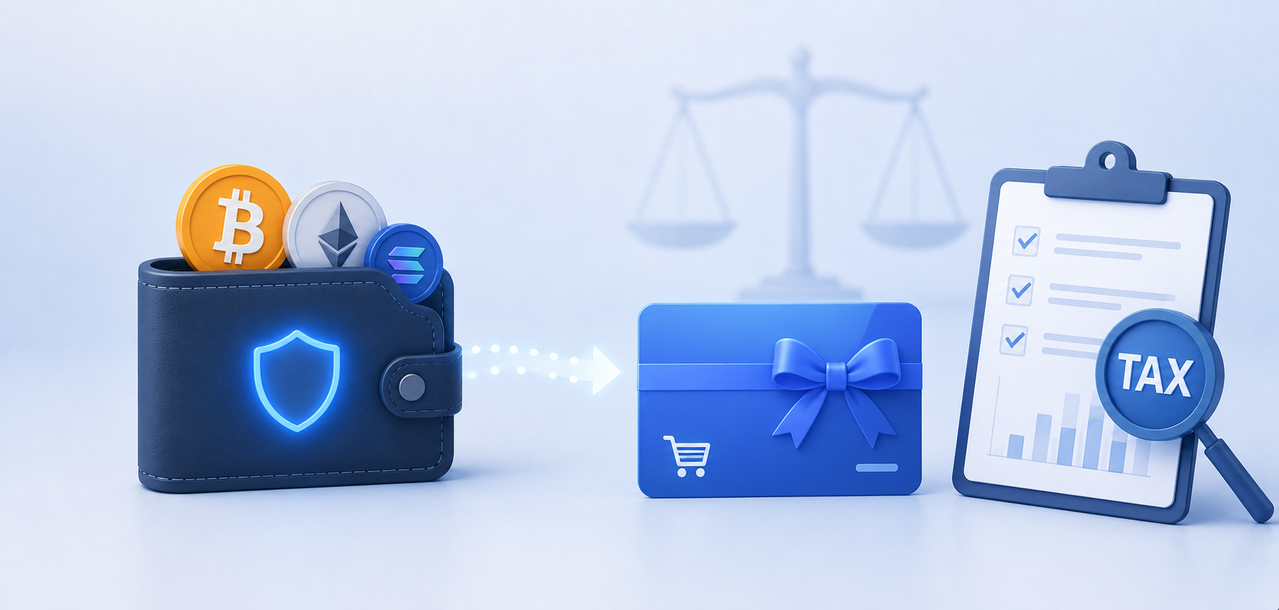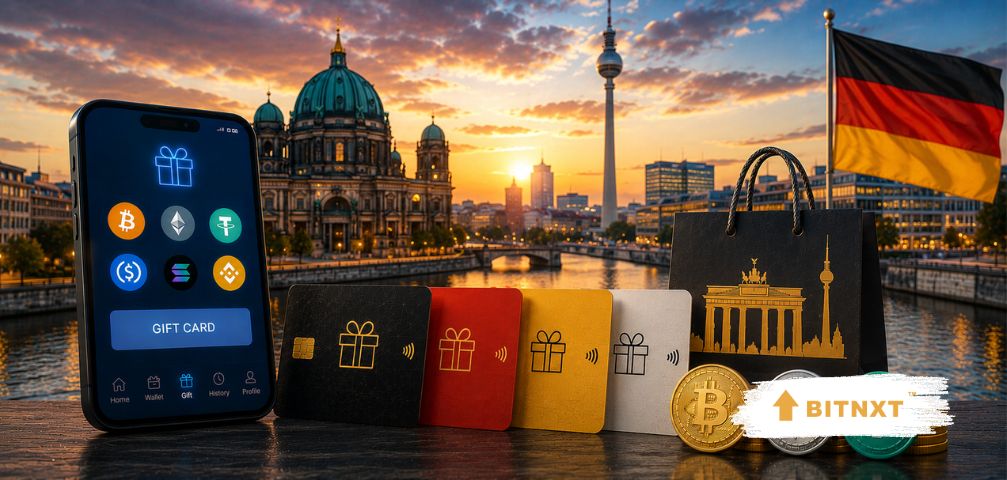
Germany is the only major economy in this series where the answer to "do I pay tax on this gift card?" depends not on what you buy or how much you spend, but on which specific coins you spend.
Cryptocurrency held for more than twelve months is completely tax-free on disposal under §23 EStG, regardless of the size of the gain. Held for less than twelve months, the same gain is taxed at your personal income tax rate, which runs up to 45% plus a solidarity surcharge.
So a German buyer spending Bitcoin bought eighteen months ago pays nothing. The same buyer spending Bitcoin bought last month on the identical gift card can face a substantial bill. This guide covers the platforms and the catalogue, but the timing section is the part that actually matters.
The one-year rule
German tax law treats cryptocurrency as an "other economic asset" under §23 EStG, placing it in the same category as private valuables such as gold or art rather than as a financial instrument. Disposals within twelve months are private sale transactions. Disposals after twelve months are outside the charge entirely.
The holding period is measured from the exact acquisition date, not from the start of a calendar or tax year. Twelve months from the day you bought it, plus one day, and the gain is exempt however large it is.
Two clarifications worth knowing. The BMF letter of 6 March 2025 confirmed that lending or staking a coin does not extend the holding period — the old speculation that this could stretch to ten years is settled and gone. And moving crypto between your own wallets does not reset the acquisition date, provided you can demonstrate both wallets are yours.
The €1,000 threshold, and why it is a cliff
For disposals inside the twelve-month window, Germany provides a €1,000 Freigrenze per calendar year, raised from €600 with effect from the 2024 tax year.
The word Freigrenze is doing important work here, and mistranslating it as "allowance" causes real errors. A Freibetrag exempts the first slice of a gain. A Freigrenze does not. If your aggregate private disposal gains reach €1,000.01, the entire amount becomes taxable from the first euro — not merely the excess.
It also aggregates across all private disposal transactions under §23, not just crypto. Gold sold within the speculation period, or other private sales, count toward the same threshold.
The practical consequence for gift card buyers is that a run of small purchases can quietly accumulate. Ten €120 gains across the year feels trivial; at €1,200 aggregate it makes the whole sum taxable at your marginal rate. There is no partial relief once the line is crossed.
Two identical purchases, two different outcomes
The clearest way to see the rule is side by side. Same buyer, same card, same gain — different acquisition date.
Coins held long | Coins held briefly | |
|---|---|---|
Bitcoin acquired | March 2025 | August 2026 |
Spent on gift cards | September 2026 | September 2026 |
Holding period | 18 months | 1 month |
Purchase cost | €2,000 | €2,000 |
Value when spent | €5,000 | €5,000 |
Gain | €3,000 | €3,000 |
Taxable? | No — tax-free under §23 | Yes — above the €1,000 threshold |
Tax due | €0 | Personal rate, up to 45% plus soli |
Nothing about the transaction differs. Only the age of the coins does.
The FIFO problem
This is where the theory becomes practical, and where most people get it wrong.
Germany requires First In, First Out where individual units cannot be specifically identified. That means when you spend Bitcoin, you are deemed to be spending your oldest tranche first — which usually works in your favour, since the oldest coins are the most likely to have cleared twelve months.
But the 2025 BMF guidance added an important practical refinement: FIFO is applied wallet by wallet rather than across your entire holding. That changes the planning considerably.
If you keep long-held coins and recently purchased coins in the same wallet, FIFO within that wallet decides which you spend. If you keep them separated — long-term holdings in one wallet, recent purchases in another — then spending from the long-term wallet means spending coins that have cleared the holding period.
This is ordinary, legal record-keeping rather than a scheme. But it requires deliberate wallet organisation before the fact, and it is the single most useful thing a German crypto spender can do.
Spending resets the clock
One more mechanical point. When you spend crypto, that disposal ends the holding period for those units. If you then buy replacement crypto, the 365-day clock starts again from zero on the new units.
For someone using crypto for everyday spending, this means the balance being spent from rarely matures. Keeping a separate long-term holding that you do not touch is what preserves the exemption on that portion.
What is and is not taxable
Activity | Treatment for private investors |
|---|---|
Buying crypto with euros | Not taxable |
Holding crypto | Not taxable |
Moving between your own wallets | Not taxable, and the acquisition date does not reset |
Spending crypto held over 12 months | Tax-free regardless of the gain |
Spending crypto held under 12 months | Taxable if aggregate private disposal gains reach €1,000 |
Swapping one token for another | A disposal, same rules apply |
Staking or lending rewards | Other income under §22 Nr. 3, with a €256 threshold |
Note that these rules apply to crypto held as private wealth. Crypto held as business assets, or by a GmbH, is always fully taxable with no holding period exemption.
The platforms serving Germany
Platform | Best for | What to know |
|---|---|---|
Coinsbee | The German option | A German company, headquartered in Germany, with 200+ cryptocurrencies accepted and one of the largest brand catalogues in the category. No account needed for standard orders. |
Best overall | Localised German store, strong Lightning support, bitcoin cashback on selected products. Accepts BTC, Lightning, ETH, USDC, USDT, SOL, LTC, DOGE and Binance Pay. | |
Cryptorefills | No-account buying | 180+ countries, 100+ coins, no KYC. Dutch-based, strong European catalogue. |
Mainstream retailer | Runs a localised German store. Sells crypto vouchers as well as ordinary gift cards. | |
CoinGate | MiCA-aligned processor | Marketplace plus payment processing, Lithuania-based and operating under EU rules. Also resells Azteco and CryptoVoucher. |
Bitpanda | Austrian voucher route | Bitpanda To Go vouchers are distributed through retail outlets across the German-speaking market. |
Genghis | Privacy-focused | 300+ tokens including Monero, zero KYC, no platform fees. |
Bitnovo | Southern European reach | Spanish operator with vouchers, a card and ATM network. Useful for brands the German-focused platforms miss. |
Bidali | In-wallet purchasing | Embedded inside Trust Wallet, MetaMask, Phantom and others. |
Moon | Virtual card route | Lightning-funded virtual Visa, usable wherever Visa is accepted. |
Cake Pay | Monero users | Bundled inside Cake Wallet. |
BuySellVouchers | Marketplace | Independent sellers accepting USDT and BTC, for items the majors do not stock. |
Germany is unusual in this series for having a genuine domestic champion. Coinsbee is a German company and its home-market catalogue reflects that, alongside the widest cryptocurrency support in the category. For a German buyer that combination is hard to beat, though Bitrefill still generally wins on Lightning delivery and cashback.
What you can buy
The German catalogue is among the deepest in Europe. Across the platforms you will find Amazon.de, MediaMarkt, Saturn, Zalando, Otto, IKEA, Douglas, dm, H&M and Lieferando, alongside Deutsche Bahn for rail travel and the usual global set of Apple, Google Play, Steam, PlayStation, Nintendo eShop, Netflix and Spotify.
Germany is also a strong market for prepaid voucher products. paysafecard is widely carried, and crypto vouchers such as CryptoVoucher, Azteco and Bitpanda To Go circulate through German and Austrian retail distribution — a different product from a brand gift card, but frequently sold alongside them.
Availability moves with supplier stock, so check the live listing rather than assuming a brand is carried.
Fees and delivery
Pricing follows the category norm: wholesale acquisition plus a margin, so face value or a premium of roughly one to five percent depending on the brand. Genghis charges no platform fee, which is worth comparing against Coinsbee's face-value pricing on the specific card you want.
Lightning is the sensible rail for anything under about €100, since on-chain fees during congestion can exceed the platform's whole margin on a small card. Bitrefill has the strongest Lightning implementation of the platforms serving Germany.
MiCA now applies across the EU, so platforms operating into Germany are increasingly doing so under a harmonised European framework supervised domestically by BaFin. For a buyer this mostly means more consistent disclosure rather than any change in how you transact.
Reporting
Crypto disposals go on Anlage SO with your German income tax return. Staking and lending income sits under §22 Nr. 3 with its own separate €256 threshold.
The standard filing deadline for the 2025 return was 31 July 2026, extending to 1 March 2027 where a Steuerberater files on your behalf. If your gains stayed below the €1,000 threshold no entry is required, but keep the records regardless — you may need to demonstrate that you were below it.
Visibility is increasing. DAC8 and CARF reporting both begin with 2026 activity, with the first international exchanges expected in 2027. Gift card platforms are not the entities reporting, so what appears on your return is what the authorities will compare against exchange data.
How to buy
Check the age of the coins you are about to spend before you spend them. This is the single decision that determines your tax outcome.
Keep long-term holdings in a separate wallet from coins you intend to spend, since FIFO applies wallet by wallet.
Track cumulative short-term gains across the calendar year against the €1,000 threshold. It is a cliff, not a slope.
Set the region to Germany before browsing so you see euro-denominated local brands.
Use Lightning below about €100.
Record each purchase: date, crypto quantity, euro value at the time, acquisition date and acquisition cost.
Frequently asked questions
Do I pay tax on gift cards bought with crypto in Germany?
Only if the coins you spent were held for less than twelve months and your aggregate private disposal gains for the year reach €1,000. Coins held longer than twelve months are tax-free on disposal regardless of the gain.
Is the €1,000 an allowance or a threshold?
A threshold, and the distinction matters enormously. Exceed it by a single euro and the entire gain becomes taxable, not just the portion above it.
Does moving crypto to a hardware wallet reset the twelve months?
No. Transfers between wallets you own do not reset the acquisition date, provided you can prove both wallets are yours.
Can I choose which coins to spend?
Not directly — FIFO applies. But because the 2025 guidance applies FIFO wallet by wallet, separating long-term holdings into their own wallet influences which units a disposal draws from.
What rate applies to short-term gains?
Your personal income tax rate, ranging up to 45%, plus the 5.5% solidarity surcharge levied on the tax itself. There is no separate flat crypto rate.
Does staking extend the holding period?
No. The BMF letter of 6 March 2025 confirmed that lending or staking does not extend the period to ten years. The one-year rule applies.
The bottom line
Germany offers the most favourable treatment of any large economy in this series, but only to people who pay attention to dates. Twelve months and a day, and your gift card purchase is tax-free however much the coins appreciated. Eleven months, and you are exposed to your full marginal rate.
Use Coinsbee as the domestic default and Bitrefill for Lightning and cashback. But before either, check how old the coins are — and keep the long-held ones in a wallet of their own.
Tax information here is general and not advice. German crypto taxation involves genuine complexity around FIFO application, wallet treatment and business versus private classification. Consult a qualified Steuerberater about your own circumstances.
Bitnxt maintains a full directory of crypto gift card platforms across every major market, covering buy-side operators, crypto vouchers and gift-card-to-crypto marketplaces.