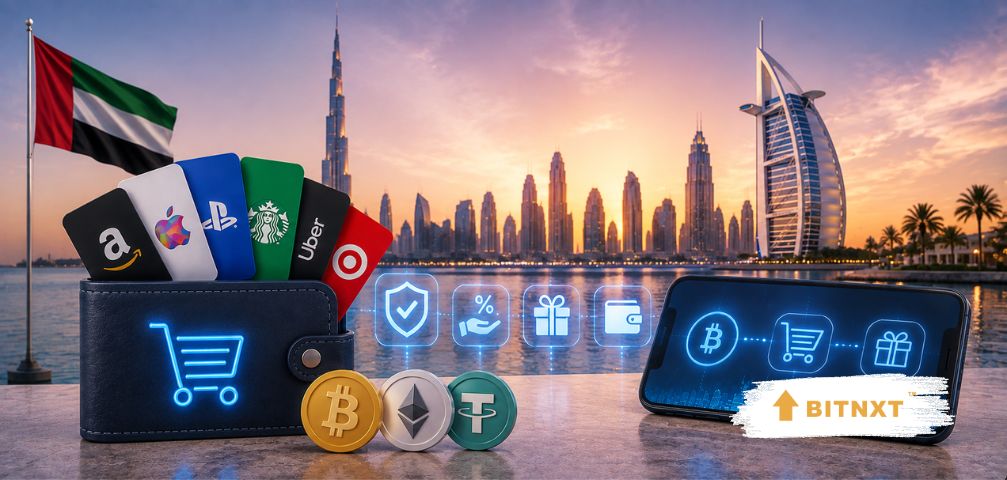
The UAE is the best country in the world to buy gift cards with crypto, and the reason has nothing to do with the platforms.
In most markets, spending crypto is a taxable disposal. A US buyer owes capital gains tax on every gift card purchase. An Indian buyer owes 30% plus cess with no loss relief. A UAE resident buying the same card, from the same platform, on the same day, owes nothing at all.
That single difference makes this the cleanest market in the category. This guide covers which platforms serve the Emirates, what you can actually buy in AED, the exact tax position and where its limits are, and the regional quirks worth knowing before you buy.
The tax position: zero, with one line to watch
The UAE imposes no personal income tax and no capital gains tax on individuals. A resident who buys Bitcoin at AED 100,000 and sells at AED 500,000 keeps the entire AED 400,000 gain with no personal tax obligation and nothing to report to a tax authority.
Buying a gift card with crypto is a disposal in the technical sense, but with no capital gains regime applying to individuals there is no charge attached to it. There is no equivalent of the American Form 1099-DA or India's Schedule VDA for a private individual here.
Where the zero stops
The line that matters is between personal investment and business activity. Under Federal Decree-Law No. 47 of 2022, crypto activity that qualifies as a business attracts corporate tax at 9% on profits above AED 375,000. Free zone entities may qualify for 0% on qualifying income.
The Federal Tax Authority can reclassify frequent traders as conducting a business. Someone buying gift cards for personal consumption is plainly outside that. Someone systematically buying discounted cards to resell is running a trade, and should be taking advice rather than assuming the individual position applies.
There is also 5% VAT, which applies to the goods and services you buy — not to the crypto disposal itself. That VAT is already priced into the AED face value of the card.
A residency caveat worth stating plainly: this treatment follows UAE tax residency, not the location of the platform you buy from. An expat who remains tax resident elsewhere may still owe tax at home on the same purchase. The Emirates ID and tenancy paperwork that establish residency matter more here than anything about the transaction itself.
Regulation: clear, which is rarer than it sounds
Crypto is legal and comprehensively regulated in the UAE. VARA, the Virtual Assets Regulatory Authority, licenses and supervises virtual asset service providers in mainland Dubai and across most free zones. DIFC sits under the DFSA, Abu Dhabi Global Market under the FSRA, and the Securities and Commodities Authority and Central Bank operate at federal level.
For a gift card buyer this mostly matters as reassurance rather than obligation. You are not doing anything that requires a licence. But it explains why the UAE has attracted so much crypto infrastructure, and why the platforms serving it treat the market seriously.
Reporting frameworks are arriving even where tax is not. The UAE is aligning with the OECD Crypto-Asset Reporting Framework, which provides for automatic cross-border exchange of crypto information. Zero tax and zero visibility are not the same thing, and the second is disappearing.
What you can actually buy in AED
Bitrefill operates a dedicated UAE storefront, which makes it the only platform with genuine local catalogue depth rather than international brands sold into the market. These are the denominations available.
Brand | AED range | Notes |
|---|---|---|
Amazon.ae | 20 – 5,000 AED | Broadest general retail option in the market. |
Noon.com | 10 – 1,000 AED | Regional marketplace across UAE, Saudi and Egypt. Carries 1% cashback on Bitrefill. |
Carrefour UAE | 50 – 2,000 AED | Groceries, appliances, fashion. In-store only, not valid on Carrefour Online. 1% cashback. |
LuLu Hypermarket | 25 – 1,000 AED | Strong choice for everyday grocery spending. |
Talabat | 50 – 500 AED | Food delivery. Redeemed in-app as a voucher. 1% cashback. |
Deliveroo UAE | 50 – 1,000 AED | Second food delivery option where Talabat is out of stock. |
Careem | 10 – 500 AED | Rides, food and groceries. Credits expire 60 days after redemption. |
Mall of the Emirates / City Centre | 100 – 3,500 AED | Majid Al Futtaim card. AED 5 activation fee at the customer service desk. |
Mall Gift Card (UAE) | 50 – 500 AED | 6,000+ stores including Zara, Apple and H&M. |
Apple / App Store & iTunes | 50 – 2,500 AED | Region-locked to a UAE Apple ID. |
Etisalat Refill | 5 – 525 AED | Mobile top-up. |
DU Refill | 5 – 500 AED | Mobile top-up. |
Beyond these, the same platforms sell eSIM data packages, and the usual global catalogue of Apple, Google Play, Steam, Netflix, Spotify and similar in USD or AED depending on the product.
The platforms serving the UAE
Platform | Best for | What to know |
|---|---|---|
Best overall | Runs a full localised UAE store with AED-denominated cards and local brands. Accepts BTC, Lightning, ETH, USDT, USDC, SOL, Base, Polygon and Binance Pay, plus Apple Pay and cards. Pays cashback on several UAE products. | |
Best coin coverage | 200+ cryptocurrencies and strong regional catalogue including Noon and Careem across the Gulf. No account required. | |
Cryptorefills | No-account buying | 180+ countries, 100+ coins, no KYC. Useful when a UAE brand is out of stock elsewhere. |
Genghis | Privacy-focused | 300+ tokens including Monero, zero KYC at any order size. Global catalogue rather than UAE-specific. |
CoinGate | Processor hybrid | Marketplace plus payment processing. Also resells crypto vouchers such as Azteco and CryptoVoucher. |
Bidali | In-wallet purchasing | Embedded inside Trust Wallet, MetaMask, Phantom and others, so there is no separate checkout step. |
BitPay | Wallet-native | Buy from a self-custody wallet in the BitPay app. Catalogue skews US but works from the UAE. |
Moon | Virtual card route | Lightning-funded virtual prepaid cards usable anywhere Visa is accepted, rather than at one retailer. |
GiftCryp | Top-up specialist | Mobile top-ups across 166 countries alongside gift cards. Accepts BTC, XMR, ETH, USDT, SOL, LTC and TRX. |
Prepaidify | Zero-KYC cards | Gift cards plus a no-KYC virtual Visa product. |
Cake Pay | Monero users | Bundled inside Cake Wallet. |
BuySellVouchers | Marketplace | Independent sellers, escrow-style model, accepts USDT and BTC. Useful for hard-to-find items. |
There is no UAE-domiciled crypto gift card operator. Every platform here is foreign, which is normal for the region and does not affect your position as a buyer.
Three UAE-specific things that catch people out
AED cards are locked to the UAE
This is the single largest cause of failed redemptions in this market, and it hits expats hardest. A Carrefour UAE card works in Carrefour and Carrefour Market stores in the Emirates and is explicitly not valid on Carrefour Online. An Apple or App Store card bought in AED requires a UAE-registered Apple ID.
If you are buying to send value to family in another country, an AED-denominated local card is the wrong instrument. Buy a card denominated for their market instead — the platforms sell those too, and the region selector at checkout is what determines whether the code will work.
Careem credits expire
Careem credits are valid for 60 days from the date the code is redeemed into the Careem wallet, and expired cards cannot be extended or refunded. Redeem close to when you intend to spend, not when you buy.
The mall card has an activation fee
The Majid Al Futtaim card covering Mall of the Emirates and the City Centre malls carries an AED 5 activation fee, charged when the eGift card is exchanged at the customer service desk. Small, but it is not disclosed prominently and it surprises people at the counter.
Fees and payment
Pricing follows the same pattern as everywhere: platforms buy at wholesale and add a margin, so you pay face value or a premium of roughly one to five percent depending on the brand. Several UAE products on Bitrefill run 1% cashback, and its eSIM products carry 5%, which can more than offset the premium.
On payment rails, the UAE market is unusually well served. Bitrefill accepts Bitcoin and Lightning, Ethereum, USDT, USDC, Solana, Base and Polygon, plus Binance Pay, alongside Apple Pay, Google Pay and card payments. Coinsbee extends that to more than 200 cryptocurrencies.
Lightning remains the cheapest and fastest route for smaller purchases. On-chain network fees on a 50 AED top-up can exceed the platform's entire margin.
Why this market matters more than its size suggests
Roughly 88% of the UAE population is expatriate, and a large share of everyday spending flows toward supporting families abroad. Crypto is already widely used in the region for cross-border value transfer, and gift cards extend that: a worker in Dubai can buy a card denominated for a family member's home market and deliver it by email in seconds.
That use case is legitimate, but the region-lock rule above is what determines whether it works. The card must be issued for the recipient's country, not yours.
How to buy, step by step
Set the region to United Arab Emirates before browsing, or you will be shown catalogue you cannot redeem.
Confirm the card is for the country where it will be used — yours, or the recipient's.
Choose Lightning if you are buying a small denomination. On-chain for larger values where speed matters less.
Check the expiry and activation terms before paying. Careem and the mall cards both have conditions worth reading.
Redeem promptly. Cards are cash equivalents, refunds are rare by design, and crypto payments cannot be reversed.
Frequently asked questions
Do I pay tax on gift cards bought with crypto in the UAE?
Not as an individual. There is no personal income tax and no capital gains tax on individuals in the UAE, so the disposal carries no charge. Businesses and anyone whose activity the Federal Tax Authority would characterise as a trade are in a different position.
Is buying gift cards with crypto legal in the UAE?
Yes. It is an ordinary purchase, and crypto is legal and regulated across the Emirates.
Can I use a UAE gift card outside the country?
Generally no. AED-denominated local cards are restricted to UAE stores. Buy a card issued for the destination country instead.
Do I need to verify my identity?
Bitrefill, Coinsbee and Cryptorefills all allow standard purchases without an account. Verification applies to card products and higher limits.
Which platform has the best UAE catalogue?
Bitrefill, by a clear margin, because it maintains a dedicated UAE store with AED denominations and local brands. Coinsbee is the better fallback for regional brands across the wider Gulf and for unusual coins.
Does the UAE report my crypto activity anywhere?
Reporting frameworks are being adopted regionally even though no personal tax applies. If you hold tax residency in another country, assume that information can reach it.
The bottom line
For a UAE-resident individual this is as clean as the category gets: no capital gains tax, no reporting form, clear regulation, and a genuinely localised catalogue with AED denominations for Carrefour, Noon, Talabat, Careem, LuLu and the major malls.
Use Bitrefill as the default for local brands, Coinsbee when a brand is missing or you hold an unusual coin, and check the region lock on every card before you pay. That last point causes more failed purchases here than everything else combined.
Tax and regulatory information here is general and not advice. Positions differ for businesses and for individuals holding tax residency outside the UAE. Consult a qualified adviser about your own circumstances.
Bitnxt maintains a full directory of crypto gift card platforms across every major market, covering buy-side operators, crypto vouchers and gift-card-to-crypto marketplaces.