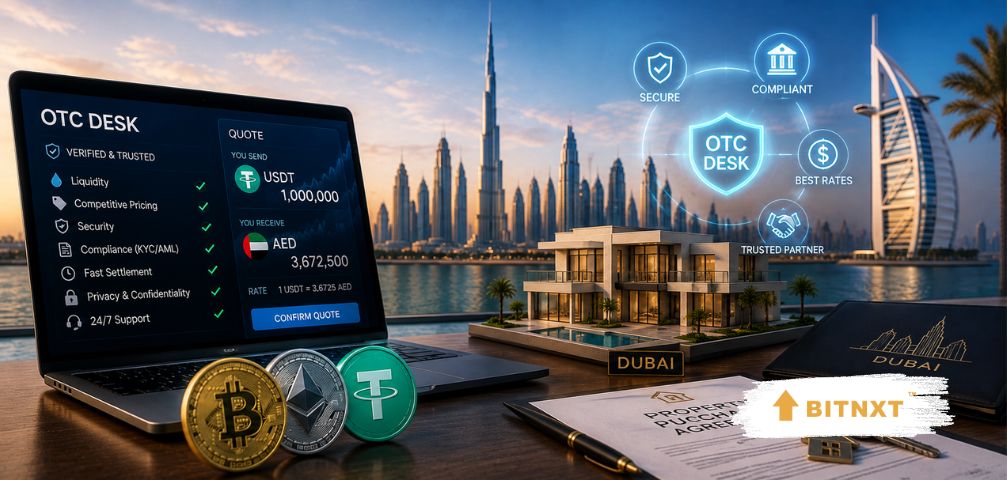
Dubai has quietly become one of the busiest places in the world to trade crypto in size. Family offices move treasury into USDT. Miners and token projects sell blocks of BTC without crashing the price. Remittance companies settle cross-border payments through stablecoins. And thousands of individuals convert crypto into dirhams every week.
Most of that volume does not go through an exchange order book. It goes through OTC desks: firms that quote you one price for the whole trade and settle it privately.
The problem is that "OTC desk Dubai" can mean anything from a VARA-licensed institutional broker to a walk-in shop with a cash counter and no licence at all. This guide sorts that out. It explains how crypto OTC in Dubai actually works, which desks are licensed, what you should expect to pay, and how to avoid the mistakes that cost people money.
Quick Answer: The Best Crypto OTC Desks in Dubai
There is no single best desk for everyone. The right choice depends on your trade size and whether you are a business or an individual. Based on publicly confirmed licensing and published service details, here is the short version:
Best for businesses and treasury teams: Fuze Finance, BitGo MENA, Relm
Best for funds and professional traders: Flowdesk, Selini Capital, ARP Digital, GCEX
Best if you already trade on a big exchange: the Dubai OTC arms of Crypto.com, OKX, Binance and Bybit
Best for smaller tickets and retail investors: Fasset, CoinMENA, CoinCorner, BitOasis
Best for OTC options and hedging: Laser Digital (Nomura)
Whichever you pick, do one thing first: search the company's legal name on the VARA public register (vara.ae) and confirm it shows an active licence for Broker-Dealer Services. That single check filters out most of the risk in this market.
What Is a Crypto OTC Desk?
OTC stands for "over the counter". Instead of placing your order on a public exchange, where it is matched against many small orders, you deal directly with a desk. You ask for a price, the desk quotes one all-in number for the full amount, and if you accept, the trade settles bilaterally between you and the desk.
Why bother? Because large orders on an exchange move the market against you. If you try to buy USD 2 million of Bitcoin on an order book, you eat through the cheapest sellers first and pay progressively more for the rest. That gap between the price you saw and the price you paid is called slippage. Everyone watching the book also sees your order, which can push the price further.
An OTC desk solves three problems at once:
Price certainty. You get one locked quote for the whole block, so there is no slippage surprise.
Privacy. The trade is not broadcast on a public order book.
Fiat settlement. Good desks settle in AED, USD and other currencies through banks they already work with, which is often the hardest part of moving large amounts of crypto.
OTC desk vs exchange vs P2P
OTC desk | Exchange | P2P platform | |
|---|---|---|---|
How the trade happens | You request a quote; desk fills the full amount | Order matched on a public book | You trade with another user |
Typical size | USD 50,000 to many millions | Any size | Small to medium |
Price | One locked, all-in quote | Moves as your order fills | Set by the counterparty |
Counterparty | The licensed desk | The exchange (matching engine) | A stranger, with platform escrow |
Best for | Large trades, businesses, AED settlement | Everyday trading | Small conversions |
Why Dubai Has Become a Global OTC Hub
A few things make Dubai unusual among crypto centres:
A dedicated crypto regulator. The Virtual Assets Regulatory Authority (VARA) was set up under Dubai Law No. 4 of 2022 specifically to license virtual asset businesses. OTC trading has its own clear licence category, which most countries still lack.
Tax. The UAE has no personal income tax. Corporate tax is 9% on profits above AED 375,000, and qualifying free zone companies can pay 0% on qualifying income. In late 2024 the UAE also exempted crypto transfers and conversions from VAT, backdated to 2018.
Geography and time zone. Dubai sits between Europe, Asia and Africa, and serves clients from India, Pakistan, Russia and the CIS, Turkey, Africa and the wider Gulf.
Real flows. The UAE handled tens of billions of dollars in on-chain crypto value in the latest annual reporting period, and institutional transfers have been the fastest-growing segment.
A growing licensed field. VARA's register passed 50 licensed firms in 2026, and a large share of new licences this year went to broker-dealers, the category that covers OTC.
Is Crypto OTC Trading Legal in Dubai?
Yes, as long as the desk is properly licensed. In Dubai (outside the DIFC financial free zone), anyone who buys from or sells to clients, or arranges trades for them, is carrying out Broker-Dealer Services under VARA rules and needs a VARA licence to do it.
A few points that trip people up:
In-Principle Approval (IPA) is not a licence. VARA issues an IPA early in the process. A firm holding only an IPA is not allowed to serve clients yet. Only a full VASP licence lets a desk trade with you.
A trade licence is not a crypto licence. A Dubai free zone company with a "crypto trading" activity on its trade licence is not the same as a VARA-licensed VASP. Free zone registration does not replace VARA.
Licences have scope limits. Some desks are licensed only for institutional and qualified investors, or only for spot trading. Check that the licence covers you and the product you want.
Other UAE regulators exist. Abu Dhabi's ADGM (regulated by the FSRA) and Dubai's DIFC (regulated by the DFSA) run their own regimes. Outside these zones and outside Dubai, the federal Capital Market Authority (formerly the SCA) covers virtual assets.
VARA takes unlicensed activity seriously. It publishes a list of unlicensed firms and has fined dozens of entities, with penalties for individual firms running into hundreds of thousands of dirhams, alongside cease-and-desist orders.
What it takes to run a licensed OTC desk
Knowing what a desk had to go through tells you a lot about how seriously to take it. Under VARA rules, a broker-dealer must:
Pay an application fee of AED 100,000 and an annual supervision fee of AED 200,000 per licensed activity.
Hold paid-up capital of at least AED 400,000 (or 15% of annual fixed overheads, whichever is higher) when client assets sit with an approved custodian, rising to AED 600,000 (or 25%) without one.
Meet VARA's Company, Compliance and Risk Management, Technology and Information, and Market Conduct rulebooks, plus the Broker-Dealer Services rulebook.
Appoint a compliance officer and MLRO, run blockchain analytics on incoming funds, apply the travel rule and screen every client for sanctions.
A desk that has cleared all this is a very different counterparty from one that has not.
The Best Crypto OTC Desks in Dubai for 2026
The list below includes only firms where we could find public confirmation of VARA licensing for broker-dealer or OTC activity. Bitnxt has not traded with these desks, so this is not a performance ranking. It is a structured shortlist based on licensing, published services and who each desk is built for. Licence details change, so always confirm on the VARA register before you send funds.
1. Fuze Finance: best for business payments and treasury
Fuze operates in Dubai through Morpheus Software Technology FZE, listed by VARA as an active VASP for Broker-Dealer Services. Its OTC desk is built for payment companies, fintechs, remittance firms and corporate treasuries.
What stands out: fixed request-for-quote (RFQ) pricing, 100+ assets including BTC, ETH, USDT, USDC and SOL, settlement in AED, USD, EUR, GBP and TRY, same-day settlement on major tokens, and whitelisted bank and wallet flows.
Minimum: USD 250,000 per trade, according to the company.
Best for: businesses that need regular, high-value conversions with clean paperwork for reconciliation and audit.
Trade-off: the minimum rules out most individuals.
2. BitGo MENA: best for institutions that also need custody
BitGo MENA FZE received its VARA broker-dealer licence in October 2025. BitGo is best known as a qualified custodian, and its Dubai offering combines an OTC desk, electronic trading and custody in one setup.
What stands out: spot trading across thousands of digital assets and stablecoins, with liquidity aggregated from multiple exchanges and market makers, and trades that can settle without moving assets out of custody.
Best for: funds, family offices and enterprises that want execution and safekeeping with one regulated provider.
Trade-off: more infrastructure than someone who just wants a simple quote may need.
3. Relm: best pure-play institutional spot OTC
Relm is the trading name of XBASE Virtual Assets Broker & Dealer Services LLC, part of XBD Group. It received its full VARA licence in early 2026. VARA's register limits the licence to spot OTC trading for institutional and qualified investors.
What stands out: a desk focused entirely on compliant OTC execution for enterprises, funds and family offices.
Best for: professional clients who want a dedicated OTC counterparty rather than an exchange.
Trade-off: a newer entrant, so ask about liquidity depth and client references. Not open to retail.
4. Flowdesk: best for market-maker liquidity
Flowdesk is an institutional market maker backed by Coinbase Ventures and BlackRock. Its Dubai entity, Flowdesk Omega FZE, received a full VARA broker-dealer licence in August 2026, after an IPA earlier in the year.
What stands out: liquidity from a firm whose core business is making markets across many venues, plus experience in OTC derivatives globally.
Best for: token projects, funds and trading firms that need deep liquidity in large and mid-cap assets.
Trade-off: aimed at qualified and institutional investors only.
5. Selini Capital: best for professional trading firms
Selini Capital FZE received a VARA broker-dealer licence in mid-2026 and is expanding institutional OTC trading from Dubai.
Best for: professional counterparties looking for a trading-firm style desk.
Ask about: supported assets, minimum ticket and fiat rails before onboarding.
6. ARP Digital: best for cross-border corridors in the GCC
ARP Digital FZCO secured a VARA broker-dealer licence in August 2026. The group is also licensed in Bahrain by the Central Bank of Bahrain. It runs an OTC liquidity desk alongside settlement rails for international corridors and on/off-ramp services.
Best for: businesses moving value between GCC countries and other markets.
7. GCEX: best for brokers and professional traders
GCEX holds a VARA licence for broker-dealer services to institutional and qualified investors. It has a long history serving brokers, funds and professional traders with crypto liquidity.
Best for: brokerages and professional traders who want prime-style access.
8. Exchange-backed OTC desks: Crypto.com, OKX, Binance and Bybit
The big global exchanges all run regulated Dubai entities, and most offer OTC or block trading to larger clients. Crypto.com's Dubai entity, CRO DAX Middle East FZE, was among the first VARA licensees, with a scope that covers brokerage and OTC. OKX Middle East and Binance FZE operate under VARA licences, and Bybit Fintech FZE received a full VARA licence for spot exchange services in October 2026.
What stands out: you can move from normal trading to OTC on the same account, with AED deposit options and deep liquidity.
Best for: traders and companies who already hold an account and want larger fills at a quoted price.
Trade-off: make sure your account sits with the UAE entity, not the global platform, and confirm that OTC is part of that entity's licensed scope.
9. Smaller-ticket and retail-friendly brokers: Fasset, CoinMENA, CoinCorner, BitOasis
Not everyone is moving a million dollars. These regional players hold VARA broker-dealer licences and serve retail as well as larger clients. Fasset and CoinMENA were among the earliest firms licensed by VARA for broker services. CoinCorner's UAE broker-dealer entity was licensed in May 2026. BitOasis is one of the longest-running UAE platforms.
Best for: individuals and small businesses converting tens of thousands of dirhams rather than millions.
Trade-off: less published detail on OTC workflows, so ask about quotes, limits and settlement directly.
10. Laser Digital: best for OTC options and hedging
Laser Digital, Nomura's digital asset arm, became the first firm to offer regulated, client-facing OTC crypto options under VARA in August 2025, through VARA's pilot framework. Trades are with institutional or qualified counterparties under ISDA documentation.
Best for: funds, miners and treasuries that want to hedge or structure exposure rather than simply buy or sell.
What about cash OTC shops?
Walk into Business Bay or Deira and you will see shops offering to swap USDT or Bitcoin for cash dirhams. Some are licensed. Many are not. International media have reported on cash OTC shops being used by sanctioned individuals, which is exactly why this segment draws regulator attention.
We have not included cash shops in the list above because we could not confirm current licensing for each one at the time of writing. If you use one, check its VARA register entry in front of you, expect full ID checks, and walk away from any desk that offers to skip KYC. A cash shop that will trade with you anonymously will also trade with criminals, and funds tied to that activity can be frozen later.
Side-by-Side Comparison
Desk | Dubai entity | Best for | Clients | Published minimum |
|---|---|---|---|---|
Fuze Finance | Morpheus Software Technology FZE | Business payments, treasury | Businesses | USD 250,000 |
BitGo MENA | BitGo MENA FZE | Trading plus custody | Institutional, qualified | On request |
Relm | XBASE Virtual Assets Broker & Dealer Services LLC | Spot OTC only | Institutional, qualified | On request |
Flowdesk | Flowdesk Omega FZE | Market-maker liquidity | Institutional, qualified | On request |
Selini Capital | Selini Capital FZE | Professional trading | Institutional, qualified | On request |
ARP Digital | ARP Digital FZCO | GCC corridors, on/off-ramp | Businesses, institutions | On request |
GCEX | GCEX (VARA licensed) | Brokers, pro traders | Institutional, qualified | On request |
Crypto.com / OKX / Binance / Bybit | Local UAE entities | Existing exchange users | Varies by entity | Varies |
Fasset / CoinMENA / CoinCorner / BitOasis | Local UAE entities | Smaller tickets | Includes retail | Low |
Laser Digital | Laser Digital (Nomura) | OTC options, hedging | Institutional, qualified | On request |
Note: "On request" means the desk does not publish a fixed minimum. Licensing and scope can change, so verify on the VARA register.
How to Choose the Right OTC Desk
Use these questions as a filter. If a desk cannot answer one clearly, that is your answer.
Is it fully licensed, and for what? Search the legal entity name on the VARA register. You want an active VASP licence with Broker-Dealer Services, not just an IPA. Check whether retail clients are allowed if you are an individual.
Is the quote firm and all-in? Ask whether the price you accept is exactly what you pay, with no extra commission, network fee or spread added later.
Can it fill your size? Ask about typical and maximum ticket sizes for your asset. A desk that is comfortable at USD 50,000 may struggle at USD 5 million.
How does settlement work? Which currencies and banks? How long for the fiat leg and the crypto leg? Who sends first? Good desks only pay out to your own verified bank account and whitelisted wallet.
Where are client assets held? Is there a licensed custodian, and are client funds segregated from the desk's own money?
What paperwork do you get? Trade confirmations, invoices and statements matter for your accountant and, if you are a company, your auditor.
Who do you talk to? A named relationship manager and clear dealing hours beat an anonymous chat window, especially when something goes wrong mid-settlement.
OTC Fees, Spreads and Minimums in Dubai
Most OTC desks do not charge a separate fee. They earn the spread: the difference between the price they quote you and the price at which they can source or offload the position. Typical ranges seen in the Dubai market:
Trade type | Typical cost | What drives it |
|---|---|---|
BTC, ETH, USDT at institutional desks | Around 0.10% to 0.50% (10 to 50 basis points) | Trade size, market volatility, time of day |
Altcoins and smaller tokens | Noticeably wider | Thinner liquidity, hedging risk |
Walk-in cash conversions | Often around 1% to 3% above screen price | Cash handling, compliance and security costs |
Minimum trade size | Commonly USD 100,000; premium desks USD 250,000+ | Desk focus (retail vs institutional) |
A practical tip: get quotes from two or three licensed desks at the same moment for the same size. The difference on a seven-figure trade can be worth more than an hour of your time. Also check the "all-in" price after network fees and bank charges, not just the headline rate.
How a Dubai OTC Trade Works, Step by Step
Onboarding. You submit KYC (individuals) or KYB (companies) documents, including source of funds. This can take a few days for individuals and longer for companies.
Whitelisting. You register the bank account and crypto wallet addresses you will use. Funds will only move to and from these.
Request for quote. You tell the desk the asset, direction (buy or sell) and size.
Quote. The desk replies with one firm price, valid for a short window, often seconds to a minute.
Acceptance. You accept. The price is now locked for the full amount.
Settlement. You send your side (fiat or crypto), and the desk sends the other side. Stablecoin legs can settle the same day; AED bank transfers often take one to two business days.
Confirmation. You receive a trade confirmation for your records.
Documents you will usually need
Individuals: Emirates ID or passport, proof of address, and evidence of where the money came from (salary slips, business income, sale of property, exchange statements showing how the crypto was acquired).
Companies: trade licence, memorandum of association, shareholder and ultimate beneficial owner details, board resolution authorising the trade, IDs of signatories, recent bank statements, and a short explanation of the business and expected volumes.
If you hold crypto bought years ago, keep your old exchange records. Desks increasingly ask for a trail showing how the coins were acquired, and wallet analytics will flag funds that passed through mixers or high-risk services.
Cash, AML and the Rules You Should Know
Dubai is open to crypto, but it is not a place to move money without questions. The UAE updated its anti-money laundering law in 2025 with Federal Decree-Law No. 10 of 2025, which explicitly covers virtual assets. Key points for OTC users:
There is no minimum amount for suspicious transaction reports. A licensed desk must report anything suspicious, whatever the size.
The travel rule applies. When crypto moves between providers, sender and receiver information travels with it. Expect to be asked who owns the wallet you are sending from or to.
Sanctions screening is continuous. Desks screen clients and wallets against sanctions lists, and a match ends the relationship.
Cash gets the most scrutiny. Large cash trades are the highest-risk activity for a desk. A licensed desk will want a clear reason and paperwork for both cash in and cash out.
This is a feature, not a bug. The desks that ask the most questions are also the ones least likely to have your funds frozen by a bank or flagged by another exchange later.
Red Flags: How to Spot a Risky OTC Desk
No entry on the VARA register, or a name that does not match the company you are paying.
Only an IPA, presented as if it were a full licence.
Offers to skip KYC or "no questions asked" cash deals.
Rates noticeably better than every other desk. In OTC, a price that is too good is usually bait.
Requests to send funds to a personal account, a third-party company or a wallet that is not the desk's own.
Pressure to "send first, quickly" before a firm quote and written confirmation.
Contact only through Telegram or WhatsApp, with no office address, website or legal entity name.
Meetings in hotel lobbies or cafes to swap cash for a wallet transfer. This is a common setup for robbery and fake-transfer scams.
Tax Basics for Crypto OTC Trades in the UAE
Individuals: no personal income tax and no capital gains tax on crypto in the UAE.
Companies: 9% corporate tax on taxable profit above AED 375,000. Qualifying free zone persons can pay 0% on qualifying income if they meet substance and activity tests.
VAT: transfers and conversions of virtual assets are exempt from VAT.
Non-residents: your home country may still tax gains made in Dubai. Using a Dubai desk does not change where you are tax resident. Keep every trade confirmation and get advice in your own jurisdiction.
Tax rules change and individual situations differ, so treat this as orientation, not advice.
For Businesses: Setting Up an OTC Relationship
If you run a company that regularly needs to convert between crypto and fiat, such as a payments firm, an exporter paid in USDT, a Web3 project paying salaries or a fund rebalancing, a few habits will save you trouble:
Onboard with two desks, not one. You get competing quotes and a backup if one bank rail is slow.
Agree settlement terms in writing, including who sends first, cut-off times and what happens if a payment is late.
Keep the paper trail tidy. Board approvals, confirmations and bank records make audits and bank reviews painless.
Use your company bank account only. Mixing personal and company funds is the fastest way to get a bank account reviewed or closed.
Final Verdict
The best crypto OTC desk in Dubai is the one that is fully licensed for your type of client, can comfortably fill your size, settles in the currency and bank you use, and gives you a firm, all-in quote. For large business flows, dedicated broker-dealers such as Fuze, BitGo MENA and Relm are the natural starting point. Funds and professional traders should look at Flowdesk, Selini, ARP Digital and GCEX. If you already trade on Crypto.com, OKX, Binance or Bybit, ask their UAE entity about OTC first. For smaller amounts, regional brokers like Fasset, CoinMENA, CoinCorner and BitOasis are more practical.
Whatever you choose, keep the rule simple: no VARA register entry, no trade.
Are you an OTC desk operating in Dubai? Bitnxt maintains a directory of crypto businesses in the UAE. Get in touch to have your desk listed and verified.
Frequently Asked Questions
What is the best crypto OTC desk in Dubai?
It depends on who you are. Businesses moving large amounts often start with dedicated VARA-licensed broker-dealers such as Fuze Finance, BitGo MENA or Relm. Funds may prefer Flowdesk or Selini Capital. Individuals with smaller amounts are usually better served by Fasset, CoinMENA, CoinCorner or BitOasis, or the OTC service of a VARA-licensed exchange.
Is crypto OTC trading legal in Dubai?
Yes. OTC trading is a regulated activity in Dubai under VARA's Broker-Dealer Services licence. Dealing with an unlicensed desk is risky, and VARA actively fines and shuts down unlicensed operators.
How do I check if an OTC desk is licensed by VARA?
Go to the public register on vara.ae and search the desk's legal entity name, not just its brand name. Confirm the licence status is active and that it covers Broker-Dealer Services. An In-Principle Approval alone does not allow a firm to serve clients.
What is the minimum amount for an OTC trade in Dubai?
Many institutional desks start at around USD 100,000, and some require USD 250,000 or more. Regional brokers and exchange platforms accept much smaller amounts.
How much does a crypto OTC desk charge?
Most desks earn through the spread rather than a separate fee. For major assets like BTC, ETH and USDT at institutional desks, spreads are commonly in the 0.10% to 0.50% range. Cash conversions at walk-in desks usually cost more.
Can I sell USDT for cash in Dubai?
Yes, but only use a licensed provider, bring ID, and expect source-of-funds questions. Never agree to meet strangers to swap cash for a wallet transfer.
Can a non-resident use a Dubai OTC desk?
Many desks accept non-resident clients, subject to full KYC and source-of-funds checks. Your home country's tax and foreign exchange rules still apply to you.
How long does OTC settlement take in Dubai?
Stablecoin and major token legs can settle the same day. AED bank transfers often take one to two business days, depending on the banks involved.
What is the difference between an OTC desk and a crypto exchange?
An crypto exchange matches many orders on a public order book, so large trades move the price. An OTC desk gives you one negotiated price for the whole trade and settles it privately with you.
Do I pay tax on crypto OTC trades in the UAE?
Individuals in the UAE pay no personal income or capital gains tax on crypto. Companies may pay 9% corporate tax on profits above AED 375,000. Non-residents should check the rules in their own country.
Disclaimer: This article is for general information only and is not financial, legal or tax advice. Bitnxt has not traded with the desks mentioned and does not endorse any provider. Licence details were checked against public sources at the time of writing and can change. Always verify a provider on the VARA public register and do your own due diligence before trading.