
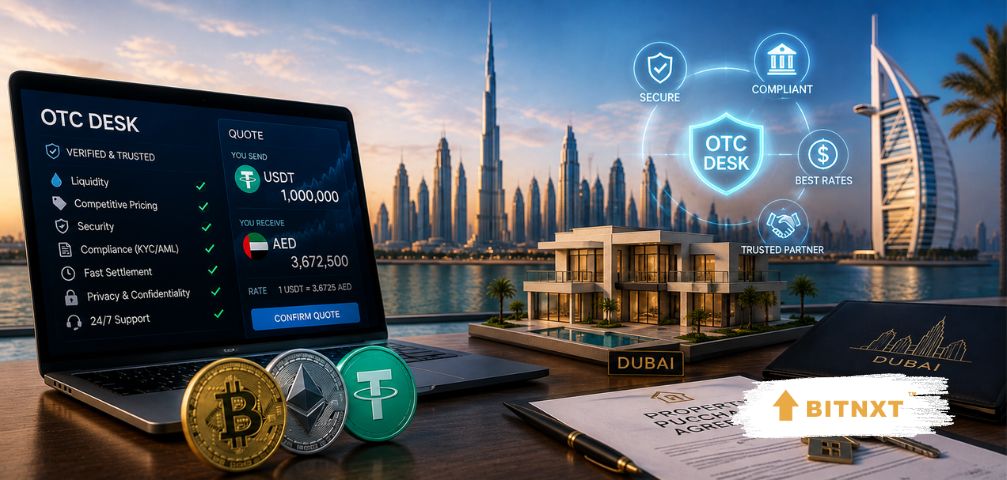
Most buyers choose an OTC desk on price. For a Dubai property purchase that is close to the least important criterion.
A tight spread is worth nothing if the AED never reaches the escrow account. The transactions that fail in this market do not fail because someone paid twenty basis points too much. They fail because the desk could not produce a source of funds pack the receiving bank accepted, or could not settle dirhams into an account in the buyer's own name, or took three weeks to onboard against a two-week payment deadline in the sale agreement.
This guide sets out what the desk actually has to be able to do, why the rules changed in February 2026, and the ten questions worth asking before you send anyone your crypto.
What buying with crypto actually means
There is a persistent misconception that Dubai property can be bought in Bitcoin. It cannot. Crypto is the source of funds; the transaction is denominated, settled and registered in dirhams.
The Dubai Land Department records ownership in AED only. Developers including DAMAC, Emaar, Nakheel, Ellington and Binghatti accept crypto for purchases, but what they accept is a crypto-funded payment converted through a licensed intermediary — not the tokens themselves.
Three regulators shape the transaction. VARA licenses virtual asset service providers across Dubai's mainland and free zones excluding the DIFC, and maintains a public register of them. The Central Bank of the UAE oversees payment services involving virtual assets. The DLD registers the property and runs the transfer process.
The rule that changed everything
Since February 2026, funds must originate from a bank account in the buyer's name and arrive in a UAE account in the registered owner's name — for off-plan, the developer's escrow account exactly as published on the DLD record.
Read that against a crypto purchase and the implication is significant. The OTC desk cannot simply pay the developer on your behalf. The dirhams have to land in your own UAE bank account first, and the payment to escrow has to come from you.
That single requirement eliminates a large number of desks from consideration. Any provider whose model is to receive crypto offshore and wire USD to a third party is structurally unable to complete this transaction, however good their pricing is.
If a desk offers to pay the developer directly for you, that is not a convenience. It is a sign they have not understood the current rules, and it is a transaction likely to be unwound at the bank or rejected at registration.
The compliant flow
Stage | What happens | |
|---|---|---|
1 | Source of funds pack assembled | Wallet histories, exchange statements, original acquisition records. Prepare before you approach a desk, not after. |
2 | Desk onboarding and KYC | Corporate or individual file, proof of address, Emirates ID or passport, and the source of funds review. |
3 | Quote and lock | RFQ on the ticket size. Note the quote validity window and who carries price movement risk until settlement. |
4 | Crypto delivered to the desk | Travel Rule data accompanies the transfer. On-chain screening runs on your originating addresses. |
5 | AED settles to your UAE bank account | In your own name. This step is not optional under the current rules. |
6 | Payment to escrow or manager's cheque | Off-plan goes to the developer's RERA escrow account. Secondary purchases typically settle by manager's cheque at the DLD. |
7 | DLD registration in AED | Oqood for off-plan, title deed at handover. The register records dirhams only. |
Two branches matter within that flow. Off-plan purchases run through the developer's RERA escrow account, registered as Oqood and converting to a title deed at handover. Secondary market purchases generally require conversion to fiat first, then settlement by manager's cheque or bank transfer at the DLD transfer appointment.
Conversion to AED and settlement into escrow typically runs 24 to 72 hours once the desk is ready to transact. Onboarding is the part that takes time, and it is the part buyers consistently underestimate.
The ten-point due diligence checklist
Question to ask | Why it matters | Red flag |
|---|---|---|
Is the desk VARA-licensed, and for what? | VARA maintains a public register of licensed VASPs. Check the entity name matches exactly and that the licence category covers broker-dealer activity, not just custody or advisory. | A licence held by an affiliate, a different legal entity, or a jurisdiction you cannot verify. |
Can they settle AED into a UAE bank account in my name? | The current rules require funds to originate from an account in the buyer's name. A desk that can only pay USD offshore leaves you with a broken chain. | Offers to pay the developer directly on your behalf. |
Which UAE banks do they clear through? | This is the single most common failure point. The desk's banking relationships determine whether the wire actually lands. | Vagueness about banking partners, or reliance on a single correspondent. |
What source of funds pack will the bank accept? | Ask to see a redacted example of a pack they have cleared before. A desk that has done this repeatedly will have a template. | Being told your wallet history alone will suffice. |
What is the settlement timeline, in writing? | AED into escrow typically runs 24 to 72 hours after conversion, but onboarding can take far longer. Match this against your SPA deadline. | No committed timeline, or a timeline that only starts after an unspecified compliance review. |
How is the price set, and when does risk transfer? | Request for quote on a fixed ticket, with a stated validity window. Understand who bears movement between quote and delivery. | Streaming quotes with no lock, or spreads quoted as 'market' without a number. |
What is the all-in cost? | Spread plus any fixed fee plus banking charges. Ask for it as a single number on your actual ticket size. | A headline spread that excludes settlement and banking costs. |
Do they handle manager's cheques? | Secondary market transfers at the DLD commonly settle by manager's cheque. Not every desk can arrange this. | Assuming a bank transfer will be accepted at the transfer appointment. |
What documentation do I receive? | You need a paper trail for the bank, potentially for the DLD, and for your own tax residence if it is not the UAE. | Verbal confirmations, or contract notes that do not state the conversion rate and timestamp. |
Have they closed property transactions specifically? | Property has deadlines, escrow rails and registration requirements that ordinary OTC flow does not. Ask for references. | General trading references with no real estate experience. |
The three that decide the transaction
Of those ten, three carry disproportionate weight.
Banking relationships
The desk's ability to move dirhams is entirely dependent on its bank, and UAE banks apply real scrutiny to crypto-derived funds. A desk with a single banking relationship is a single point of failure. Ask which banks, ask how long the relationship has existed, and ask what happens if that bank declines the transaction.
This is not information most desks volunteer. It is the question that separates operators who have closed property deals from operators who would like to.
The source of funds pack
Every meaningful transaction requires documented wallet histories, exchange records and verified source of funds. Unregistered conversion routes can result in deal cancellation.
The mistake buyers make is treating this as the desk's problem. It is not. The bank is assessing you, and the desk is only assembling the file. If your crypto has a complicated history — early mining, peer-to-peer acquisition, exchanges that no longer exist, chains of self-transfers — start assembling documentation months before you start viewing properties.
A desk that has done this repeatedly will show you a redacted example of a pack that cleared. One that has not will tell you your wallet history is sufficient, which is rarely true for a seven-figure transfer.
Timeline against your contract
Sale agreements have payment deadlines. Onboarding a new institutional client at an OTC desk, including compliance review of crypto source of funds, is not a same-week process.
Sequence it properly: onboard with the desk and clear compliance before you sign, not after. Buyers who reverse that order end up either in breach or accepting whatever pricing the one desk that can move quickly chooses to offer.
Pricing, honestly
Most desks in Dubai work from around $10,000 upward, and pricing is negotiable at property-sized tickets. What matters is how the quote is structured.
Ask for a request-for-quote on your actual ticket with a stated validity window, rather than an indicative spread. Establish explicitly who bears price movement between the quote and the moment your crypto lands. On a large ticket in a volatile hour, that question is worth more than the spread itself.
Then ask for the all-in number including banking charges, because a headline spread that excludes settlement costs is not a comparable figure.
The full cost stack
Item | Indicative |
|---|---|
DLD transfer fee | 4% of the property value, plus administrative charges |
OTC conversion spread | Negotiable and ticket-dependent; ask for it as a fixed number |
Bank charges | Incoming wire, manager's cheque issuance, FX handling |
Agency commission | Typically 2% on secondary purchases; usually developer-paid off-plan |
Registration and trustee fees | Oqood for off-plan, title deed issuance at handover |
Indicative all-in overhead | Budget roughly 4-5% above the property price for a crypto-funded purchase |
Off-plan structured well can run closer to the lower end of that range than a ready-property transaction, because agency commission is generally developer-paid and the payment schedule spreads conversion across tranches rather than requiring one large conversion event.
Tranching your conversions
Off-plan payment plans run two to ten years, which creates an option most buyers ignore: you do not have to convert everything at once.
Converting in tranches aligned to the payment schedule spreads your exchange rate exposure and keeps each individual conversion smaller and easier to clear from a compliance perspective. It also means you are not forced to sell a large crypto position into a single day's market.
The trade-off is that you need a desk willing to maintain the relationship across years rather than transact once, and you carry the risk of your crypto falling before later tranches are due. Discuss this structure explicitly during onboarding rather than assuming it is available.
A note on tokenised property
The DLD launched a Phase II tokenisation framework in February 2026, enabling fractional ownership through blockchain tokens with entry points around AED 50,000 and trading on licensed platforms.
This is regulated jointly by the DLD and VARA, with mandatory escrow and audited smart contracts, and it is a genuinely different product from a crypto-funded conventional purchase. It does not remove the need for an OTC desk if you are buying a whole property, and it comes with its own liquidity and exit considerations.
Worth understanding as an alternative route. Not a substitute for the due diligence above if you are buying a villa.
Red flags summary
Offers to pay the developer or seller directly on your behalf.
A licence you cannot verify on the VARA register under the exact legal entity name.
Vagueness about which UAE banks they clear through.
Assurances that source of funds documentation is a formality.
Pricing quoted only as an indicative spread with no validity window.
No prior property transactions, or unwillingness to provide references.
Pressure to send crypto before written confirmation of the settlement path.
Settlement only in USD, or only to an offshore account.
Frequently asked questions
Can I buy Dubai property directly in Bitcoin?
No. Crypto is the source of funds. The sale is denominated, settled and registered in AED through the Dubai Land Department.
Do I need a UAE bank account?
For most structures, yes. Funds must originate from an account in the buyer's name, which means the converted dirhams need somewhere to land before moving to escrow or a manager's cheque.
How long does the whole process take?
Conversion and settlement typically run 24 to 72 hours. Onboarding and compliance clearance at the desk is the variable, and it is where deals slip. Start it before you sign anything.
Which developers accept crypto?
DAMAC, Emaar on a selective basis, Nakheel, Ellington and Binghatti among others. Acceptance means accepting crypto-funded payment through a licensed intermediary, not receiving tokens.
Is any of this taxable in the UAE?
Not for a UAE-resident individual, since there is no personal income tax or capital gains tax. If you hold tax residency elsewhere, the disposal of crypto to fund the purchase is very likely taxable at home.
What if my crypto has an unusual history?
Raise it at the start rather than at the wire. Early mining, peer-to-peer acquisition and defunct exchanges are all workable with the right documentation, but they take time to evidence and they will not clear at speed.
The bottom line
Choose the desk on its ability to complete, not on its spread. The three things that decide a Dubai property transaction are whether the desk can settle AED into an account in your name, whether its banking relationships will actually clear the wire, and whether its source of funds pack satisfies the receiving bank.
Verify the VARA licence on the register under the exact legal entity name. Onboard before you sign. Assemble your documentation early. And treat any offer to pay the developer directly as disqualifying rather than helpful.
This article is general information, not legal, tax or investment advice. Property and virtual asset regulation in the UAE has changed repeatedly and may have changed since publication. Engage qualified UAE legal counsel and verify current requirements with the DLD and VARA before transacting.
Bitnxt maintains a global directory of crypto OTC desks covering 94 platforms across more than 40 countries, including VARA-licensed providers operating in the UAE.


