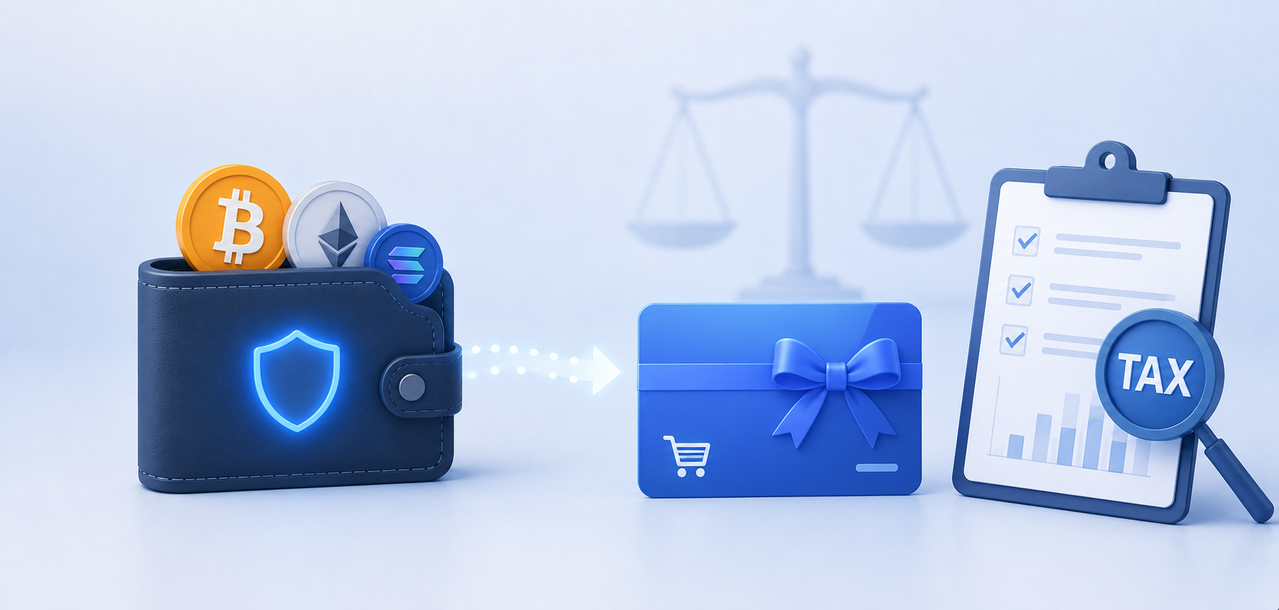
Yes, in most countries, and the reason catches people out repeatedly: you did not sell your crypto, but you did dispose of it.
Buying a gift card with Bitcoin on Bitrefill, Coinsbee or any similar platform is a transfer of an asset in exchange for something of value. Every major tax authority treats that the same way it treats a sale. The fact that no rupees, dollars or pounds ever touched your bank account is irrelevant.
In India specifically, that disposal is taxed at a flat 30% plus 4% cess on the gain, with no relief of any kind. This article works through what that actually costs, covers a stablecoin trap that almost nobody writes about, and compares treatment across ten jurisdictions.
The mental model that causes the problem
Most people intuitively divide crypto activity into two buckets: cashing out, which feels taxable, and spending, which feels like ordinary consumption. If you buy coffee with your debit card, no tax event occurs. It seems reasonable that buying an Amazon voucher with Bitcoin should work the same way.
It does not, because your rupees are currency and your Bitcoin is property. Spending currency is not a disposal of an asset. Spending property is. When you hand over Bitcoin and receive a gift card, you have exchanged one asset for another, and the tax system measures whether the asset you gave up had appreciated since you acquired it.
A useful reframe: buying a gift card with crypto is economically identical to selling the crypto for cash and then buying the gift card with that cash. Tax authorities have consistently taken the view that the compressed version should be taxed like the two-step version, because otherwise the two-step version would simply never be used.
India: the worked example
Section 115BBH taxes income from the transfer of a virtual digital asset at 30%, plus 4% health and education cess, bringing the effective rate to 31.2% before any surcharge. Using crypto to pay for goods or services is a transfer.
Suppose you bought 0.01 BTC for ₹50,000. Some months later you use it to buy a gift card worth ₹75,000.
Amount | |
|---|---|
Cost of acquisition (what you paid for the BTC) | ₹50,000 |
Value of the gift card received | ₹75,000 |
Taxable gain on the disposal | ₹25,000 |
Tax at 30% | ₹7,500 |
Cess at 4% | ₹300 |
Total tax on the purchase | ₹7,800 |
True cost of a ₹75,000 gift card | ₹82,800 |
The ₹75,000 gift card actually cost you ₹82,800. If you had not modelled the tax, you have overspent by roughly 10% without noticing.
The stablecoin trap
This is the part that surprises even careful filers, and it applies to a very large number of Indian users, because USDT is the dominant asset in India's peer-to-peer market.
The instinct is that spending a stablecoin cannot produce a gain, since a dollar-pegged token is worth a dollar on the day you bought it and a dollar on the day you spend it. That reasoning is correct in dollars. Your tax is computed in rupees.
Amount | |
|---|---|
1,000 USDT bought when the rate was ₹84 | ₹84,000 |
Same 1,000 USDT spent when the rate was ₹89 | ₹89,000 |
Taxable gain in rupee terms | ₹5,000 |
Tax at 30% plus cess | ₹1,560 |
Change in dollar value | Zero |
The rupee moved against the dollar, so the rupee value of your USDT rose, so you have a taxable gain of ₹5,000 on an asset that never left its peg. The figures above are illustrative, but the mechanism is real and applies to every stablecoin purchase you make.
Anyone buying gift cards regularly with USDT is generating small taxable gains on every transaction, and almost certainly not recording them.
Three further complications in India
The platform premium is not deductible
Gift card platforms typically price at face value plus a margin of roughly one to five percent, and network fees sit on top. None of this is deductible. Section 115BBH permits only the cost of acquisition — not exchange fees, gas fees, platform premiums or anything else.
So if you spend 1,000 USDT to obtain a card worth 980 USDT, you have disposed of the full 1,000 USDT. The 20 USDT premium reduces what you received but does not reduce your taxable gain.
Spending at a loss gives you nothing
If your crypto has fallen since you bought it, spending it produces a capital loss — which in India is worthless. VDA losses cannot be set off against other VDA gains, cannot be set off against any other income, and cannot be carried forward.
This produces an asymmetry worth internalising. Spend an appreciated asset and you pay 30%. Spend a depreciated one and you get no relief at all. The regime only ever moves in one direction.
TDS is unclear on offshore platforms
Section 194S requires 1% TDS on the consideration for a VDA transfer, with thresholds of ₹50,000 a year for individuals and HUFs below the tax audit limit, and ₹10,000 for others. Indian exchanges handle this automatically.
Gift card platforms are almost all foreign entities, and in practice they do not deduct Indian TDS. That absence does not extinguish your 30% liability — it simply means there is no credit sitting in your Form 26AS to offset it, and no automatic record. Discuss the TDS position on offshore purchases with your CA rather than assuming it does not apply to you.
The reporting reality
Schedule VDA is completed transaction by transaction, with fields for date of acquisition, date of transfer, cost of acquisition, sale consideration, the specific VDA, and the platform or wallet used.
Every gift card purchase is a separate row. Someone who buys a ₹500 mobile top-up weekly with crypto generates 52 disposals in a year, each needing an acquisition date, an acquisition cost, and a rupee valuation at the moment of spending. Loss-making rows are reported as nil rather than as negative figures, so netting is not an option.
This is not a warning against using crypto for everyday spending. It is a warning that doing so without automated tracking creates a reconciliation problem that becomes genuinely unmanageable by year end.
How other countries treat it
The Indian position is unusually harsh, but the underlying principle is close to universal.
Country | Treatment | Detail |
|---|---|---|
India | Taxable | Flat 30% plus 4% cess on the gain. No loss set-off, no deduction beyond cost of acquisition. |
United States | Taxable | Capital gains on the disposal. Short or long term depending on holding period. |
United Kingdom | Taxable | A CGT disposal. Annual exempt amount may cover small gains. |
Australia | Taxable, with a narrow exception | A CGT event, but a personal use asset exemption may apply where the crypto cost under AUD 10,000 and was acquired to spend. |
Germany | Often not taxable | Private assets held more than one year are exempt. Spending within a year is taxable. |
France | Taxable | 30% flat rate for occasional investors. |
Portugal | Often not taxable | Generally 0% for non-professional individuals; higher rates for frequent traders. |
Singapore | Generally not taxable | No capital gains tax for individuals. |
UAE | Not taxable | No personal income tax. |
El Salvador | Not taxable | No capital gains tax on Bitcoin. |
Australia's personal use asset exemption
Australia contains the one genuine carve-out worth knowing about. Where crypto qualifies as a personal use asset and the cost was AUD 10,000 or less, the disposal may be exempt from capital gains tax.
The exemption is narrow and frequently misunderstood. It turns on intent and behaviour: crypto acquired and held as an investment, then later spent, generally does not qualify. Crypto acquired specifically to spend, held briefly, and used to buy goods has a much better case. The way you stored it also bears on the analysis.
In practice most investors will not qualify, but for someone who genuinely buys crypto to spend on gift cards rather than to hold, it is a real exemption and worth raising with an Australian adviser.
Germany's one-year rule
Germany treats crypto as a private asset. Gains on assets held for more than one year are exempt. Spend Bitcoin you have held for thirteen months on a gift card and there is generally no tax. Spend Bitcoin you bought last month and there is.
This produces the exact opposite incentive to India's, where holding period is irrelevant and the rate is identical whether you held for a day or a decade.
The zero-tax jurisdictions
The UAE levies no personal income tax, so gift card purchases with crypto raise no personal tax question there. Singapore has no capital gains tax for individuals. El Salvador applies no capital gains tax to Bitcoin. Portugal is generally 0% for non-professional individuals, though frequent trading is treated differently.
Residency rather than platform location is what determines your position. Buying from a Swedish or German platform does not place you under Swedish or German tax rules.
Practical guidance
Record the rupee value of the crypto at the moment of every gift card purchase, not just the card's face value. That figure is your sale consideration.
Keep the acquisition record for the specific coins spent. Use FIFO consistently rather than picking lots after the fact.
Save the platform order confirmation with the exact quantity of crypto sent and the transaction hash.
If you spend crypto frequently, automate the tracking from the start. Reconstructing a year of small disposals in March is where most of the pain in this topic lives.
Model the tax into your decision. A card bought with appreciated crypto costs its face value plus roughly a third of your gain.
Frequently asked questions
Is it different if I use a stablecoin?
Not in principle. In India the gain is computed in rupees, so exchange rate movement between the rupee and the dollar creates a taxable gain even where the dollar value is unchanged.
What if the gift card is a gift for someone else?
The disposal is still yours and still taxable. What you do with the card afterwards does not change the fact that you transferred the crypto.
Does it matter that the platform is foreign?
Not for your liability. Indian residents are taxed on this income regardless of where the platform is incorporated. It may matter for TDS mechanics and, if you hold a balance with the platform, potentially for foreign asset disclosure.
What if I only spend small amounts?
There is no de minimis exemption for VDA income in India. The 30% applies from the first rupee of gain, and the absence of a basic exemption threshold is one of the defining features of Section 115BBH.
Is buying the gift card with INR and then buying crypto separately better?
If you buy the gift card with rupees directly, no VDA disposal occurs and no VDA tax arises. That is simply because you have not transferred crypto. It is not a scheme; it is a different transaction.
The bottom line
Buying a gift card with crypto is a disposal nearly everywhere, and in India it is taxed at 30% plus cess on the gain with no offsetting relief.
The three things that trip people up are the assumption that spending is not selling, the assumption that stablecoins cannot produce a gain, and the sheer volume of small transactions that everyday crypto spending generates. All three are solvable with tracking. None of them is solvable after the fact.
This article is general information, not tax advice. International treatment is summarised at a high level and varies with individual circumstances. Consult a qualified adviser in your own jurisdiction.
Cryptoo.tax tracks crypto spending transaction by transaction, computes rupee-denominated gains including on stablecoins, and generates Schedule VDA-ready reports for Indian filers.