The United States is the most competitive market in this category and the one where buyers have the most genuine choice. Every major global platform serves it, several operate US-only, and two of them pay you bitcoin back for shopping.
It is also the market with the most consequential tax trap, because the new IRS broker reporting form does not capture gift card purchases even though the IRS is clear that they are taxable. That gap is covered in detail below, and it is the section most competing guides skip entirely.
The platforms serving US buyers
Platform | Best for | What to know |
|---|---|---|
Best overall | Deepest catalogue and the strongest Lightning integration. Independent comparisons put its median markup close to zero and its average around 4%. Also covers US carriers including Verizon, T-Mobile and Mint Mobile. | |
BitPay | Best wallet integration | Buy gift cards directly from a self-custody wallet inside the BitPay app or Chrome extension. Accepts BTC, ETH, LTC, BCH, DOGE and more. |
Best coin coverage | Roughly 3,000 cards for the US market and over 200 cryptocurrencies accepted. No account or KYC for standard orders. No rewards programme. | |
Fold | Best rewards | US-only. In early 2026 Fold removed its paid subscription tier, making rewards available to all users at no cost. |
The Bitcoin Company | Best for Lightning users | Bitcoin and Lightning only, with sats back on purchases. Strong domestic brand selection. |
eGifter | Mainstream fallback | 300+ brands and no fee for paying with crypto. Processes bitcoin through BitPay and requires six on-chain confirmations, which makes it the slowest option here. |
Coincards | Cross-border US and Canada | Useful if you shop across both markets. Strong Canadian retail depth alongside US brands. |
No-account buying | 180+ countries, 100+ coins, no KYC. Useful when a brand is out of stock elsewhere. | |
In-wallet purchasing | Embedded inside Trust Wallet, MetaMask, Phantom, Coinomi and others, so there is no separate checkout. | |
CoinGate | Processor hybrid | Marketplace plus payment processing, covering 90+ countries with particular strength in Europe. Also resells crypto vouchers. |
Virtual card route | Lightning-funded virtual prepaid cards, usable anywhere Visa is accepted rather than at a single retailer. | |
Cake Pay | Privacy-focused | Monero-first, bundled inside Cake Wallet. |
What you can actually buy
The US catalogue is the deepest of any market. Across the major platforms you will find Amazon, Walmart, Target, Best Buy, Home Depot, Starbucks, Uber, DoorDash, Airbnb, Apple, Google Play, Steam, Nike and hundreds more.
Beyond retail gift cards, the same platforms sell mobile top-ups for the major US carriers, eSIM data packages, and in some cases prepaid Visa and Mastercard products that work anywhere rather than at a single merchant.
Gaming is unusually well served. Coinsbee in particular is popular with US gamers for PlayStation credit, Xbox, Steam and streaming subscriptions.
Fees: what you are actually paying
None of these platforms publishes a single flat fee, because none charges one. They acquire cards at wholesale and add a margin, so the cost you see is typically face value or a premium of roughly one to five percent depending on the brand.
Bitrefill generally leads on this metric — independent comparisons put its median markup close to zero, with an average nearer four percent across the catalogue. eGifter charges no fee specifically for paying with crypto. Coinsbee prices at face value but offers no cashback, so you get neither a premium nor a rebate.
There is a second, less visible cost: the exchange rate the platform applies when converting your crypto. Two platforms can list the same card at the same dollar price while one of them takes noticeably more of your bitcoin. If you are buying regularly and in size, compare the actual crypto amount debited rather than the listed card price.
The third cost is the network fee. Paying on-chain during a period of congestion can cost more than the platform's entire margin on a small card. This is the single strongest practical argument for using Lightning in the US market.
Delivery speed
Most platforms in this list support Lightning, and delivery over Lightning is effectively instant — cards arrive in about a second through wallets such as Phoenix, Breez, Muun and BlueWallet.
The outlier is eGifter, which processes bitcoin payments through BitPay and requires six on-chain confirmations before releasing the code. That can mean an hour or more. It remains useful as a fallback for brands other platforms do not carry, but it is not the right choice when you are standing at a checkout.
Rewards: the US-only advantage
This is where the US market genuinely differs from everywhere else. Two platforms pay you bitcoin back on gift card purchases.
Fold is US-only and, as of early 2026, eliminated its paid subscription tier, making its rewards available to every user at no cost. The Bitcoin Company operates on Lightning and pays sats back on purchases. Bitrefill also runs a cashback programme paid in bitcoin.
For a US buyer who was going to shop at these retailers anyway, the rewards can offset or exceed the platform premium. That is a materially better proposition than the same purchase made from India, the UK or the Gulf, where no equivalent rewards layer exists.
The tax problem nobody is warning you about
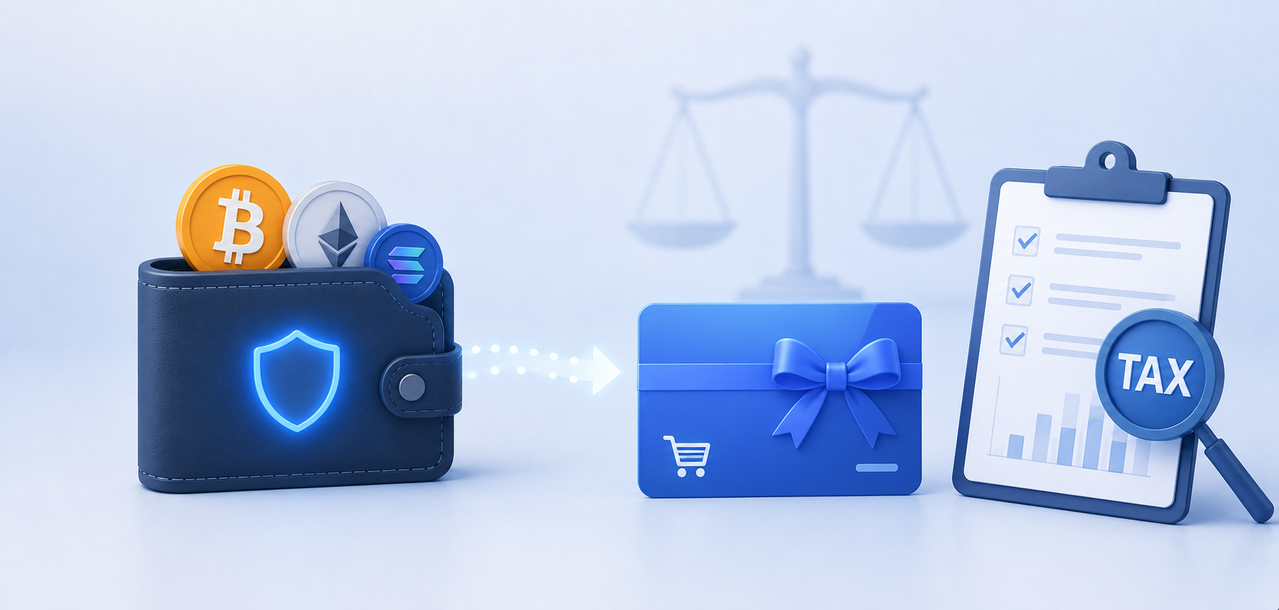
The IRS treats digital assets as property. Spending crypto — including buying a gift card with it — is a disposal, and any gain since you acquired the crypto is a taxable capital gain, short or long term depending on your holding period.
That much is settled. What has changed is the reporting environment around it, and the change has created a gap that catches careful people.
How Form 1099-DA works
Form 1099-DA, titled Digital Asset Proceeds From Broker Transactions, is the IRS's dedicated reporting form for digital asset sales and exchanges. Brokers began reporting gross proceeds for transactions on or after 1 January 2025, with the first forms arriving in early 2026. Cost basis reporting phases in for covered assets acquired on or after 1 January 2026.
It functions much like the Form 1099-B that stock brokerages have used for decades, and it gives the IRS a direct way to match broker-reported proceeds against what you file.
Why gift card purchases fall through the gap
Gift card platforms are not custodial brokers. They will not send you a 1099-DA. Neither will a self-custody wallet you paid from.
So a US buyer can spend appreciated bitcoin on gift cards all year, receive no tax form referencing any of it, and still owe capital gains tax on every purchase. Spending crypto may not appear as a taxable transaction on your 1099-DA despite clear IRS guidance that it is one.
The IRS has been explicit that receiving a form is not a precondition for reporting. You are required to report all digital asset transactions whether or not a broker issues anything, and the absence of a 1099-DA is not a defence.
There is a second trap in the cost basis rules. Crypto bought before 1 January 2026, or transferred in from another wallet or exchange, is treated as a non-covered asset — meaning your broker does not report its cost basis and you are responsible for tracking it yourself. For most people buying gift cards today, that describes nearly everything they hold.
Practically, this means every gift card purchase needs a record: the date, the quantity of crypto spent, its fair market value in dollars at that moment, and the original acquisition cost of those specific coins. Gains and losses are reported on Form 8949 and Schedule D.
The saving grace, relative to some other jurisdictions, is that US capital losses are usable. If your crypto has fallen since you bought it, spending it at a loss produces a deductible capital loss that can offset gains, with a limited annual allowance against ordinary income and indefinite carry-forward.
Safety and scams
Gift cards are the preferred instrument of a very large category of US fraud, and the crypto version compounds the problem because both legs of the transaction are irreversible.
Two rules cover almost every case. First, no legitimate organisation — not the IRS, not a utility, not law enforcement, not a tech support line — will ever ask to be paid in gift cards. That request is definitionally a scam, with no exceptions worth entertaining. Second, never read a gift card code aloud to anyone who contacted you first.
On the buying side, the relevant risks are different. Gift card purchases are final sale with no chargeback mechanism, and crypto payments cannot be reversed, so the combination leaves no recourse if something goes wrong. Buy from established platforms, buy close to when you intend to spend, and treat any site offering cards at a suspiciously deep discount as a marketplace of stolen codes rather than a bargain.
How to buy, step by step
Pick the platform based on the specific brand you want, then compare price across one or two others. Catalogues differ more than marketing suggests.
Choose Lightning where the platform supports it. It is faster and cheaper than on-chain for typical card values.
Check the region on the card. US-denominated cards generally will not redeem against accounts registered in other countries.
Record the transaction immediately: date, crypto amount, dollar value at the time, and the acquisition cost of those coins.
Redeem promptly rather than accumulating unspent balances. Cards are cash equivalents and refunds effectively do not exist.
Frequently asked questions
Is buying gift cards with crypto legal in the United States?
Yes. It is an ordinary purchase. The tax consequences are the same as selling the crypto and spending the proceeds.
Do I need to verify my identity?
It depends on the platform. Bitrefill, Coinsbee and Cryptorefills allow standard purchases without an account. Platforms with card products or higher limits generally require verification. No platform in this category is a privacy tool.
Which platform is cheapest?
Bitrefill most often, on the combination of low markup and Lightning delivery. But the honest answer is that it varies by brand, and the only reliable method is comparing the actual crypto amount debited for the same card on two platforms.
Can I get a refund if a code does not work?
Policies vary and refunds are rare by design. Contact the platform's support immediately with the order reference and transaction hash. Do not assume a chargeback route exists, because there is not one.
Will I get a tax form for these purchases?
Almost certainly not. Gift card platforms are not brokers and do not issue Form 1099-DA. You are still required to report the disposals.
Does using a stablecoin avoid the tax?
It reduces it rather than avoiding it. A dollar-pegged token held at a stable value produces little or no gain, so the taxable amount is usually small — but the disposal still occurs and still needs reporting.
The bottom line
US buyers have the best version of this market anywhere: the deepest catalogue, the most platforms, the fastest delivery, and the only meaningful rewards programmes in the category. Bitrefill is the sensible default, BitPay if you want it inside your wallet, Fold or The Bitcoin Company if you want sats back.
The thing to get right is the paperwork. Every purchase is a taxable disposal that no platform will report for you, and the cost basis for anything you bought before 2026 is yours alone to track.
Tax information here is general and not advice. Consult a qualified tax professional about your own circumstances.
Bitnxt maintains a full directory of crypto gift card platforms across every major market, covering buy-side operators, crypto vouchers and gift-card-to-crypto marketplaces.