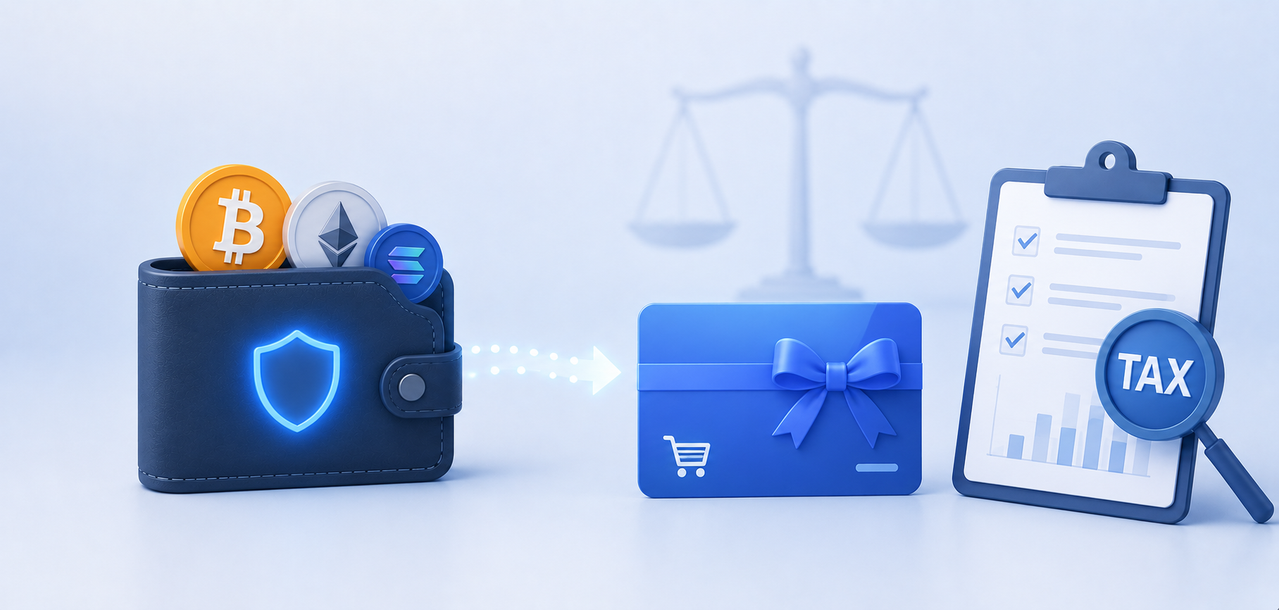
Australia is the only country in this series with a tax rule that could make buying a gift card with crypto entirely tax-free — and it exists precisely because you intended to spend the crypto rather than invest it.
The personal use asset exemption is genuinely unique. It is also far narrower than most crypto content suggests, and it has a sting in the tail that almost nobody mentions: if it applies, your losses vanish too.
This guide covers who actually qualifies, what the ordinary rules are if you do not, and which platforms serve the Australian market.
The personal use asset exemption
Australian tax law provides that a capital gain on the disposal of a personal use asset is exempt from CGT where you acquired the asset for less than $10,000.
Crypto can qualify. The ATO's own guidance addresses this directly: a crypto asset is a personal use asset if you acquire it and use it mainly for personal consumption — for example, buying it specifically in order to purchase something.
Read against gift card buying, that is a remarkably good fit. Someone who buys $400 of Bitcoin on a Tuesday because they intend to buy a gift card with it on Thursday is doing exactly what the provision describes.
Why most people do not qualify
The exemption turns on your purpose at acquisition, and the ATO applies it narrowly.
If you bought crypto as an investment and later decided to spend some of it, it is not a personal use asset. If it sat on an exchange for months while you watched the price, the ATO's position is that the acquisition purpose was investment. And the ATO states explicitly that using the returns from crypto investments to acquire personal items does not change the character of the underlying asset.
Time matters too. The longer between acquisition and use, the weaker the argument. So does storage: crypto held on an exchange in an investment posture is treated differently from crypto acquired and spent promptly.
Situation | Treatment |
|---|---|
Bought crypto specifically to spend, spent it soon after, cost under $10,000 | Possibly exempt as a personal use asset |
Bought crypto as an investment, later decided to spend some | Not exempt. Ordinary CGT applies |
Held on an exchange for a long period before spending | Generally not exempt — the ATO treats this as investment |
Used investment returns to buy personal items | Not exempt. The ATO is explicit that this does not change the character of the asset |
Cost of the crypto was $10,000 or more | Not exempt regardless of intent |
Qualifies as a personal use asset but the value fell | Loss is disregarded entirely — cannot offset, cannot carry forward |
The part nobody mentions
The exemption cuts both ways, and this is the detail missing from essentially every article on the subject.
Capital losses on personal use assets are disregarded entirely. You cannot use them to offset a net capital gain in the income year, and you cannot carry them forward to future years. They simply do not exist for CGT purposes.
So if you buy $3,000 of Bitcoin intending to spend it, the price falls, and you spend it at $2,400, that $600 loss is gone. Under ordinary CGT treatment it would have offset gains elsewhere in your portfolio.
The exemption is therefore genuinely valuable only in a rising market and genuinely costly in a falling one — and you do not get to choose retrospectively which treatment applies. The character of the asset was fixed when you acquired it.
The exemption is narrow, contested, and requires careful documentation. Do not build a spending strategy on it without advice.
If the exemption does not apply
Which, for most people, it will not. In that case ordinary CGT rules govern.
The ATO treats cryptocurrency as a CGT asset rather than money or foreign currency. Spending it is a CGT event. Your gain is calculated in Australian dollars: capital proceeds less cost base, with acquisition and disposal fees included in the calculation.
The 50% discount
Hold a crypto asset for at least twelve months before disposing of it and you may access the 50% CGT discount under Division 115, which halves the gain before it is added to your assessable income. It is available to resident individuals and trusts, but not to companies.
This produces materially different outcomes by holding period and bracket.
Taxable income (AUD) | Marginal rate | Under 12 months | 12+ months |
|---|---|---|---|
0 – 18,200 | 0% | 0% | 0% |
18,201 – 45,000 | 16% | 18% | 9% |
45,001 – 135,000 | 30% | 32% | 16% |
135,001 – 190,000 | 37% | 39% | 19.5% |
190,001 and above | 45% | 47% | 23.5% |
The figures include the 2% Medicare levy. At the top bracket the discount takes the effective rate on a long-held gain from 47% down to roughly 23.5%, which is why the twelve-month mark shapes Australian spending behaviour so heavily.
A note on the discount rumours
Claims have circulated that Australia is scrapping the 50% CGT discount for crypto. The ATO has confirmed the discount remains in place, and no legislation, budget announcement or official guidance has proposed removing it.
Some commentary references possible future reform to the discount mechanism. Treat that as speculation about future policy rather than current law, and disregard anything asserting the discount has already gone.
Losses
Under ordinary treatment, capital losses offset capital gains and can be carried forward indefinitely. They cannot offset ordinary income. This is a considerably better position than India's regime, where VDA losses are unusable in every direction.
The ATO is watching
Australia runs one of the more aggressive crypto compliance operations globally. The ATO's data matching programme collects transaction data from all major Australian exchanges, and it has been extended in scope to cover token swaps, staking and DeFi activity.
Gift card platforms are foreign entities and not part of that programme, so your purchases will not appear in ATO-matched data. The disposal still occurred. Unreported gains risk penalties and amended assessments, and the mismatch between what the ATO sees on the exchange side and what you declare is exactly what the programme is designed to surface.
The platforms serving Australia
Platform | Best for | What to know |
|---|---|---|
Best overall | Localised Australian store with AUD-denominated brands, strongest Lightning support, bitcoin cashback on selected products. Accepts BTC, Lightning, ETH, USDC, USDT, SOL, LTC, DOGE and Binance Pay. | |
Best coin coverage | 200+ cryptocurrencies and a deep international catalogue. No account required for standard orders. | |
No-account buying | 180+ countries, 100+ coins, no KYC. Reliable fallback when Australian stock runs thin. | |
In-wallet purchasing | Embedded inside Trust Wallet, MetaMask, Phantom, Coinomi and others, removing the separate checkout. | |
Wallet-native | Buy from a self-custody wallet via the app or Chrome extension. | |
Privacy-focused | 300+ tokens including Monero, zero KYC at any order size, no platform fees. | |
Processor hybrid | Marketplace plus payment processing. Also resells crypto vouchers such as Azteco and CryptoVoucher. | |
Sats back | Lightning-native with rewards paid in sats. Catalogue skews US. | |
Virtual card route | Lightning-funded virtual Visa, usable anywhere Visa is accepted rather than at one retailer. | |
Top-up specialist | Mobile top-ups across 166 countries alongside gift cards. | |
Monero users | Bundled inside Cake Wallet. | |
Marketplace | Independent sellers accepting USDT and BTC, for items the majors do not carry. |
There is no significant Australian-domiciled crypto gift card operator, so the market is served entirely by international platforms. Bitrefill maintains a localised Australian store and is the sensible default; Coinsbee is the fallback for breadth and unusual coins.
What you can buy
The Australian catalogue is solid without being exceptional. Across the platforms you will typically find Woolworths, Coles, Bunnings, JB Hi-Fi, Kmart, Big W, Myer, Officeworks, Rebel, Chemist Warehouse, Dan Murphy's and BWS, alongside delivery services including Uber Eats, Menulog and DoorDash.
Travel and the global set — Qantas, Apple, Google Play, Steam, Netflix, Spotify, Xbox — are widely carried. Australian mobile top-ups and eSIM data are also available.
Stock moves with supplier availability, so check the live listing rather than assuming a major grocer is carried on a given day.
Fees and delivery
Pricing follows the category norm: wholesale acquisition plus a margin, so face value or a premium of roughly one to five percent depending on the brand. Genghis charges no platform fee, which is worth comparing against Bitrefill on the specific card you want.
Lightning is the right rail for anything under about AUD 150. On-chain fees during congestion can exceed the platform's entire margin on a small card, and Lightning delivery is effectively instant.
Compare the actual crypto amount debited rather than the listed Australian dollar price, since exchange rate handling differs meaningfully between platforms.
Practical guidance
Decide your purpose before you buy the crypto, not after. The character of the asset is fixed at acquisition and determines everything that follows.
If you are genuinely buying crypto to spend, document it: the purchase, the short holding period, the purpose, and the spend. Keep the trail contemporaneous.
Do not assume the personal use exemption applies to coins you have been holding. It almost certainly does not.
Track the twelve-month mark on investment holdings. The difference between 47% and 23.5% at the top bracket is worth waiting for.
Record every purchase in AUD at the time of the transaction: date, crypto quantity, AUD value, and fees.
Remember the Australian financial year runs 1 July to 30 June, not the calendar year.
Frequently asked questions
Do I pay tax on gift cards bought with crypto in Australia?
Usually yes. Spending crypto is a CGT event. The personal use asset exemption may apply if you acquired the crypto specifically to spend, used it promptly, and it cost less than $10,000 — but the ATO interprets this narrowly.
Is the $10,000 based on the crypto or the gift card?
The cost of the crypto when you acquired it, not the value of what you bought with it.
Can I claim a loss if I spend crypto that has fallen in value?
Under ordinary CGT treatment, yes. If the asset qualifies as a personal use asset, no — those losses are disregarded entirely and cannot be carried forward.
Has the 50% CGT discount been removed?
No. The ATO has confirmed it remains in place. Claims to the contrary have circulated without official support.
Does the ATO know about my crypto?
It receives data from all major Australian exchanges through its data matching programme. Gift card platforms are not part of that, but the underlying disposal is still reportable.
Which platform is best for Australian brands?
Bitrefill for its localised Australian store and Lightning delivery, with Coinsbee as the fallback for coverage and coin support.
The bottom line
Australia gives you two genuinely useful things: a 50% discount that roughly halves the rate on anything held past twelve months, and a personal use asset exemption that can eliminate the tax entirely on crypto bought specifically to spend.
The catch is that the two are mutually exclusive in practice. Crypto held long enough to earn the discount is, by that very fact, an investment rather than a personal use asset. You are choosing between them at the moment you buy, whether you realise it or not.
Use Bitrefill for the Australian catalogue and Lightning, decide your purpose before you acquire, and document whichever route you take.
Tax information here is general and not advice. The personal use asset exemption is narrow, fact-dependent and interpreted strictly by the ATO. Consult a registered tax agent about your own circumstances before relying on it.
Bitnxt maintains a full directory of crypto gift card platforms across every major market, covering buy-side operators, crypto vouchers and gift-card-to-crypto marketplaces.

.jpg)
.jpg)