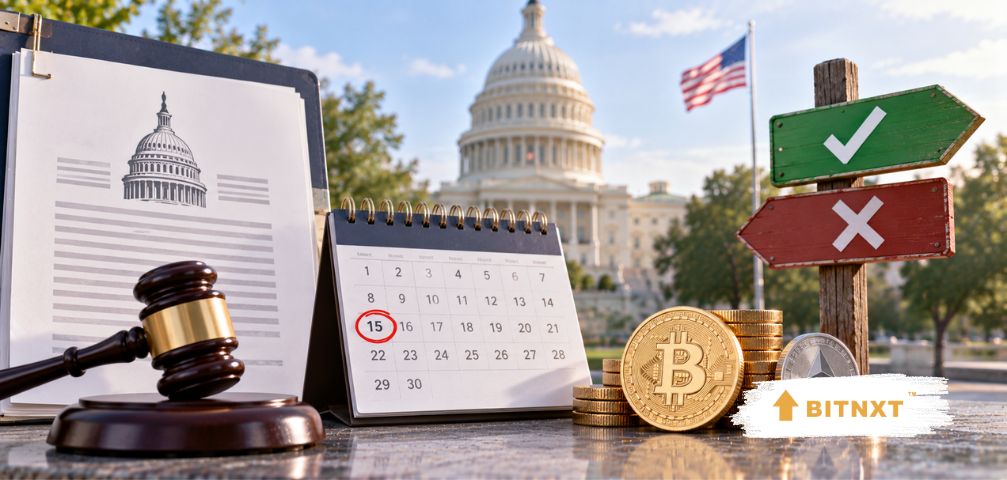
After more than a year of waiting, the US Senate has a date on the calendar. On 15 September 2026, the chamber is scheduled to hold a cloture vote on the Digital Asset Market CLARITY Act, the market structure bill that the crypto industry has treated as its central policy objective since 2025.
SEC Chairman Paul Atkins said in early September that the vote will go ahead and that he expects the bill to eventually reach the President’s desk. The industry is less certain. Investment bank TD Cowen has put the odds of the bill clearing the Senate at roughly one in three, and Galaxy Digital trimmed its own estimate to around 30% as negotiations dragged through the summer.
Most coverage this month will focus on what happens if the bill passes. That is the easier story to write. The more useful question for anyone actually running a business in this sector is the opposite one: if cloture fails on 15 September, what changes?
The short answer is that far less changes than the headlines will suggest — and that is precisely the problem.
What is actually being voted on
First, a correction that a lot of reporting gets wrong. The 15 September vote is not a vote to pass the CLARITY Act. It is a cloture vote on the motion to proceed — a procedural step that ends debate and allows the Senate to formally take the bill up.
Cloture requires 60 votes. Republicans hold 53 seats. That arithmetic is the entire story: the bill needs somewhere between seven and ten Democratic senators to cross over before the Senate can even begin debating it in earnest.
Even a successful cloture vote would not make the CLARITY Act law. The Senate version would still need to be reconciled with the House version passed in July 2025 before anything reaches the President. A failed cloture vote, by contrast, is close to terminal for the 2026 legislative calendar.
How the bill got here
Date | Milestone |
May 2025 | Digital Asset Market CLARITY Act introduced with bipartisan co-sponsors |
17 July 2025 | House passes H.R. 3633 by 294–134, with more than 70 Democrats voting in favour |
14 May 2026 | Senate Banking Committee advances an amended version by 15–9 |
1 June 2026 | Bill placed on the Senate Legislative Calendar as Calendar No. 423 |
8 August 2026 | Senate leadership files a motion to proceed and a cloture motion — too late to vote before the five-week recess |
19 August 2026 | President Trump hosts crypto executives at the White House and urges Congress to break the deadlock |
15 September 2026 | Scheduled cloture vote requiring 60 votes |
Why the Democrats are holding out
Seven Senate Democrats issued a joint statement saying the current Republican-written text falls short, naming five areas they want strengthened: government ethics, consumer protection, illicit finance, conflicts of interest and market integrity.
Two disputes have done most of the damage:
Ethics provisions. The bill has been repeatedly held up over language designed to prevent government officials from profiting from digital assets — a live political question given the current administration’s own crypto ventures.
Stablecoin yield. Whether stablecoin holders should be permitted to earn interest has pitted the banking lobby against the crypto industry, and momentum stalled over it repeatedly through the northern summer. Banks argue that yield-bearing stablecoins pull deposits out of the banking system. Issuers argue that a ban is protectionism.
Neither dispute is technical. Both are distributional fights over who captures the economics of a regulated US digital asset market, which is why they have proved so resistant to a drafting fix.
Scenario one: cloture succeeds
If 60 senators vote to proceed, the bill moves into floor debate and amendments. Expect stablecoin yield and the ethics language to be the amendment battlegrounds, and expect the final Senate text to differ meaningfully from the House version. Reconciliation between the two chambers would follow, with signature realistically landing in late 2026 or early 2027.
For businesses, the practical outcome is a statutory division of labour: the CFTC would gain broad authority over digital commodity spot markets, bringing registration, recordkeeping, market surveillance and customer asset protection requirements to exchanges, brokers and dealers. The SEC would retain jurisdiction over digital securities. Tokenised stocks and bonds stay securities; digital commodities do not.
Scenario two: cloture fails — what actually happens
This is the scenario worth preparing for, and it is less dramatic than it sounds. US crypto regulation does not revert to a vacuum, because the agencies have spent 2026 building the framework anyway.
1. The SEC keeps going without Congress
In March 2026 the SEC issued an interpretive release — widely referred to as the Token Taxonomy Release — establishing four categories of asset that are not deemed securities: digital commodities, digital collectibles, digital tools, and payment stablecoins under the GENIUS Act. That release also categorised assets including Bitcoin, Ethereum, XRP, Solana, Cardano, Chainlink, Dogecoin and Avalanche as digital commodities.
Then, on 18 August 2026, the SEC went further and proposed Regulation Crypto Assets, a tailored securities offering regime for investment contracts involving crypto assets. The proposal includes:
A startup exemption permitting offerings of up to $5 million over a four-year period.
A larger fundraising exemption permitting up to $75 million in each 12-month period, with financial statements and ongoing reporting obligations.
A principles-based disclosure framework built for crypto issuers rather than conventional corporate securities.
A conditional safe harbour addressing when a crypto asset stops being subject to an investment contract.
Federal preemption of state securities registration requirements for qualifying offerings and certain secondary market transactions.
The critical detail: the SEC has said this framework draws heavily on Congressional work, particularly the CLARITY Act. In other words, the regulator is already implementing a version of the bill it is waiting for. If CLARITY dies on 15 September, Regulation Crypto Assets does not die with it.
2. The CFTC keeps going too
The derivatives regulator has moved even faster. On 29 May 2026 the CFTC approved the listing of a true Bitcoin perpetual contract on a CFTC-registered exchange — the first new derivative type the agency had approved in over a decade. Chairman Michael Selig has framed the effort as onshoring perpetual futures activity that migrated offshore in the absence of a domestic pathway, starting with leverage capped at around 10x and reviewing each new asset on a case-by-case basis.
Beyond perpetuals, the CFTC has signalled rulemaking on when DeFi software providers must register, standards for leveraged and margined spot trading, prediction markets, and the treatment of AI-driven trading systems — much of it coordinated with the SEC under a joint initiative.
3. The agencies get more aggressive, not less
Industry observers have been explicit about the fallback. If CLARITY does not pass, the expectation is that the SEC and CFTC will become considerably more active very quickly afterwards, filling the statutory gap with rulemaking and interpretation.
For anyone who lived through the previous era, this should sound familiar. Regulation by agency discretion is exactly what the industry lobbied against. The difference in 2026 is that the discretion is currently being exercised in the industry’s favour.
The real cost of failure: fragility, not chaos
The strongest argument for the CLARITY Act was never that current rules are unworkable. It is that rules created by regulators can be undone by regulators.
A statute passed by Congress survives a change of administration. An interpretive release, a proposed exemption and a no-action position do not. Regulation Crypto Assets is a proposal open to public comment; its final language may differ from what was published, and it can be revisited, narrowed or reversed by a future Commission. Every framework built this way carries an implicit expiry date tied to the next election.
That fragility has a price, and it shows up in exactly the place the industry cares about most: long-term institutional capital. Executives and investors have consistently argued that durable legislation is what attracts patient money, because a pension fund or a listed corporate cannot underwrite a five-year allocation against a rulebook that could change with the next Commission.
So the honest answer to “what happens if CLARITY fails” is this: nothing breaks on 16 September. Exchanges keep operating, the SEC keeps proposing rules, the CFTC keeps approving products. What is lost is durability — and the window to get it.
The calendar problem
If cloture fails, the path forward narrows sharply. The Senate has a limited number of working days before it breaks again for the final stretch of the November midterm campaign. Policy analysts have warned that missing the 2026 window could push market structure legislation into 2027 entirely, with a differently composed Congress and a very different political calculus.
There is also a wildcard. Ahead of the midterms, the administration has been weighing a push to index capital gains to inflation, a change that would benefit investors realising profits on Bitcoin and Ether unless digital assets were specifically carved out. Nothing has been formally proposed, but it is a reminder that crypto policy in the fourth quarter of 2026 will be shaped as much by electoral positioning as by committee negotiation.
What it means for you
If you are… | A failed vote means… |
A US exchange or broker | No statutory CFTC registration regime yet. You continue operating under existing registrations and agency guidance, with rulemaking risk rather than legal certainty. |
A token issuer | Regulation Crypto Assets remains a proposed rule, not usable law. Treat it as a roadmap for future compliance, not an exemption you can rely on today. |
An institutional allocator | The durability question stays open. Mandates that require statutory clarity stay on the sidelines into 2027. |
A non-US platform | The relative appeal of licensed regimes elsewhere increases. The UK’s FCA authorisation gateway opens on 30 September 2026, MiCA has been fully enforceable across the EU since 1 July 2026, and the UAE now operates a defined federal licensing framework. |
A trader | Very little changes day to day. Expect a short-term price reaction to the vote and limited structural impact either way. |
What to watch after 15 September
Whether the vote is held at all. Procedural votes get pulled when leadership knows the count is short. A postponement is itself a signal.
The Democratic defection count. Even a failed vote that attracts five or six Democrats keeps a renegotiated bill alive; two or three effectively ends the 2026 path.
Whether stablecoin yield gets carved out. A compromise that defers the yield question to separate legislation is the most plausible route to 60 votes.
The SEC comment file on Regulation Crypto Assets. If CLARITY fails, that proposal becomes the main event in US crypto policy.
CFTC product approvals. Each new perpetual or leveraged spot approval is another piece of market structure being built without legislation.
The bottom line
The CLARITY Act is the most advanced crypto market structure bill in US history, and on 15 September it faces a vote it may well lose. If it does, the United States will not stop regulating crypto. It will simply keep regulating it the way it has all year — through agencies, interpretations and proposals that can be rewritten by whoever holds the pen next.
For builders, that means the compliance roadmap is unchanged but the ground under it is not fixed. For anyone choosing a jurisdiction in the next twelve months, it is one more reason to read the UK, EU and UAE rulebooks alongside the American one.
Sources
Reporting and primary materials from the US Securities and Exchange Commission, the Commodity Futures Trading Commission, Congress.gov, CoinDesk, CNBC, Bloomberg, Reuters and The Block. This article is general information about public policy developments and is not legal, tax or investment advice.
Bitnxt tracks crypto regulation, exchanges, OTC desks and licensed service providers across the US, UK, EU and UAE. Explore the directory at bitnxt.io.