
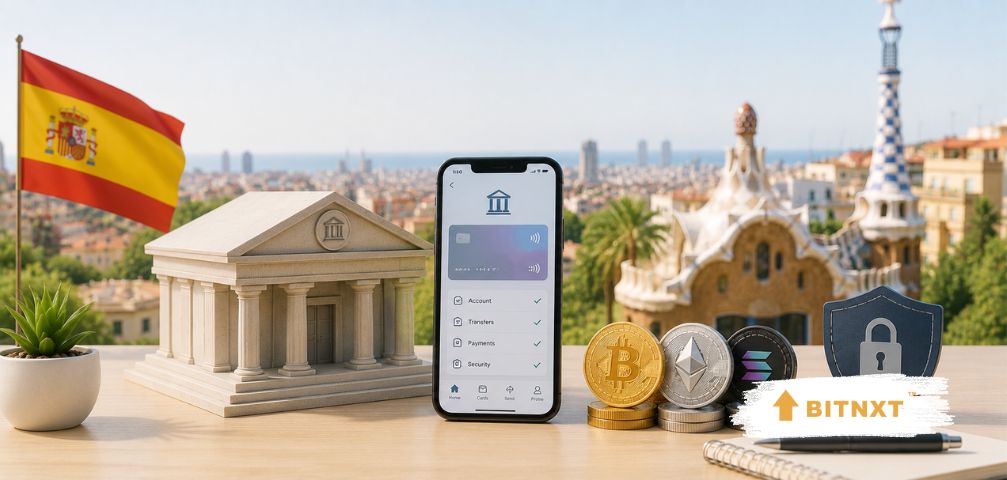
Spain has emerged as one of Europe's most crypto-friendly banking markets, thanks largely to BBVA's groundbreaking launch of retail Bitcoin and Ether trading directly within its banking app. With the CNMV (Comisión Nacional del Mercado de Valores) as the national regulator under MiCA, Spain now offers retail customers the ability to buy, sell, and hold crypto from a major traditional bank — a milestone few other European markets can match.
Whether you're a Spanish resident looking for a bank that won't freeze your account for crypto transfers, or you want integrated crypto trading within your banking app, this guide covers the best crypto-friendly banks in Spain for 2026 — from BBVA's integrated crypto service, to neobanks that tolerate crypto, to the Spanish crypto exchange ecosystem.
Spain's Crypto Banking Landscape: The CNMV and MiCA
Spain's crypto regulation is now governed by MiCA, with the CNMV as the national regulator. Key points:
CNMV regulates CASPs — Any firm providing crypto-asset services in Spain must be licensed by the CNMV under MiCA, unless passported from another EU member state.
BBVA pioneered retail crypto banking — In April 2025, BBVA launched Bitcoin and Ether trading and custody for all retail customers in Spain, the first major European bank to do so.
Spanish banks investing in crypto — Bankinter, BBVA, and Cecabank have all invested in Bit2Me, Spain's leading MiCA-licensed crypto exchange.
Strong crypto exchange ecosystem — Bit2Me (CNMV-licensed), Bitpanda, Coinbase, and Kraken all operate in Spain under MiCA.
The practical result: Spain is one of the most crypto-friendly banking markets in Europe, with a major traditional bank (BBVA) offering integrated crypto trading and a well-regulated exchange ecosystem.
Category 1: Spanish Banks with Integrated Crypto Services
Spain leads Europe in this category — a major traditional bank now offers retail crypto trading directly within its banking app.
BBVA — Europe's Crypto Banking Pioneer
Best for: Spanish residents who want crypto trading within their bank app
BBVA is the standout crypto-friendly bank in Spain — and arguably in Europe. In April 2025, BBVA launched its Bitcoin and Ether trading and custody service for all retail customers in Spain, after filing the relevant disclosure with the CNMV. Customers can now buy, sell, and hold Bitcoin and Ether directly through the BBVA app, within a fully integrated environment that includes the bank's other financial services.
Buy, sell, and hold Bitcoin and Ether directly in the BBVA app
CNMV-approved, MiCA-aligned
No fees for the first purchase
Full integration with BBVA's traditional banking services
BBVA has over a decade of blockchain experience (Switzerland 2021, Turkey 2023, Spain 2025)
Spanish banking license, deposit protection up to €100,000
Significance: BBVA is the first major European bank to offer retail crypto trading integrated into its banking app. This is a landmark for crypto adoption in European banking, and Spain is the market where it happened first.
Limitations: Currently limited to Bitcoin and Ether (not the full range of cryptocurrencies). The bank does not provide investment advice on crypto assets — access is exclusively customer-initiated through the app.
Bankinter — Investor in Spain's Crypto Ecosystem
Bankinter has invested in Bit2Me, Spain's leading MiCA-licensed crypto exchange, alongside BBVA and Tether. This signals Bankinter's commitment to the crypto ecosystem, though it hasn't yet launched integrated retail crypto services like BBVA. Bankinter is known for being more innovation-friendly than many traditional Spanish banks.
Cecabank — Crypto Custody for Institutions
Cecabank has launched crypto custody services in collaboration with Bit2Me, with Renta 4 Banco as its first client. This is primarily an institutional offering, but it signals that Spanish banking infrastructure is building crypto custody capabilities for the broader market.
Category 2: Neobanks Available in Spain
These EU-licensed neobanks are available to Spanish residents and offer crypto-friendly features alongside modern banking.
Revolut — The Multi-Currency Super-App
Best for: Multi-currency needs alongside crypto tolerance
Revolut holds a Lithuanian banking license (EU-regulated, €100,000 deposit protection) and is available to Spanish residents. It offers multi-currency accounts (30+ currencies), a built-in crypto exchange (Revolut X), and accepts transfers from MiCA-regulated exchanges.
30+ currencies — useful if you deal in EUR, USD, GBP, and more
Built-in crypto trading via Revolut X
Accepts transfers from MiCA-licensed exchanges
Free tier available; paid plans offer more features
N26 — The German Neobank in Spain
Best for: A clean, regulated, crypto-tolerant account
N26 holds a full German banking license (BaFin-regulated) and is available to Spanish residents. It accepts transfers to and from regulated crypto exchanges without blanket restrictions, and offers a clean mobile banking experience.
German banking license (BaFin), €100,000 deposit protection
Accepts transfers from MiCA-licensed exchanges
Free tier available; SEPA Instant transfers free for EUR
Integrated crypto trading via partners
Bunq — Multi-IBAN Dutch Neobank
Best for: Multiple IBANs to separate crypto from personal funds
Bunq is a Dutch neobank available in Spain, known for its multi-IBAN feature (up to 25 IBANs). It generally handles crypto exchange transfers smoothly, with occasional compliance checks on larger amounts. Dutch banking license, €100,000 deposit protection. Bunq also offers in-app crypto trading powered by Kraken.
Multiple IBANs — useful for separating crypto and personal funds
In-app crypto trading powered by Kraken (fees from 0.25% per trade)
Business accounts with crypto-friendly features
Available to Spanish residents
Plans from free to €18.99/month
Wise — The Transfer Specialist
Best for: Cheap international transfers to and from crypto platforms
While technically an e-money institution, Wise is indispensable for Spanish crypto users who need to move money across borders. It offers multi-currency accounts with local IBANs in EUR, GBP, USD, and more, with low, transparent FX fees.
Hold and convert 40+ currencies at mid-market rates
Local IBANs for EUR, GBP, USD, and more
Low, transparent transfer fees
⚠️ Note: Wise is not a bank — funds aren't deposit-protected. Use it as a transfer layer, not a long-term store of funds.
Category 3: Traditional Spanish Banks and Crypto
Beyond BBVA, traditional Spanish banks vary in their crypto stance. Here's where things stand.
Santander, CaixaBank, Sabadell — Cautious but Evolving
Other major Spanish banks (Santander, CaixaBank, Sabadell) have historically been cautious about crypto. User reports vary: some have successfully transferred to and from regulated exchanges without issues; others have faced compliance questions. The general pattern:
Transfers to MiCA-licensed exchanges (Bit2Me, Bitpanda, Coinbase, Kraken) are more likely to be accepted
Transfers to offshore or unregulated exchanges may trigger compliance flags
Large or unusual transfers are more likely to be questioned
⚠️ If you use a traditional Spanish bank other than BBVA: Keep meticulous records of your crypto activity, use only MiCA-licensed exchanges, and consider keeping a neobank account (Revolut, N26) as a crypto-friendly alternative or backup.
Category 4: Spanish Crypto Exchanges
Spain has a strong crypto exchange ecosystem, with several MiCA-licensed platforms that make banking smoother for Spanish users.
Bit2Me — Spain's Leading MiCA-Licensed Exchange
Best for: Spanish users who want a fully domestic, regulated crypto platform
Bit2Me is Spain's leading crypto exchange, authorised under MiCA by the CNMV. Founded in 2014, it offers over 400 cryptocurrencies, Pro trading, Earn, Card, Loan, Tax, and Launchpad features. Bit2Me is also authorised as a payment institution by the Banco de España (PSD2), and has received backing from BBVA, Bankinter, Tether, Telefónica, and Cecabank.
CNMV-licensed under MiCA — fully Spanish regulation
Over 400 cryptocurrencies
Free EUR deposits and withdrawals (SEPA)
Backed by major Spanish banks and Telefónica
Spanish-language support and Bit2Me Academy
Business solutions for corporate crypto treasury
Significance: Bit2Me is the natural choice for Spanish users who want a fully domestic, CNMV-regulated crypto platform. Its backing by major Spanish banks signals the integration of crypto into Spain's financial ecosystem.
Bitpanda — MiCA-Licensed European Platform
Bitpanda is an Austrian platform (MiCA-licensed via BaFin, FMA, and MFSA) with SEPA support. It offers crypto, stocks, ETFs, and metals from a single platform. As a MiCA-licensed platform, transfers to Spanish banks are generally smooth.
Coinbase, Kraken — Global MiCA-Licensed Exchanges
Both Coinbase and Kraken are MiCA-licensed and widely used in Spain. They offer SEPA deposits and withdrawals, and transfers to Spanish banks from these regulated platforms are generally accepted.
Comparison: Which Bank Should You Choose in Spain?
Bank | Type | License | Crypto Level | Best For |
|---|---|---|---|---|
BBVA | Traditional | Spanish (CNMV) | Integrated | Crypto in banking app |
Bankinter | Traditional | Spanish (CNMV) | Investor | Innovation-friendly |
Revolut | Neobank | Lithuanian (EU) | Tolerant + Integrated | Multi-currency + crypto |
N26 | Neobank | German (BaFin) | Tolerant | Regulated EUR account |
Bunq | Neobank | Dutch | Tolerant + Integrated | Multiple IBANs + Kraken |
Santander, CaixaBank | Traditional | Spanish (CNMV) | Cautious | Traditional banking |
Bit2Me | Exchange | Spanish (CNMV) | Integrated | Fully domestic crypto |
How to Avoid Account Freezes in Spain
Spanish banks are required to enforce AML rules, and account freezes can happen. Here's how to minimise the risk:
Use MiCA-licensed exchanges — Bit2Me, Bitpanda, Coinbase, Kraken are all regulated in Spain or the EU. Transfers from these platforms are far less likely to trigger compliance flags.
Consider BBVA for integrated crypto — If you want crypto and banking in one app, BBVA offers the most integrated experience in Spain (and Europe).
Avoid offshore or unregulated exchanges — Transfers to Binance, Bybit, or other non-EU-licensed platforms are more likely to be flagged.
Keep records of your crypto activity — Save exchange statements, transaction histories, and proof of source of funds.
Don't mix personal and crypto funds excessively — Consider using a separate account (Bunq's multi-IBAN feature is useful here) for crypto-related transfers.
Avoid large, sudden transfers — A €50,000 transfer from a new exchange is more likely to be flagged than regular smaller transfers.
Be transparent — If you're a frequent crypto trader, consider proactively informing your bank.
Have a backup account — Keep a second account at a different institution in case one is temporarily frozen.
Tax Considerations for Spanish Crypto Users
Spain has specific crypto tax rules that affect how you use your bank account:
Capital gains tax — Crypto capital gains are taxed as savings income in Spain, at rates ranging from 19% to 28% depending on the amount.
Annual declaration — Spanish residents must declare their crypto holdings and transactions annually (Modelo 721 for holdings, capital gains on income tax return).
Keep transaction records — Spanish tax authorities (Agencia Tributaria / Hacienda) require detailed records of all crypto transactions for tax purposes.
Tip: Use a crypto tax tool that integrates with Spanish tax rules to track your transactions and calculate your tax liability automatically.
Frequently Asked Questions
Which Spanish bank is most crypto-friendly?
BBVA is by far the most crypto-friendly bank in Spain — it's the first major European bank to offer retail Bitcoin and Ether trading directly within its banking app. For neobank alternatives, Revolut, N26, and Bunq all offer crypto-friendly services available to Spanish residents.
Can I buy Bitcoin from BBVA?
Yes. BBVA launched its Bitcoin and Ether trading and custody service for all retail customers in Spain in April 2025, after CNMV approval. You can buy, sell, and hold Bitcoin and Ether directly through the BBVA app, with no fees for the first purchase.
Will my Spanish bank freeze my account for crypto transfers?
It depends on the bank and the exchange. BBVA is crypto-friendly by design. Neobanks (Revolut, N26, Bunq) generally accept transfers from MiCA-licensed exchanges. Other traditional banks (Santander, CaixaBank, Sabadell) may be more cautious. Always use regulated exchanges and keep records.
Can I use Binance with a Spanish bank account?
It's risky. Binance is not MiCA-licensed in Spain, and many Spanish banks may flag or block transfers to Binance. If you want smooth banking, use a MiCA-licensed exchange like Bit2Me, Bitpanda, Coinbase, or Kraken instead.
Does the CNMV regulate crypto in Spain?
Yes. The CNMV is the national regulator for crypto-asset service providers under MiCA. Bit2Me is among the first Spanish CASPs registered with the CNMV. Any firm providing crypto services in Spain must be licensed by the CNMV, unless passported from another EU member state.
Is Bit2Me safe and regulated in Spain?
Yes. Bit2Me is authorised under MiCA by the CNMV and is also authorised as a payment institution by the Banco de España (PSD2). It's backed by major Spanish banks (BBVA, Bankinter, Cecabank) and Telefónica, and has operated since 2014 without major incidents.
Conclusion
Spain is one of Europe's most crypto-friendly banking markets, led by BBVA's groundbreaking integrated crypto trading service. The right choice depends on your needs:
For integrated crypto trading within a banking app, BBVA is the pioneer and leader — the first major European bank to offer this
For multi-currency needs, Revolut offers 30+ currencies alongside crypto trading
For multiple IBANs and in-app crypto, Bunq offers both Kraken-powered trading and multi-IBAN features
For a fully domestic, CNMV-regulated crypto exchange, Bit2Me is the natural choice
For traditional banking with crypto tolerance, neobanks like N26 are the safest bet
Whatever you choose, the key principles stay the same: use MiCA-licensed exchanges, keep meticulous records for tax and compliance, maintain a backup account, and be transparent with your bank. With BBVA leading the way and a strong CNMV-regulated exchange ecosystem, Spain offers some of the best crypto-friendly banking options in Europe — and the market is only going to improve.
Disclaimer: This article is for informational purposes only and does not constitute financial, legal, or tax advice. Banking services, crypto policies, and regulations change frequently — always verify current terms directly with the institution and consult a licensed advisor for advice specific to your situation. Spanish tax rules are complex; consult an asesor fiscal (tax advisor) for crypto tax guidance.

.jpg)


.jpg)