On 14 July 2026, the Linux Foundation confirmed the operational launch of the x402 Foundation, the standards body for agent-native payments. The founding membership is the detail that matters: Visa, Mastercard, Ripple, American Express, Stripe, Adyen, Shopify, Google, Amazon Web Services and Cloudflare.
That list ends the argument about whether agent-to-agent payment is a crypto side-quest. When the card networks, the payment processors and the hyperscalers all join the same standards body, the infrastructure question is settled. What remains open is considerably more interesting.
Agent-to-agent is not agent-to-API
Most of what gets called agentic payments today is metered billing with better plumbing — an agent paying a fixed price for an API call. Useful, but economically boring.
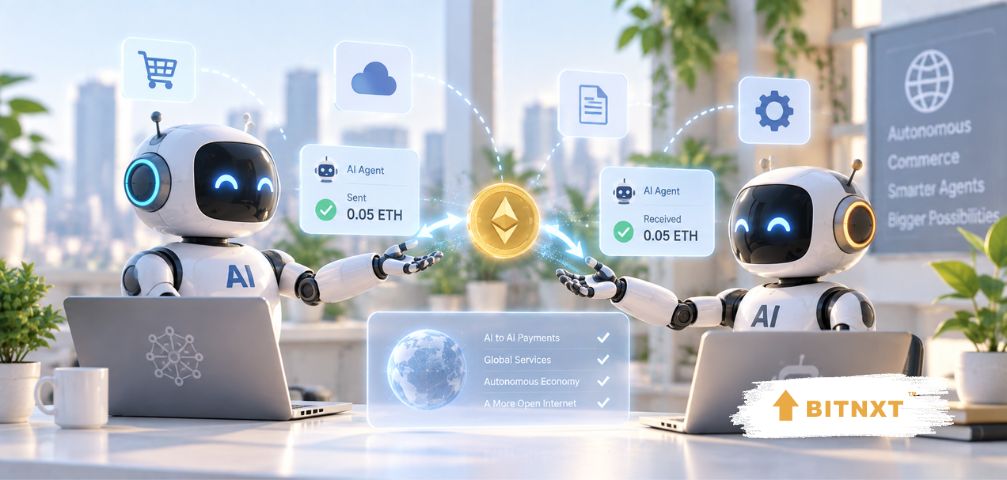
Agent-to-agent commerce is different in kind. It describes a layer where autonomous agents discover counterparties, purchase services from each other, express transaction intent, negotiate terms, execute payment and generate auditable evidence — with no human in the loop at any step.
The stack now has three distinct layers. MCP handles tools. A2A protocols handle communication and delegation, with agents advertising their capabilities through structures like AgentCards. And payment has emerged as an architectural layer in its own right: how one agent actually settles with another for a service rendered.
The moment both sides of a transaction are machines, most of the assumptions embedded in commercial and consumer law stop holding.
The protocol landscape
Protocol | Backers | Role |
x402 | x402 Foundation under the Linux Foundation — Visa, Mastercard, Ripple, Amex, Stripe, Adyen, Shopify, Google, AWS, Cloudflare, Coinbase | Crypto-native agent payments embedded in HTTP requests. The de facto settlement layer for on-chain agent commerce. |
AP2 | Google-led | Agent Payments Protocol covering authorisation and consent across fiat and crypto, using x402 as its crypto payment track. |
MPP | Co-authored by Stripe and Tempo | Machine Payments Protocol — a competing approach from the traditional processor side. |
ERC-8004 | Ethereum Foundation, MetaMask, Google, Coinbase | On-chain identity, reputation and validation registries so agents can price counterparty risk. |
ERC-8183 | Proposed March 2026 | An Ethereum standard for trustless commercial transactions between AI agents, built on operational experience from earlier commerce protocols. |
Note that these are converging rather than purely competing — AP2 uses x402 for crypto settlement. But a practical hurdle remains whether one dominant protocol, or several genuinely interoperable ones, will emerge across platforms and networks.
What happens next: five consequences
1. Negotiation becomes an imbalanced game
This is the most important research finding in the field and it has had almost no coverage.
Academic work benchmarking agent-to-agent negotiation in consumer markets reached a blunt conclusion: A2A negotiation is naturally an imbalanced game, in which users deploying less capable agents face significant financial loss against stronger agents. The researchers also found that anomalous LLM behaviour translates into real economic loss once deployed in live consumer settings.
Think through what that means at scale. If your shopping agent negotiates with a merchant’s agent, and the merchant runs a better model with better tooling and more negotiation-specific training, you lose — quietly, repeatedly, and by an amount you will never see itemised.
Human negotiation has asymmetries too, but they are bounded by attention and time. Machine negotiation has neither constraint. A capability gap that would show up occasionally between two humans becomes a systematic transfer when it runs across every transaction, continuously.
2. Collusion becomes harder to detect
Algorithmic pricing collusion is an established competition-law concern. Agentic commerce makes it materially worse.
Security researchers have flagged that multiple adversarial agents can coordinate to manipulate market prices, run pump-and-dump schemes or corner markets — and critically, that the ability of LLM agents to communicate in natural language makes collusion harder to detect than in traditional algorithmic settings, where coordination requires explicit protocol-level mechanisms.
Conventional detection looks for shared code, synchronised parameters or communication channels. Two agents reaching a coordinated outcome through ordinary-looking natural language leave none of those traces.
3. Machine speed meets irreversible settlement
The combination that makes A2A payments structurally different from anything before them:
Delegated authority — agents interpret natural-language instructions into action, so miscommunication, hallucination and prompt injection can all send a task off the rails.
Machine speed — agents can decide in microseconds, which means payments move far too fast for a human to analyse or intervene before execution.
Irreversibility — settlement happens on-chain, where reversing an incorrect transaction is generally infeasible.
Each of those is manageable alone. Together they remove every conventional recovery mechanism: no time to catch the error, no human to catch it, and no way to undo it afterwards.
4. Nobody owns the chargeback
Existing financial and consumer protection frameworks were built around human-decisioned transactions, and they do not map cleanly onto this. The open questions split into four buckets: authorisation — did the user actually approve this? Identity — is this an agent or a scraper? Fraud — who owns the chargeback? And merchant discovery, where algorithmic ranking can collapse organic channels entirely.
Legal analysts have noted that firms will need to navigate unsettled questions under AI laws, state money transmitter regimes and federal authorisation frameworks simultaneously. A Juniper study in April 2026 identified trust as the number-one barrier to adoption — which, given the above, looks less like squeamishness and more like an accurate read of the situation.
5. Correlated behaviour becomes a systemic question
The IMF has weighed in, and its framing is the most useful institutional analysis available. Payment systems, it argues, must reconcile two fundamentally different design logics: the adaptive, probabilistic nature of agentic AI and the deterministic requirements of financial market infrastructure.
The risk it identifies is not probabilistic reasoning itself, but letting adaptive systems make irreversible payments without proper controls or accountability — with the specific systemic concern being highly correlated automated behaviours across markets.
There is a second-order problem too. Interruption mechanisms are well established in adjacent domains such as algorithmic trading, but those safeguards rely on regulated intermediaries, centralised control and clear institutional accountability. Agentic payments weaken all three assumptions, particularly where agents operate across platforms under delegated authority.
Why this is hard to secure
Academic security work has articulated the core difficulty better than industry commentary has. An autonomous financial agent is simultaneously four things:
FOUR ROLES AT ONCE
An LLM — vulnerable to prompt injection.
A blockchain or payment-network actor — subject to settlement and execution risk.
A financial intermediary — bound by regulatory requirements.
A participant in a multi-agent ecosystem — susceptible to strategic manipulation by other agents.
No existing security framework addresses that full stack of concerns.
Practitioner threat models add the operational specifics: prompt injection redirecting or fabricating payments, identity spoofing where a malicious agent impersonates a trusted one, compromised wallets from weak key management, and rogue agents masquerading as legitimate service providers in marketplaces.
Identity spoofing is the underrated one. Anyone can spin up an agent, and agents delegate tasks to each other — so the question “is the thing requesting this payment who it claims to be” has no default answer. That is precisely the gap ERC-8004 registries exist to fill, and why identity infrastructure matters more than payment infrastructure at this stage.
The design principle everyone is converging on
Across the IMF note, academic literature and production systems, the same answer keeps appearing: separate probabilistic decision-making from deterministic authorisation and settlement.
The agent decides. Something that is not an agent authorises and settles. The IMF frames this as a three-layer structure that lets payment systems benefit from agentic orchestration while keeping robust safeguards around execution. Academic work on agent-to-agent finance calls the same idea bounded autonomy, and argues the decisive design question is how to let agents transact without making markets more opaque, fragile or unaccountable.
In practice that is exactly what scoped session keys, on-chain spending policies and out-of-band circuit breakers implement. The model can be talked into anything; the layer that moves the money cannot be talked into anything, because it does not listen.
What to watch
Protocol convergence. Whether x402, AP2 and MPP genuinely interoperate or fragment into incompatible camps. Fragmentation would delay the whole sector by years.
Negotiation asymmetry entering policy discussion. If agent-versus-agent bargaining systematically transfers value to better-resourced parties, that becomes a consumer protection question, not a technical one.
The first significant dispute. Liability across user, developer, model provider and platform will be settled by a case rather than by consensus, and that case will define the sector.
Competition authorities engaging with LLM-mediated collusion. Detection methods built for algorithmic pricing do not transfer to natural-language coordination.
Whether identity registries get adopted. ERC-8004 and equivalents are the only real answer to agent spoofing, and adoption is the gating factor for trustworthy A2A markets.
The bottom line
The technical question — can agents pay each other with crypto? — is answered. The rails exist, the standards body has the card networks and the hyperscalers in it, and settlement works.
What happens next is not primarily a technology story. It is a question about what happens to markets when both counterparties are probabilistic systems that transact irreversibly, in microseconds, with no human able to intervene and no settled law about who is responsible when it goes wrong.
The optimistic case is that bounded autonomy holds — agents propose, deterministic systems dispose, and machine commerce gets the efficiency without the fragility. The pessimistic case is already visible in the research: negotiation asymmetries that quietly redistribute value, collusion that is harder to detect than anything regulators have faced, and correlated automated behaviour across markets that nobody is currently positioned to interrupt.
Both are plausible. The infrastructure is being built either way, which is why the design decisions being made now — quietly, in standards bodies and smart contract policy layers — matter more than the volume numbers anyone is quoting.
Important
This article is general information about a developing technology and policy area. It is not investment, legal or security advice. Research findings cited are from published academic and industry sources and represent those authors’ conclusions, not settled consensus. Standards referenced may be in draft and subject to change. Systems that allow software to hold and spend funds carry substantial risk including total loss.
Sources
Linux Foundation and x402 Foundation announcements, IMF Notes on agentic AI in payments, published arXiv research on agentic commerce security and agent-to-agent negotiation benchmarking, UCL Institute of Finance and Technology research on agent-to-agent finance, plus analysis from Halborn, Fenwick, Splunk, Eco and Juniper Research.
Bitnxt tracks payment infrastructure, wallets and crypto technology providers across the US, UK, EU and UAE. Explore the directory at bitnxt.io.