





























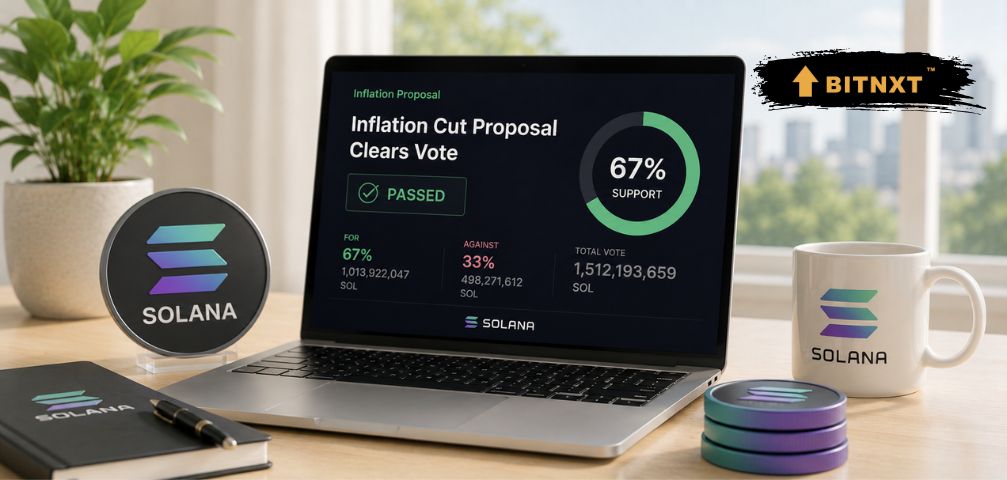
Narrow margin clears two-thirds threshold
Solana's official governance dashboard showed that the proposal, called Double Disinflation, finished voting with 176.29 million SOL in favor, representing 67% of the participating stake. Another 66.19 million SOL, or 25.16%, opposed the proposal, while 20.63 million SOL, or 7.84%, abstained. Voting participation reached 60.7%, representing 433.49 million SOL and exceeding the one-third quorum required under Solana's governance rules.
Under the Solana governance process, a proposal passes when at least one-third of network stake participates and two-thirds of all participating stake votes in favor. Abstentions count toward both participation and the total used to calculate support, leaving the proposal only slightly above the required 66.67% threshold.
The result provides a stake-weighted mandate to proceed with faster disinflation. It does not immediately reduce SOL issuance because a governance proposal establishes the network's preferred direction, while a separate improvement document specifies the technical changes required to carry it out.
Faster path to terminal inflation rate
The technical proposal would increase the rate at which SOL inflation declines each year from 15% to 30%. Rather than cutting the current inflation rate in half at once, the change would make inflation fall twice as fast from its level when the change becomes active. Solana would reach its existing terminal inflation rate of 1.5% in about 2.8 years, compared with 5.7 years under the current schedule.
The authors estimate that the change would remove 18.9 million SOL from projected issuance over six years, or about 2.6% of the supply expected under the present schedule. Developers designed the change to keep issuance continuous at activation, re-anchoring the inflation formula at the activation slot to prevent an immediate drop in the rate or a retroactive change to rewards already earned.
Before mainnet activation, validator clients must add and support a feature gate. The technical document says the feature would activate at an epoch boundary, with the faster schedule applying to rewards from the following epoch. Because inflation rewards affect Solana's bank capitalization and bank hash, every validator client must calculate the new schedule in the same way to avoid conflicting network states.
Resource-fee proposal fails to pass
Alongside the disinflation vote, Solana voters rejected the Resource and Inclusion Fee proposal despite 61.14% participation. The final tally showed 53.9% support, 18.92% opposition, and 27.18% abstentions. Support fell almost 13 percentage points below the two-thirds threshold.
The failed proposal would have replaced Solana's flat base-fee model with a 2,500-lamport inclusion fee and a separate charge based on the resources requested by each transaction. Validators would receive the inclusion and priority fees, while the protocol would burn the full resource-based portion. Using May 2026 network activity, its authors estimated daily burns of 1,500 to 9,000 SOL depending on the stage, compared with approximately 648 SOL per day currently burned through the flat fee.
Even at the highest proposed rate, the added burn would equal about 0.5% of supply annually against an inflation rate of roughly 3.8%. The proposal therefore did not project that the fee model alone would make SOL a net-deflationary asset. Transaction costs would also have varied according to requested network resources, with one example Pump.fun swap facing a potential increase of 3,150%.
Institutional concerns about staking income
Opposition to both proposals included Solana Company, a Nasdaq-listed digital asset treasury firm trading under the ticker HSDT. In an Aug. 21 statement, the company said it supported lower issuance and resource-based fees as long-term goals but opposed changing two established economic parameters during Solana's first formal governance cycle. The company said institutions rely on stable staking yields and predictable transaction costs when preparing forecasts, audited reports and operating budgets.
Solana previously considered a competing proposal that linked emissions to staking participation instead of following a fixed reduction schedule. That proposal failed to reach quorum in March 2025 after validators raised concerns about staking income, validator economics and the complexity of the model. The approved disinflation proposal uses a fixed schedule that does not respond to changes in staking participation, preserving a predictable inflation path while avoiding a sudden reduction that could place immediate pressure on validator revenue.


