





























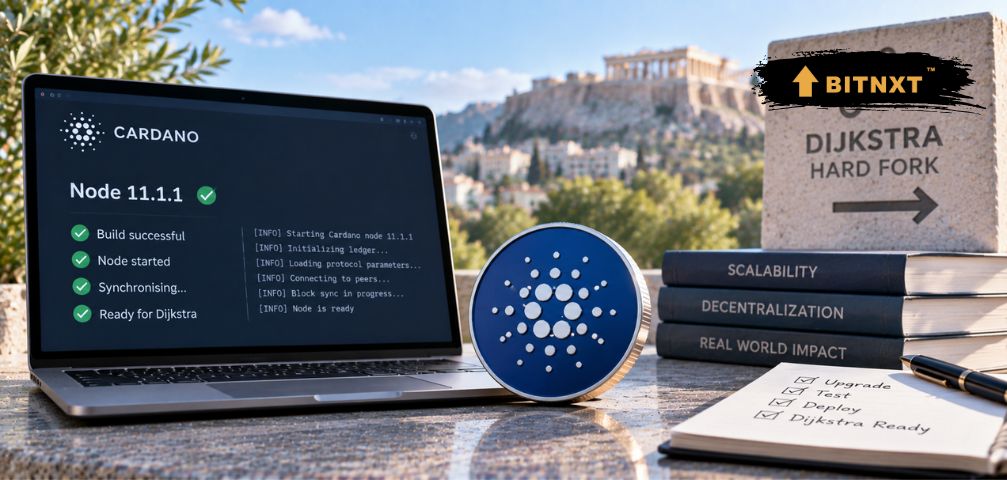
Cardano's Dijkstra upgrade now has a countdown you can actually track: node 11.1.1 shipped early, landing in Intersect's container registry over the weekend ending Sept. 6, ahead of the targeted week. It is the first of four software milestones before the hard fork that activates protocol version 12, and the release is pure maintenance, which is exactly what you want to see at step one.
The changelog is operational, not glamorous. Version 11.1.1 removes Cardano's legacy tracing infrastructure, fixes known Genesis-related operational issues and resolves the higher resident memory usage flagged in node 11.1.0 benchmarks. Builds are available in standard, AMD64 and ARM64 flavors via Intersect's GitHub registry. The ARM64 support matters more than it sounds: lower-power stake pool operators stay viable as requirements grow, a small vote against the node centralization that quietly kills small validators on other chains.
"What does Dijkstra ask of you now? Good news, there is time to find out and prepare properly." — Intersect (@IntersectMBO), September 7, 2026
The Road to Protocol Version 12
The sequence from here is public. Node 11.2, expected within about a month, introduces most Dijkstra ledger features for public testing, minus the Leios consensus pieces. Node 11.3, one to two months out, becomes the hard-fork release candidate combining full Dijkstra with Linear Leios. Node 12.0 is the enactment release. Intersect frames a Dec 5-Jan 4 window at "moderate confidence" and Feb 24-March 26 at high confidence, honest labeling for an industry that usually ships dates as promises. Dijkstra itself brings Plutus V4, Nested Transactions that encapsulate other transactions with independent validation, and CIP-50's revised pledge and reward economics. Testing splits across two parallel testnets: DijkstraNet for ledger rules and Plutus V4, MusashiNet for Leios consensus, isolation that keeps a smart-contract bug from stalling consensus work, the same separation discipline Ethereum is applying to its own redesign.
Two cautions. Node 11.1.1 activates nothing: Dijkstra's ledger rules stay dormant until DReps and SPOs approve the on-chain governance motion, plus constitutional parameter updates in the Amendment Portal. Code readiness could outpace governance if DReps fight over CIP-50's reward redistribution, the gap that has stalled upgrades on chains with more hubris than process, and the reason transitions like Pi Network's protocol vote drag for months.
Watch node 11.2's public testnet window and the DReps' first formal debate on CIP-50. Those two signals tell you whether the December window survives contact with Cardano's governance, or whether Dijkstra becomes a 2027 story.


