






























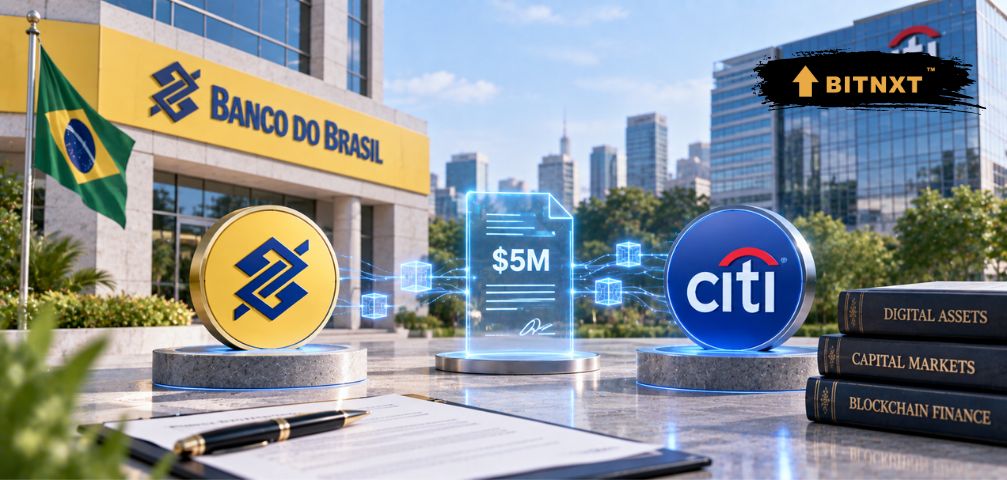
Banco do Brasil has made its first digital note investment, placing $5 million of proprietary treasury money into a structured note issued by Citi on Euroclear's blockchain platform — a deal the bank describes as the first of its kind by a Latin American institution, and a signal that native digital securities are moving from experiments to treasury allocations.
The transaction saw Banco do Brasil invest in a Digitally Native Structured Note issued by Citigroup Global Markets Funding Luxembourg SCA on Euroclear's Digital Financial Market Infrastructure, with Citi Issuer Services — through Citibank N.A.'s London branch — serving as issuance and payment agent. Unlike tokenized wrappers created after the fact, the note was digital from birth: issued, registered and managed entirely through the blockchain-based platform, which the bank says can reduce operational steps while giving participants greater visibility over transaction records.
What makes a digital note different
The distinction matters more than the size. Conventional securities rely on separate systems and intermediaries handling issuance, registration, reconciliation, settlement and recordkeeping — information passes between platforms as a transaction moves through its lifecycle. Under the D-FMI model, participants share a common digital record, and Banco do Brasil says that can make settlement, reconciliation and asset management faster and more efficient while increasing transparency and traceability. The distinction between digitally native securities and later-tokenized products has become a central industry debate, because some tokenized instruments merely track an asset's economic value without ownership rights — the exact controversy AMC's CEO just raised over Robinhood's stock tokens. A note born onchain carries its issuance record with it from the start.
Executives on both sides framed the deal as infrastructure-building. "We believe that the digitalization of financial markets represents a long-term structural trend," said Francisco Lassalvia, vice president of Wholesale Banking at Banco do Brasil, adding that transactions of this type help establish standards, governance systems and infrastructure for a new generation of digital assets. Citi's Roksolana Dushynska, Global Markets Issuance Equity Structuring Manager, said the issuance "reinforces the role Citi is playing in accelerating the growth of digital capital markets," with the bank intending to keep developing models that use the technology to improve efficiency, transparency and accessibility.
The bigger pattern behind the deal
Banco do Brasil's investment lands inside a rapidly consolidating institutional blockchain stack. Circle is preparing an institutional chain whose founding validators include BlackRock, DTCC, Visa, Mastercard, Standard Chartered and Intercontinental Exchange, with DTCC planning to tokenize DTC-custodied assets on it beginning in 2027 and BlackRock expected to deploy its tokenized BUIDL fund on the same network. Bottomline connected its $16 trillion payments network to blockchains through Chainlink, and SoFi and Kraken just fused banking rails with crypto rails — each integration attacks a different layer of the same problem, and Euroclear's D-FMI is the post-trade layer's answer.
The Latin American angle deserves its own emphasis. The region has often been cast as a follower in institutional digital assets; a state-controlled Brazilian bank allocating treasury capital to a natively digital instrument — validated by Euroclear's post-trade machinery and Citi's structuring desk — moves Brazil into the early-adopter column alongside the usual Basel and Wall Street names. Brazil's central bank is separately preparing a crypto monitoring system after a major cyberattack, evidence that the institutional buildout and the regulatory response are advancing together. Retail access keeps expanding in parallel, but the Banco do Brasil deal is the more strategic milestone: when a national champion's treasury treats blockchain-issued paper as a routine $5 million allocation, the technology stops being a pilot and starts being a market.


