




























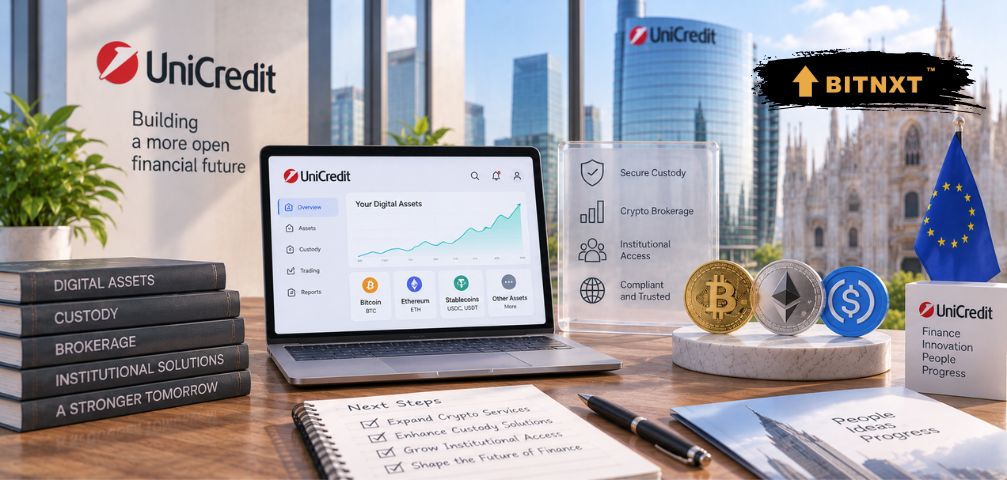
UniCredit crypto custody plans have quietly graduated from isolated experiments to a full-stack institutional build, and the vendor selection now underway is the tell. Italy's largest bank is actively choosing a third-party technology provider to construct enterprise digital asset infrastructure spanning crypto custody, brokerage execution for buying and selling, tokenized investments, tokenized fixed-income securities, and stablecoin services offered directly to bank clients. No vendor has been chosen, the budget is undisclosed, and a spokesperson officially declined to comment, but the scope itself is the news: this is not another structured note. It is core commercial banking infrastructure, announced the same week UniCredit acquired a minority stake in VC Trade, a German digital lending platform, to deepen its digital capital markets reach.
The shift is easy to underread. UniCredit's crypto history so far was deliberately cautious: a July 2025 five-year dollar-denominated structured product tied to BlackRock's iShares Bitcoin Trust ETF, with 100% capital protection, sold to Italian professional clients, and a tokenized minibond in late 2025. Those were products. Custody, brokerage, and stablecoin rails are plumbing, the difference between offering a Bitcoin-adjacent note and operating digital asset services as a permanent business line, a normalization signal consistent with what institutional analysts have tracked from the IBIT complex's own growth pains to Asian banks tokenizing securities on public chains.
How UniCredit Crypto Custody Fits the Qivalis MiCA Stack
The consortium context makes the move coherent. UniCredit is a founding member of Qivalis, the euro stablecoin consortium that expanded in May 2026 from 10 to 37 banks across 15 European countries, adding ABN AMRO, Rabobank, Nordea, and Intesa Sanpaolo to founders including BNP Paribas, ING, Banca Sella, KBC, DekaBank, Danske Bank, SEB, CaixaBank, and Raiffeisen Bank International. Qivalis selected Fireblocks in April for tokenization and wallet infrastructure and targets an H2 2026 launch under Dutch Central Bank supervision. Add UniCredit's own custody and brokerage stack and the bank gains vertical coverage of the entire digital asset chain, issuance through Qivalis, custody and brokerage through the new build, and tokenized capital markets through VC Trade, all under the uniform EU CASP rules that MiCA finally gave the continent. Peer benchmarking supports the urgency: Banca Sella has already obtained Bank of Italy approval for crypto custody and transfer via MiCA notification, and no tier-1 lender wants to buy that capability late.
The Risk Note the Bank's Own Chair Wrote
The honest counterweight comes from inside UniCredit. Deputy Vice Chair and board risk chair Elena Carletti warned in May that Europe could face deposit stress from crypto reserve flight, citing SVB's 2023 collapse, where $3.3 billion of USDC reserves burned with the bank, and noting that "European authorities could have fewer options to provide similar protection because EU deposit insurance is capped at €100,000." The bank building the continent's most complete institutional crypto stack is the same bank whose risk chair flagged that MiCA compliance does not solve what happens when depositors run. That tension, build the business, insure the downside, is the real state of European bank crypto strategy, and the vendor UniCredit picks will tell us which side is winning: a custody-native specialist implies commitment; a bolt-on white label implies hedging.
Watch the vendor announcement and the Qivalis launch window in H2 2026. If both land before year-end, Europe's tier-1 banking layer goes fully live on digital assets with UniCredit holding rails at every layer. That is a structural shift, announced one procurement decision at a time.


