





























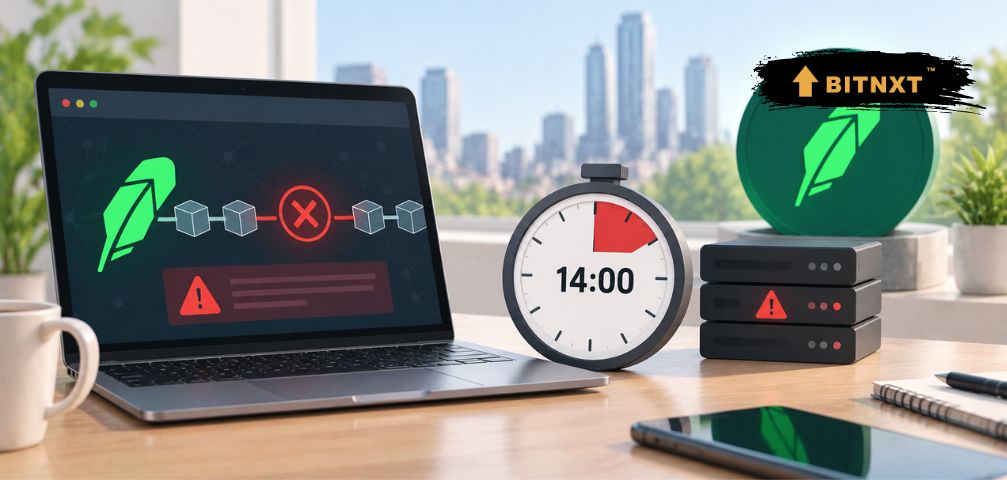
Robinhood Chain went dark for more than 14 minutes when its sequencer stopped producing blocks at around 12:57 p.m. UTC — a brief but pointed outage for a two-month-old network that had been selling itself as the institutional-grade home for tokenized stocks, and a reminder that "blockchain" and "uninterrupted" are not yet synonyms.
Block explorer data showed the Ethereum layer-2 network stuck at the same block height while new transactions kept appearing and piling up unconfirmed. Transfers, smart contract calls and router interactions could not move forward until production resumed intermittently. News aggregator Aggr News was among the first to flag it:
"ROBINHOOD CHAIN GOES DOWN, NO NEW BLOCKS PRODUCING." — Aggr News (@AggrNews), September 4, 2026
Robinhood did not disclose the cause, publish a technical account, or list an incident on its main status page — leaving the explorer as the only public source of truth. No report indicated lost balances, and the halt affected the chain, not Robinhood's brokerage, where stocks, ETFs and options operated normally.
Why 14 minutes matters on Robinhood Chain
The arithmetic makes the halt more significant than its duration suggests. Robinhood Chain normally produces a block every 100 milliseconds — a 14-minute stop represents roughly 8,400 expected block intervals without production. The architecture explains the failure mode: the chain is built with Arbitrum Orbit technology, runs transactions off Ethereum's main execution layer, and depends on a sequencer to order transactions and produce blocks. When the sequencer stops, users can submit transactions, but nothing confirms or settles until it returns. That is the structural criticism every centralized-sequencer L2 lives with — the same design that delivers 100-millisecond finality delivers a single point of failure. For DeFi users, blocked production means no swaps, no collateral transfers, no loan repayments and no smart contract interaction, even while wallets keep displaying old balances.
The outage lands at a delicate moment for the network's growth story. Robinhood Chain launched July 1 with 95 tokenized stocks and wallet access in more than 120 countries; by late August it had recorded $945 million in daily DEX volume, $47 billion cumulative, and roughly $1.4 billion in total value locked, ranking fifth among tracked networks by 30-day volume. That volume surge made it a genuine Solana challenger, its stock tokens have made it legally conspicuous, and its DeFi economy is generating real fee revenue — all of which raises the cost of every stopped block. Bernstein maintains an Outperform rating on Robinhood Markets partly on these chain metrics; infrastructure that institutionalizes tokenized equities has to institutionalize uptime too.
What the halt does and doesn't say
The market reaction was real but ambiguous. HOOD shares opened at $120.48 after closing Thursday at $124.72 — itself a 16.6% rally — traded as low as $118.30, a 5.1% decline, then recovered to around $122.81, cutting the daily loss to about 1.5% on volume of 13.96 million shares. The stock had traded near $120 in premarket before outage reports circulated, so available data does not establish the chain halt caused the decline. The honest read: a 14-minute sequencer stop is a small operational event and a large symbolic one.
Symbolic, because the industry's pitch for tokenized stocks is that blockchains remove settlement risk and single points of failure — and the most visible stock-token chain just demonstrated it can simply pause. Robinhood's response will be watched as closely as the incident: competitors including the major L2s publish post-mortems within days; silence leaves regulators and partners to imagine worse. The chain's users also have a calendar marker — Robinhood's 90-day gas subsidy for wallet users ends around Sept. 29, right as the network tries to convert a launch honeymoon into durable infrastructure. Uptime is the product now. The next outage, whenever it comes, will be measured against this one — and against the growing pile of value sitting on a network that just showed everyone where its single point of failure lives.


