





























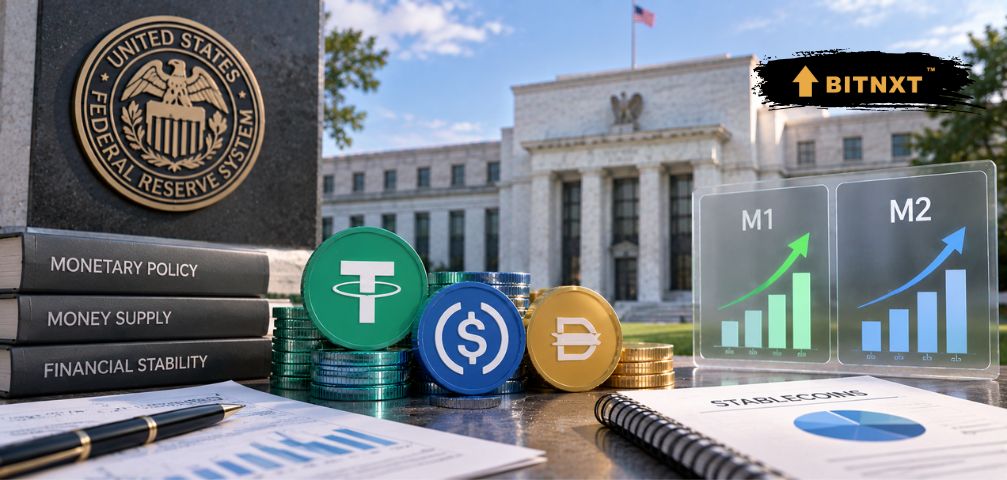
Two Federal Reserve researchers just asked the question central banks have been dodging: should stablecoins be counted in the money supply? Kristen Payne and Mary-Frances Styczynski published a paper Sept. 4 evaluating whether payment stablecoins, tokenized bank deposits and tokenized money market funds belong in M1 or M2, and their framework has consequences for every dollar-pegged issuer, whether the Fed adopts it or not.
The classification logic is straightforward. M1 holds transaction assets used as a medium of exchange; M2 holds savings-like stores of value. A payment stablecoin settles instantly on-chain, arguably more liquid than a demand deposit, so its dominant use should decide its bucket: transactions make it M1, trading and yield parking make it M2. The authors propose observing behavior before assigning, and they stress the paper reflects personal views, not a Fed policy decision or active deliberation.
The double-counting trap at the center of the stablecoin debate
The technical heart of the paper is an accounting trap. If a stablecoin's reserves sit in commercial bank deposits, those deposits are already counted in M1. Add the stablecoin itself and the same dollar is counted twice. The same applies to reserves parked in retail money market funds already inside M2. The only reserve composition that avoids the double count is Treasury bills, which sit outside both aggregates. Read that again slowly, because it is effectively an accounting incentive: a Fed that wants clean monetary aggregates should prefer stablecoins backed entirely by T-bills, and issuers seeking future legitimacy have a reason to comply. Bank consortium coins with deposit-based reserves would face the opposite pressure, which is a strange outcome for products marketed as the system-friendly option.
The paper also sorts the neighbors. Tokenized bank deposits are already captured in M1 as checking accounts; tokenizing them adds no new money, just new plumbing. Tokenized money market funds belong in M2, and their yield flows to shareholders, unlike stablecoins where the issuer keeps the reserve income, a distinction the authors flag without moralizing.
Why this paper matters if the Fed does nothing
Now the skepticism. The Fed has initiated no formal change, the 2020 precedent, when savings deposits moved into M1 after regulatory changes, took rule changes first, and the data problems are severe: public blockchains cannot separate US domestic circulation from global usage, so a US money aggregate would have to count dollars held in Lagos and Lahore. The GENIUS Act's disclosure standards and the OCC's pending reserve rulemaking are unfinished, leaving issuer reporting unstandardized. By the authors' own caveats, the measurement project may be impossible to execute cleanly.
But the paper still moves the ball. It gives the Treasury-bill reserve structure an intellectual endorsement that the OCC-chartered banking wave and expanding issuers like Paxos will cite, and it puts on the record that stablecoins are, functionally, privately issued money. That framing, not the statistics, is the thing regulators will fight over for the next decade. Watch the H.6 release language and the OCC's reserve rules. If either moves toward issuer-reported geographic data, this paper was the starting gun, and the stablecoin industry gets the one thing it has never had: a central bank obliged to think about it as money.


