





























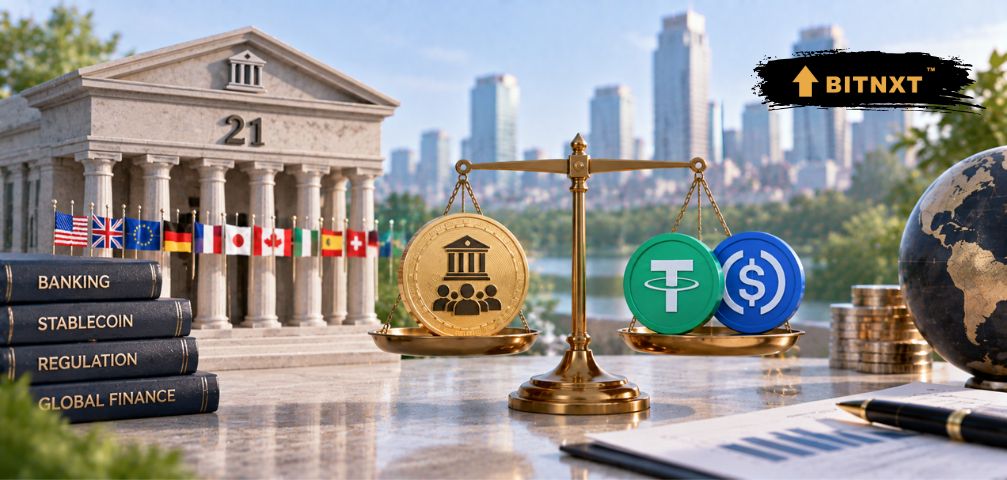
The 21-bank stablecoin planned by Bank of America, Citi, Goldman Sachs, Deutsche Bank, UBS and their peers will launch with advantages no crypto issuer can buy — regulatory resources, corporate relationships, and international payment rails across four continents. But four industry executives told crypto.news the same thing in different words: bank backing buys distribution, and only liquidity, portability and redemption determine whether the 21-bank stablecoin circulates beyond its members' own networks.
The consortium committed on Sept. 1 to establish a stablecoin company during the second half of 2026, subject to closing conditions, and intends to launch a US dollar-denominated token in the first half of 2027, with a euro product named as the first expansion priority. What it has not disclosed is equally telling: no token name, no supported blockchains, no reserve custodian, no governance model, no redemption process. Those blanks are where the executives focused their skepticism.
Distribution is the bank stablecoin's real asset
Utkarsh Ahuja, founder of Moon Pursuit Capital, put the advantage plainly: "The banks start with something that normally takes a financial product years to build: distribution into the companies that actually move very large amounts of money." The participating institutions already serve corporate treasury departments, process cross-border payments and run compliance systems across jurisdictions — the token could slide into existing workflows. But Ahuja's caveat matches the consensus: established relationships do not provide the portability USDT and USDC built across exchanges, wallets, blockchains and market makers. Bringing corporate clients to the token is the easy half; convincing them to use it outside the member banks' perimeter is the hard part.
Jerald David, CEO of Lynq Network, read the motive as both offense and defense: opening blockchain payment revenue while protecting deposits from migrating to non-bank issuers who earn the reserve income on circulating tokens. His operating warning applies to any consortium design: "Interoperability will be more important than issuance. If capital can enter the token easily but cannot move out or across networks just as efficiently, the consortium risks creating another isolated pool of liquidity." An institution receiving the token must be able to redeem it for dollars or exchange it without delays, spreads or thin depth — the exact properties USDT and USDC spent a decade earning the hard way. Business banking rails are moving onchain from every direction, and coalition models like USDG are already shipping while the banks remain in formation.
The warning from Société Générale
The strongest reality check is already onchain. Société Générale's digital asset subsidiary launched USD CoinVertible on Ethereum and Solana in 2025 — a stablecoin from a major global bank with full regulatory pedigree. Its circulating supply as of Sept. 4: approximately $12.55 million. Waseem Salim, CEO of Valdora, drew the lesson: institutional backing provides initial trust, but utility determines whether people continue to hold and use a stablecoin. The benchmark it must climb is enormous — the stablecoin market stands at roughly $316 billion, with USDT near $187 billion and USDC around $75 billion.
Alvin Kan, COO of Bitget Wallet, described the wallet side of the bar: providers will need audited smart contracts, transparent redemption, consistent standards across every supported chain, and preferably native mint-and-burn issuance rather than wrapped assets that split liquidity across bridges. Gas abstraction matters too — users will not adopt a dollar token that requires buying another chain's asset just to move it — and reusable identity credentials could prevent re-verification for every issuer. "Ultimately, interoperability will matter more than how many bank tokens get issued," Kan said. "The winning infrastructure will make multiple tokens feel like one connected financial system."
The GENIUS Act and MiCA compliance intent gives the venture a regulatory lane the crypto-native issuers lacked at launch, and the banking-charter wave is building parallel infrastructure. But the executives' collective message is unsentimental: a consortium can legislate itself a balance sheet, not a network effect. USDT and USDC could lose share while bank tokens expand the total market — both outcomes can be true — and the first half of 2027 will show whether 21 logos can do what one exchange, one issuer, and one decade of uptime already did. The fusion of banking rails and crypto rails is no longer a question; the only question is whose token rides them.


