





























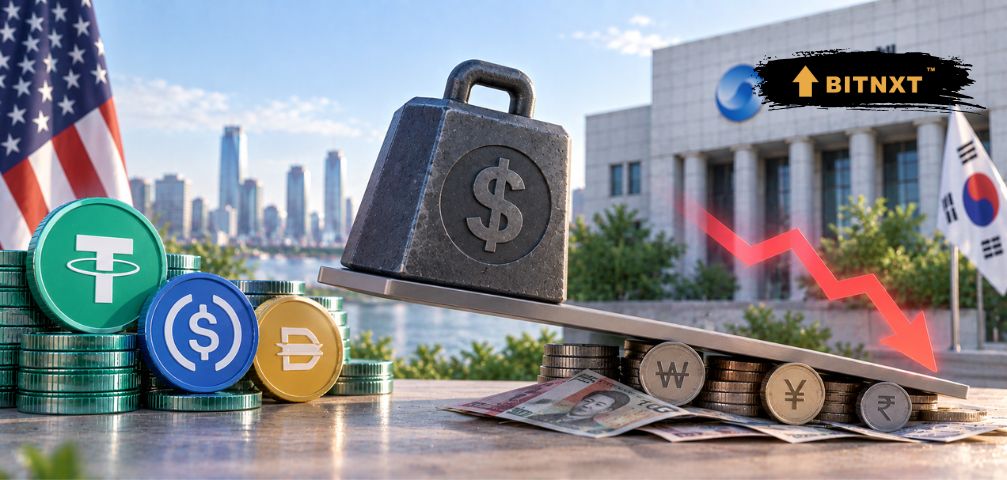
Dollar stablecoins can push local currencies lower, and the Bank of Korea has the data to prove it. A BOK study published Sept. 3, authored by researchers Jihyun Kim and Sangheum Cho, examined 12 national currencies across exchange pairing events from 2019 to 2025 and found a working transmission channel: the moment Binance listed direct trading pairs between local fiat and dollar stablecoins, local stablecoin premiums fell by 0.33 to 0.38 percentage points, and part of that buying pressure moved into the exchange rate instead.
The mechanism is the useful part. In an insulated market, stablecoin demand just raises the local premium, the gap between domestic stablecoin prices and global rates. Once global market makers gain direct fiat pairs, they sell USD stablecoins for local currency, then sell that local currency in FX markets to hedge, and the local currency takes the hit. The study's sharpest data point: a one-standard-deviation increase in Google searches for "Bitcoin," its proxy for crypto demand, was associated with a 0.118% depreciation of the Brazilian real and a 0.109 percentage point rise in Brazil's domestic stablecoin premium. Retail enthusiasm for crypto literally becomes emerging-market selling pressure through market-maker hedging.
What the BOK study does and doesn't prove
The researchers are careful, and so should you be. Stablecoin demand does not automatically cause depreciation; the effect requires direct pairs and global intermediary access. South Korea itself showed no measurable won depreciation in the sample, because Binance lacked a direct KRW-stablecoin pair, so Korean demand shocks were absorbed entirely by domestic premiums. The Google search proxy captures general risk sentiment, not isolated crypto demand, and Tether's adoption claims in inflation markets remain company assertions. The study measures a channel, not a catastrophe.
But the channel is the story for anyone weighing a domestic stablecoin strategy. Won-denominated stablecoin purchases reached roughly 4 billion in the twelve months through June 2025, per Chainalysis data cited in the study, making South Korea Asia-Pacific's largest local-currency stablecoin market, which is precisely why the BOK is nervous. The bank backs bank-led won stablecoin consortiums while lawmakers draft the Digital Asset Basic Act, and the implicit bet is that a regulated won token captures demand without the FX leakage. The study's own findings question that logic: if domestic demand is fundamentally flight into dollar assets, a won stablecoin is a bucket with a hole.
The uncomfortable global read
Zoom out and the pattern is not a Korea story. Dollar stablecoin liquidity keeps deepening globally, consortium stablecoins keep launching, and dollar-denominated accounts keep expanding, all of which extends the reach of the exact mechanism the BOK measured. An offshore exchange's listing decision can now transmit monetary pressure into a country's currency faster than most central banks can respond, which is why the study matters more than its modest coefficients suggest.
The thing to watch is which emerging markets get direct fiat pairs next. Each listing is now an involuntary monetary experiment, and the BOK has handed regulators the methodology to measure it. The countries that pair first will provide the stress tests, and the won's insulated premium structure will show whether the escape hatch, refusing the pair, is still politically available once citizens discover the offshore version anyway.


