Six feeds cover three key U.S. economic indicators
The program covers real gross domestic product, the Personal Consumption Expenditures Price Index, and Real Final Sales to Private Domestic Purchasers. Each indicator is available through two feeds: one reports the current level, while the other shows its quarter-over-quarter change at an annualized rate. Real GDP measures the value of goods and services produced in the United States after adjusting for inflation, with the level feed reporting the figure in billions of chained 2017 dollars.
The PCE Price Index tracks changes in the prices U.S. consumers pay for goods and services. The Federal Reserve uses PCE data as its preferred inflation measure when assessing progress toward its 2% target, making the releases closely watched by investors across stocks, bonds, currencies and digital assets. Chainlink's PCE feeds provide both the headline index level, with 2017 set as the base year, and the quarter-over-quarter annualized change.
Real Final Sales to Private Domestic Purchasers, the third indicator, measures inflation-adjusted spending by consumers and private businesses. By excluding government spending, exports, and inventory changes, the figure provides a focused measure of private domestic demand. Its two feeds follow the same structure used for GDP: one reports the level in chained 2017 dollars, and the other gives the annualized quarterly rate of change.
Ten blockchains initially support the data feeds
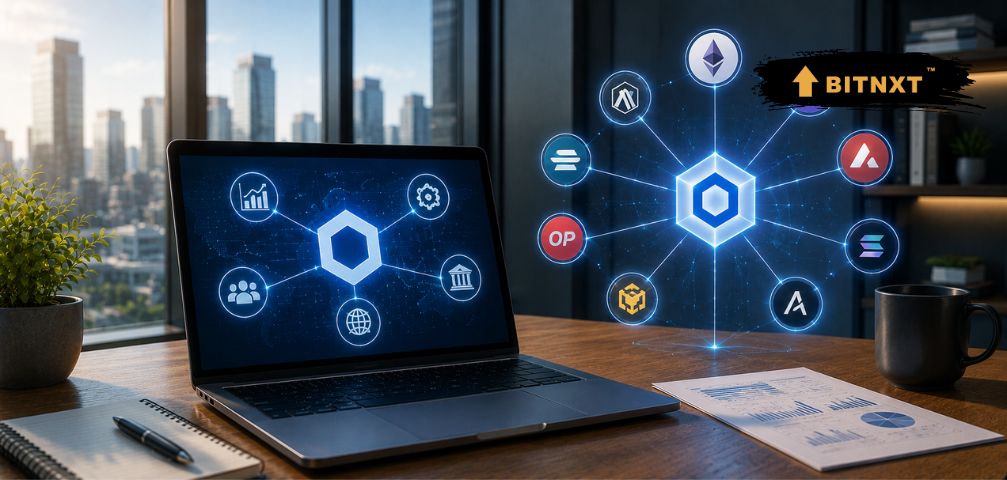
Data is initially available on Ethereum, Arbitrum, Avalanche, Base, Botanix, Linea, Mantle, Optimism, Sonic, and ZKsync. Chainlink said support for other networks can be added in response to user demand. Chainlink updates the six feeds monthly or quarterly, depending on when the Bureau of Economic Analysis releases the underlying figures.
Although Chainlink drew fresh attention to the arrangement in a recent post, the feeds were first announced in August 2025. The Commerce Department worked with both Chainlink and Pyth Network at the time, using the two oracle providers to place selected BEA data on public blockchains. The data feeds do not release economic statistics earlier than the government's usual publication channels. Updates follow the BEA schedule, meaning onchain users receive the same underlying figures released to the public through official reports.
Government data can support automated onchain products
Oracle networks connect blockchains with information created outside their systems. Smart contracts cannot retrieve government statistics on their own, so an oracle provides the data in a format that blockchain applications can read and use. According to Chainlink, direct access to BEA figures could support inflation-linked digital assets, prediction markets, perpetual futures, and automated trading products.
Developers may also use the feeds to build dashboards or adjust risk settings in decentralized finance protocols after a new economic report is published. A prediction market, for example, could use an official feed to settle a contract tied to quarterly GDP growth. An inflation-linked product could reference the PCE Price Index, while a lending protocol could incorporate changes in private demand into a predefined risk model.
Chainlink identified each of those areas as a possible use rather than a product already launched through the Commerce Department arrangement. Chainlink said its feed infrastructure has received ISO 27001 certification and a SOC 2 Type 1 attestation. Such credentials concern the controls and information-security processes supporting the service; they do not remove the need for individual applications to manage smart-contract, market, and data-integration risks.
Commerce Department blockchain program expands
The Chainlink feeds form one part of the Commerce Department's blockchain data program. In August 2025, the department separately published second-quarter U.S. GDP information across nine networks, including Bitcoin, Ethereum and Solana. The agency published a cryptographic hash of its full report and the reported 3.3% annualized GDP growth rate.
Coinbase, Gemini, and Kraken helped distribute the information, while Chainlink and Pyth supported other parts of the program. Commerce Secretary Howard Lutnick described the initiative as a way to make U.S. economic information globally accessible and resistant to alteration, saying the government was making America's economic truth immutable and globally accessible like never before.
Chainlink has also extended its data infrastructure to tokenized stocks and other real-world assets. On Aug. 26, the company introduced price feeds for Coinbase-issued versions of Nvidia, Apple, Meta, and Alphabet shares on Base. The NVDAc, AAPLc, METAc, and GOOGLc feeds allow lending applications to calculate collateral values, borrowing limits, loan health, and liquidation thresholds. The expansion from tokenized stocks to government economic data reflects a broader push to bring institutional-grade data onchain.