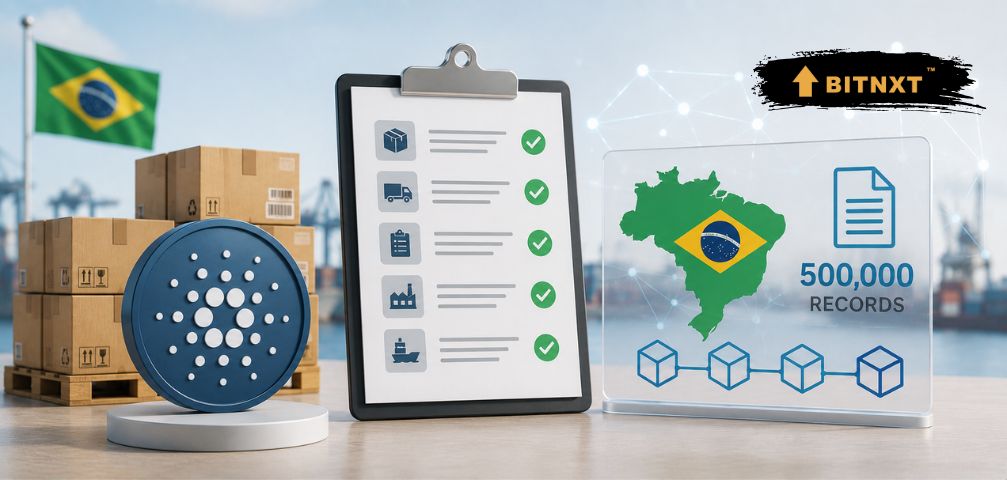
Cardano has emerged as a public verification layer for more than 500,000 enterprise supply chain records, according to an announcement from the Cardano Foundation and Brazilian technology company Blockforce on August 31. The production deployment highlights a practical enterprise use case for blockchain technology beyond market prices and speculation. The Cardano supply chain system uses a dual-ledger architecture, with Blockforce recording individual supply chain events on a permissioned network accessible only to authorized companies, suppliers, and participants. For every record, the platform creates a cryptographic proof and anchors it to Cardano’s public blockchain, allowing anyone to independently verify that the information existed and has not been modified.
Why supply chain records need a public layer
The design resolves a familiar problem in enterprise blockchain projects: companies may need independent verification without publishing supplier identities, prices or contracts on a public ledger. An auditor or regulator can compare a supplied record against its public Cardano proof to establish whether the record has changed since anchoring. The architecture does not verify whether the information entered into the private system was accurate in the first place — data quality still depends on source documents and validation procedures — but it provides tamper-evidence at scale.
The flagship customer is Azzas 2154, described by the partners as Latin America's largest fashion group, which applies the system to leather traceability by combining fiscal documents, supplier information and official public databases into an auditable product history. The group has set a corporate target of tracing 100% of the leather used across its brands by 2030. The commercial pressure is external as well: the European Union's Ecodesign for Sustainable Products Regulation is establishing Digital Product Passports for priority categories including textiles and apparel, giving exporters a reason to invest in verifiable product records.
Cardano anchoring costs fell 92% through batching
Publishing an individual blockchain transaction for every supply chain event would be prohibitively expensive at enterprise volumes, so the partners attacked the cost problem directly: joint engineering work reduced the public anchoring cost per record by 92%, achieved by batching certificates before anchoring them to Cardano through Blockforce's uVerify system. The 92% figure comes from the project partners and has not been supported by a publicly disclosed independent audit, and the announcement did not provide the original cost or per-certificate pricing — but the reported 500,000-record deployment moves the project beyond prototype territory into a live, revenue-bearing operation.
The partners said signed contracts cover 6.5 million certified records through 2030 — contracted future activity rather than processed volume — and Blockforce plans to expand the architecture into automotive manufacturing, agribusiness, pharmaceuticals and cosmetics. Execution depends on companies supplying consistent source data and integrating existing documentation systems with the permissioned network, and auditors will need tools for retrieving records and comparing them against Cardano proofs as the deployment scales.
What it means for Cardano
For a network long criticized for favoring research papers over shipped products, the deployment offers something rare: a named corporate customer, a measurable milestone and a cost-reduction story that explains why a company would choose this design over a purely private blockchain, where verification depends on trusting the same parties being audited. BIS researchers tested similar proof-anchoring logic on the XRP Ledger this week, and enterprise adoption is pulling blockchains into unglamorous back-office work — supply chains, records and receipts.
The next measurable milestone is progress from 500,000 anchored records toward the contracted 6.5 million. If the trajectory holds, Cardano's most important product of 2026 may not be a protocol upgrade at all — it may be the receipts.