





























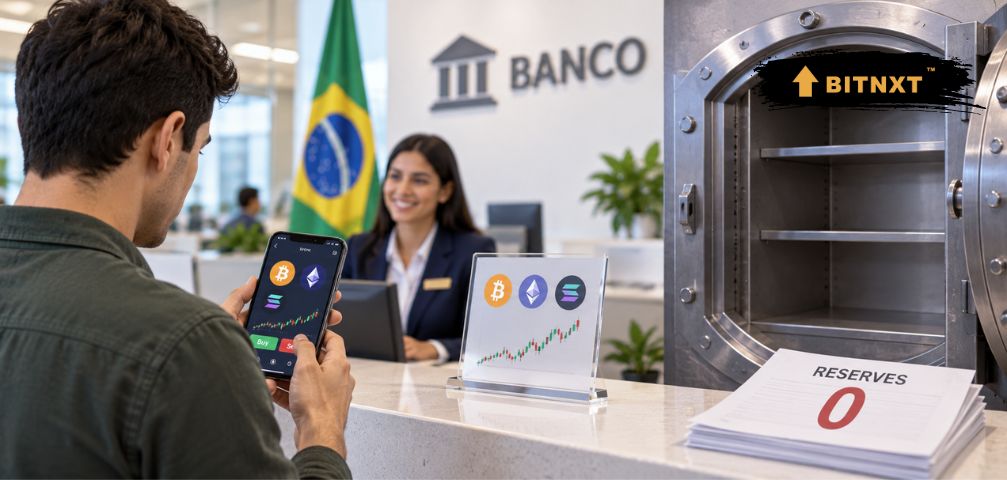
Brazilian banks will sell you crypto all day. They just will not hold any. Central Bank filings from March 2026 confirm every major bank's balance sheet shows zero virtual assets, even as the country's crypto trading volume hit R$505.5 billion, about $98.7 billion, in 2025, up 22% from 2024 and 433% from 2020. The custodian-and-broker model is not a compromise; it is the strategy.
The institutional build-out is broad. Itau Unibanco offers 15 crypto assets including BTC, ETH and USDC on its investment platform. Nubank lists 28 digital assets for more than 7 million crypto platform users. Banco do Brasil launched BTC and ETH buying in January 2026 and has processed over R$11 million in trades, a number it published days after making its first tokenized note investment with Citi. Banco Safra went further, launching its own Safra Dolar stablecoin in September 2025 for high-net-worth clients with in-house dollar custody, a smaller-scale echo of the 21-bank stablecoin consortium.
Zero Exposure, Zero Missed Fees
The zero-holdings posture is consistent with resolutions 519, 520 and 521 from November 2025, which require roughly 120 crypto firms to secure Central Bank licensing by Oct. 30, 2026, with asset segregation, minimum capital and governance mandates. Under that regime, a bank acting as intermediary captures fees without ever pricing crypto risk onto its book, and every custody failure becomes someone else's regulatory problem. Receita Federal's own data shows corporates generated R$497 billion, 98.3% of volume, with retail at just 1.7%, which tells you who the banks are actually building for: treasury desks, not traders.
The skepticism writes itself. Zero balance-sheet exposure also means zero skin in the game: if a bank's custody partner fails, the bank's client takes the loss while the bank keeps the brokerage fee. And the R$11 million Banco do Brasil processed is trivial against R$505.5 billion of national volume, suggesting early offerings are compliance theater more than product-market fit.
Why the Brazil Model Travels
Watch the Oct. 30 licensing deadline. Brazil is running the experiment the whole emerging-market world is watching: full crypto access through regulated rails, zero bank balance-sheet contamination, and stablecoin dollar access inside the banking app, the same demand pulling users toward yield-bearing stablecoin accounts. If Brazil's banks convert volume into custody relationships without a blow-up, every regional peer copies the model within two years. If a custody partner fails first, the zero-holdings posture becomes the banking industry's favorite cautionary tale.


