



























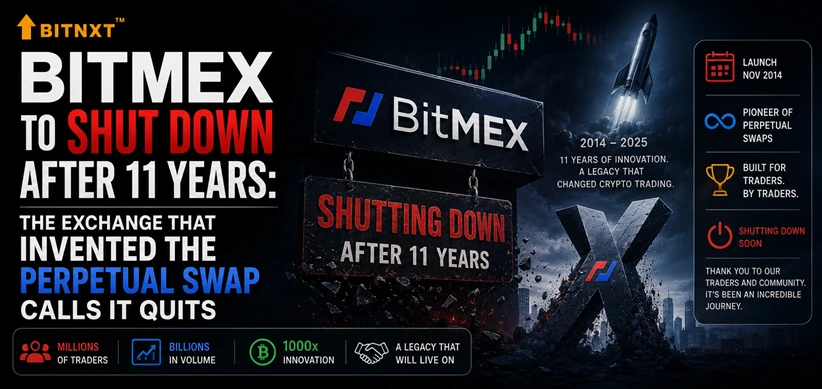
BitMEX, the pioneering derivatives exchange that gave crypto one of its most important trading instruments, is closing for good. On July 23, 2026, owner and operator HDR Global Trading Limited announced that BitMEX will permanently cease operations on September 23, 2026, urging users to close positions and withdraw funds. The news sent BitMEX’s native token tumbling and added another name to a growing list of once-dominant crypto businesses winding down. Here is a research-backed account of the shutdown, the timeline, and what it signals.
The Announcement
In an emotional post, BitMEX said that following a strategic review of the business and the broader crypto industry, the board of HDR Global Trading Limited decided to close the exchange. Notably, the company did not cite financial difficulties or regulatory action as the cause, framing the move purely as the outcome of a strategic assessment, and it did not disclose what the review found or whether a sale process begun the prior year produced a bidder. The exchange struck a valedictory tone, expressing pride in its 11-plus-year legacy and emphasizing a security record it described as flawless — zero customer funds lost to hacks over its entire operating history. New account registrations were halted the same day.
The Withdrawal Timeline Users Must Know
BitMEX laid out a strict, staged wind-down that users need to follow carefully. From August 26, 2026, at 04:00 UTC, the platform moves to reduce-only mode: no new positions can be opened, and users can only close existing ones, with the exchange progressively force-closing remaining contracts. On September 23, 2026, at 04:00 UTC, all remaining open positions will be force-closed and trading services will end. After that, the platform remains accessible for withdrawals and read-only historical data only. The company also confirmed that all staked BMEX tokens have been unstaked and returned to user wallets for immediate withdrawal, and it warned users about phishing scams exploiting the closure, noting withdrawals could face delays from blockchain congestion.
The Penalty for Leaving Funds Behind
There is a real cost to inaction. KYC-verified users who leave assets on the platform after September 23 will be charged a monthly maintenance fee of $50 equivalent or an annualized 1% on their balance, whichever is greater — a fee the company said could increase further with advance notice. The message to users is unambiguous: withdraw well before the deadline.
The BMEX Token Collapse
The exchange’s native token, BMEX, was the most immediate casualty. It cratered on the news — most outlets reported a drop of over 90%, cutting its market capitalization to roughly $497,000, while some data showed declines as steep as 98% to a fraction of a cent. The reason is structural: BMEX operated on a deflationary model with monthly burns funded by trading fees, so once the exchange announced it was turning off the lights, those future burns — and the token’s entire utility — became worthless. Analysts drew a direct parallel to the implosion of FTX’s FTT token, reinforcing a hard lesson: an exchange token isn’t an independent financial asset, but a bet on the exchange’s continued operation. When that continuity ends, so does the token’s value.
You might also like: Bitcoin Climbs 4.16% as Crypto Decouples From Falling Stocks — CLARITY Act, BitMEX's Exit and $26M in Bridge Hacks Defined the Week
The Key Facts at a Glance
Item | Detail |
Exchange | BitMEX (owner/operator: HDR Global Trading Limited) |
Announcement date | July 23, 2026 |
Reduce-only mode | Aug 26, 2026, 04:00 UTC |
Final shutdown | Sep 23, 2026, 04:00 UTC (positions force-closed) |
Late-withdrawal fee | $50/month or 1%/yr on balance, whichever is greater |
BMEX token | Down 90%+ (some data ~98%); market cap ~$497K |
Founded | 2014 by Arthur Hayes, Ben Delo, Samuel Reed |
Daily volume (Jul 2026) | ~$400,000 (<0.01% market share) |
A Landmark Legacy
It’s hard to overstate BitMEX’s historical importance. Founded in 2014 by Arthur Hayes, Benjamin Delo, and Samuel Reed, the exchange introduced the perpetual swap — a leveraged contract with no expiration date — and popularized 100x leverage. That single product became the most-traded instrument in all of crypto and the backbone of digital-asset derivatives markets, copied by virtually every major exchange that followed. For years, BitMEX was the dominant venue for leveraged crypto trading. Its closure is, in a real sense, the end of a foundational era.
A Long, Regulated Decline
The wind-down caps years under a regulatory cloud. Between September 2015 and September 2020, the CFTC charged BitMEX with offering illegal crypto-derivatives services to U.S. customers, alleging it failed to implement adequate know-your-customer and anti-money-laundering controls, while the DOJ charged employees under the Bank Secrecy Act. The three co-founders pleaded guilty to BSA violations in 2022, and the exchange itself pleaded guilty in July 2024; combined U.S. penalties reportedly exceeded $200 million. In March 2025, President Donald Trump pardoned the three co-founders. Even so, the platform never regained its former standing: by July 2026 daily volume had withered to roughly $400,000, less than 0.01% of the market, and earlier that month BitMEX had delisted 21 contracts — a clear signal it was winding down rather than competing.
The Bigger Picture: Consolidation and the Rise of DEXs
BitMEX’s exit fits a broader market-structure shift. According to CoinGecko’s Q2 2026 industry data, perpetual-futures volume on centralized exchanges fell 10% to $12.7 trillion, even as decentralized alternatives kept gaining ground — led by Hyperliquid, which rose to become one of the largest perpetuals venues, with perp DEXs’ share of total open interest climbing to around 13.5%. In other words, the very product BitMEX invented is increasingly migrating on-chain, to platforms it once had no rival against. Its closure is being read as another chapter in the post-FTX reorganization and consolidation of the crypto industry, where legacy centralized players are squeezed between tighter economics and nimbler decentralized competitors.
Why It Matters
For BitMEX’s remaining users, the immediate takeaway is practical and urgent: close positions and withdraw funds ahead of the deadlines to avoid forced liquidations and maintenance fees, and stay alert to phishing attempts. For the industry, the shutdown is a symbolic milestone — the exchange that taught crypto how to trade derivatives is leaving just as its signature product thrives elsewhere. And for anyone still holding exchange-native tokens, the BMEX collapse is a stark reminder that such tokens live and die with the platform behind them.
Sources and Further Reading
TheStreet – “Another crypto business announces shutdown, asks users to withdraw funds” (reference article)
BitMEX / HDR Global Trading – official closure announcement (July 23, 2026)
Crypto Briefing – “BitMEX shuts down as analysts warn of accelerating crypto consolidation” and BMEX token coverage
Tech Times – “BitMEX Exchange Shuts Down September 23 After $200M in Fines and Failed Sale”
Bitcoin.com / CryptoTicker / TradingView (Stocktwits) – shutdown timeline, DEX competition, and market data
Note: Details reflect reporting from July 23–25, 2026; some figures (e.g., BMEX’s exact decline and market cap) vary across sources and over time and are attributed above. This article is for informational purposes only and is not investment advice; markets carry significant risk.


