































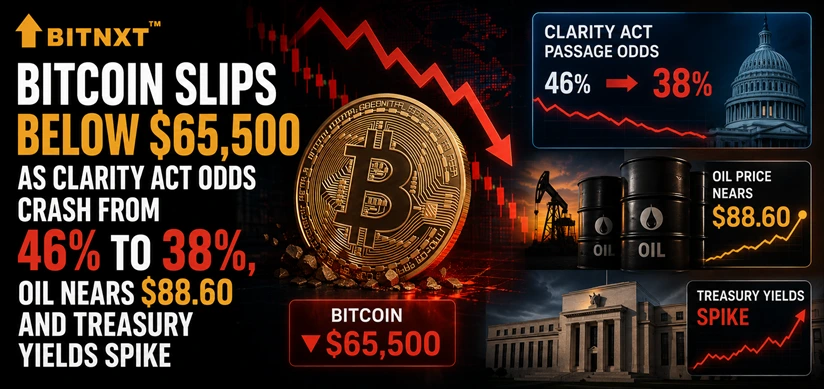
Three separate pressures landed on Bitcoin at once early Thursday, and the cryptocurrency buckled under all of them. BTC changed hands near $65,500, down roughly 0.7% since midnight UTC and extending a pullback from Wednesday's high near $66,700, as oil prices surged, Treasury yields climbed to multi-month peaks, and the crypto industry's flagship legislation suffered a fresh setback in Washington. The weakness spread across the market, with ether, Solana, and XRP all trading lower.
Oil and Rates: The Macro Squeeze
West Texas Intermediate futures on the NYMEX climbed to $88.60 per barrel, the highest since June 11 and a steep rebound from recent lows below $70. That matters well beyond energy markets: a sustained oil rally is a fresh inflationary impulse capable of pushing consumer price indexes higher in the US and globally, which in turn complicates any central bank plan to cut interest rates.
The bond market is already repricing that risk. The US two-year Treasury yield jumped to 4.31%, its highest level since February 2025, while the benchmark 10-year climbed to 4.66%, the highest since May. For Bitcoin, the mechanism is direct — higher yields raise the opportunity cost of holding non-yielding assets like Bitcoin and gold, pulling capital toward fixed income that now pays meaningfully more.
An Escalation in the Iran Conflict
Geopolitics added another layer of caution. Axios reported that the US military deployed a B-1 long-range bomber on Tuesday to strike targets tied to Iran's Islamic Revolutionary Guard Corps. Committing a heavy bomber marks a clear step up in the scale of American operations — a signal that Washington may be preparing for a broader campaign rather than continuing with the more limited strikes of recent days. That escalation is also the engine behind the oil move, tying the geopolitical and macro threads together.
Washington Delivers the Third Blow
The regulatory setback may sting the most, because it followed what was supposed to be a breakthrough. Senate Republicans released an updated draft of the Digital Asset Market Clarity Act on Wednesday containing an ethics provision agreed to by the White House and President Trump — language Senator Bernie Moreno hailed as the most powerful ethics text in US history.
Key Senate Democrats promptly said the new draft falls short on ethics and other critical provisions. Prediction markets reacted instantly: implied odds of the Clarity Act passing tumbled from 46% to 38% on Polymarket. That reversal captures the bill's central problem — a text can satisfy the White House and Senate Republicans completely and still fail, because passage requires Democratic votes that the ethics language hasn't won over.
For traders, the convergence is what matters. Any one of these — an oil shock, a yield spike, or a legislative stall — would pressure risk assets on its own. Arriving together, they leave Bitcoin without an obvious catalyst to lean on, and with the Senate's pre-recess calendar shrinking, the Washington variable looks unlikely to resolve quickly.
Source: Reporting via CoinDesk (Omkar Godbole), with market data from TradingView and NYMEX, prediction market data from Polymarket, and military reporting from Axios. Figures reflect the time of the original report and this is a developing story. This article is for informational purposes only and is not investment advice.


