





























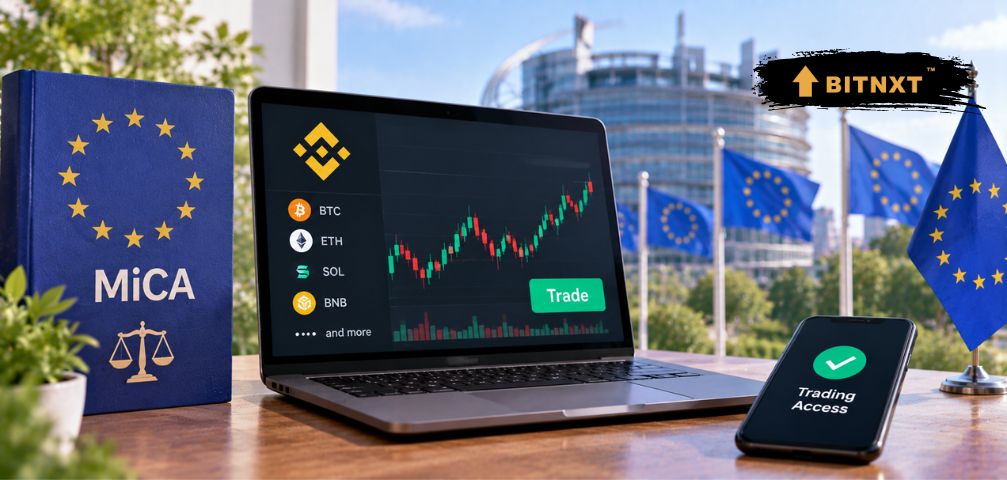
Binance is using a MiCA workaround to keep European Union customers trading more than two months after missing the bloc's July 1 licensing deadline — leaning on the regulation's reverse solicitation provision and an Abu Dhabi entity while it hunts for a new authorization route, according to a Bloomberg report that reopens the question of what Europe's flagship crypto law actually enforces.
The report, published Sept. 4, describes the world's largest crypto exchange continuing to serve and onboard customers in parts of the 27-member bloc despite withdrawing its Greek Markets in Crypto-Assets application in June. People familiar with the matter said Binance has relied partly on MiCA's reverse solicitation provision, which permits certain services when customers approach an unlicensed crypto company on their own initiative rather than being targeted by marketing — and Binance has interpreted that provision as allowing it to onboard new customers who independently seek out the platform. Some EU-based customers' trading has been routed through a Binance entity in Abu Dhabi, where the business operates under a different regulatory framework.
How the Binance MiCA workaround holds up
The legal question is whether "customers who approach on their own initiative" covers users who complete new registrations after the deadline. MiCA's wind-down instructions were explicit: ESMA told unauthorized providers to stop onboarding new EU customers and limit remaining services to what customers need to exit. Yet August tests across Austria, France, Germany, Spain and Belgium found some new users could complete registration and identity verification on Binance, with one account created Aug. 19 using a European identity document verified and subsequently funded with cryptocurrency. Binance remained absent from ESMA's register of authorized crypto providers. Nina-Luisa Siedler, a lecturer at the Berlin University of Applied Sciences who advises companies on MiCA compliance, told Bloomberg that failing to receive a license does not automatically require Binance to close every European customer's account — a reading that leaves the prohibition's practical scope to national regulators, which are responsible for imposing sanctions.
The picture varies sharply by country. In France, Spain, Italy, Poland, Sweden and Lithuania — where Binance previously maintained local entities — customers received multiple emails asking them to leave, with most accounts restricted to withdrawals. Some customers were subsequently allowed to return under Binance's interpretation of reverse solicitation. ESMA has recently contacted the exchange seeking confirmation that it is appropriately winding down its EU business, and the authority declined to discuss the individual company.
The Greek application that collapsed
The backstory explains the improvisation. Binance had sought MiCA authorization through Greece, which would have passported across the bloc. The Hellenic Capital Market Commission was expected to consider the application at a June 17 board meeting; Binance withdrew the filing on June 16, the day before. The company maintained it had received no formal indication of rejection and believed it met the requirements — but Bloomberg reported that European Central Bank President Christine Lagarde personally intervened behind the scenes to prevent the application's approval, an account the ECB declined to comment on. Binance says it is "actively working toward becoming MiCA-authorised" on a long-term, compliant basis, though it has not named the member state for its next application.
The market share data shows what's at stake: Binance still controlled more than 45% of global spot trading volume in late August, and its euro trading share remained largely unchanged from before the deadline. The exchange is cleaning up its listed universe and expanding into tokenized stock options — moves consistent with a company that wants its regulatory record to improve, which makes the EU standoff more curious than defiant.
The deeper issue is MiCA's own credibility. A regulation that permits a giant to keep operating through solicitation semantics and offshore routing while licensed rivals bear the full compliance cost teaches the wrong lesson to every mid-size exchange watching. National regulators now face a choice between enforcement theater and confrontation — and the longer Binance's workaround holds, the more Europe's comprehensive crypto rule looks like a border it applies to everyone except its biggest guest.


