
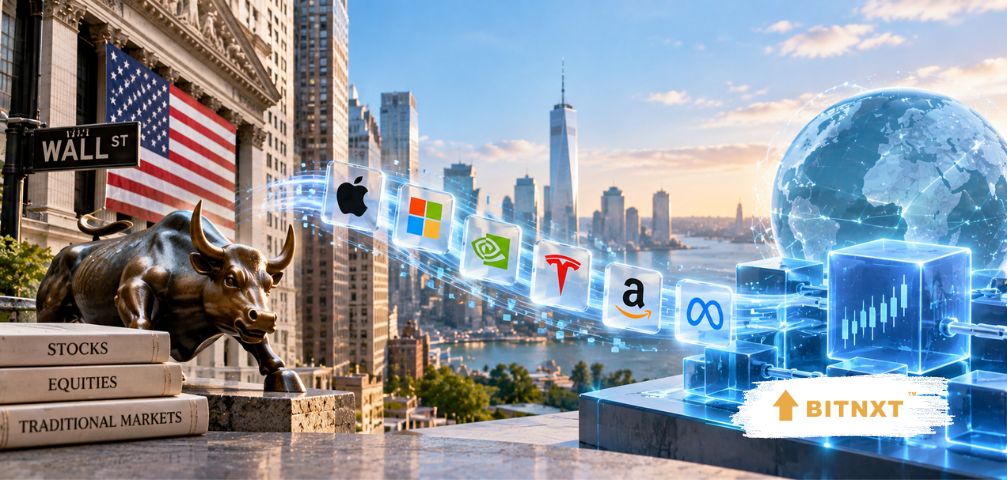
The short answer is: not in the way the headline implies, and yes in a way most coverage has missed.
What Nasdaq received approval to do is real and significant, but it is deliberately conservative. What is being built alongside it is neither.
What actually happened
Date | Development |
|---|---|
December 2025 | SEC staff grant a no-action letter clearing the Depository Trust Company to run a three-year tokenization pilot, permitting participants to tokenize security entitlements and transfer them in tokenized form. |
19 March 2026 | The SEC approves Nasdaq’s rule change permitting trading of securities in tokenized form on the exchange. |
March 2026 | Nasdaq also announces work with Kraken on converting securities into tokenized formats for blockchain use. |
July 2026 | DTCC targets initial, limited production trades involving tokenized securities. |
October 2026 | Full launch of the service planned, developed with input from more than 50 firms across traditional finance and digital assets. |
Eligible assets are deliberately narrow: constituents of the Russell 1000, ETFs tracking major indices such as the S&P 500 and Nasdaq-100, and — for the DTC pilot — US Treasury bills, bonds and notes. All of it consists of securities already held inside DTC’s custody system.
How the Wall Street rail actually works
The mechanism is worth understanding precisely, because it determines how radical this is.
A market participant selects a tokenization flag when entering an order. If the trade executes, Nasdaq passes that instruction to DTC, which mints and delivers a token to a DTC-registered wallet and reconciles a control account in the background.
Everything else stays the same. Tokenized and traditional shares use the same order book, the same order types, the same market data feeds, the same surveillance tools and the same T+1 settlement cycle. Tokenized orders receive no execution priority. The tokenized version is fungible with the traditional one and carries identical rights.
The token is minted after the trade settles. This is not the stock market moving on-chain — it is a token appended to the end of existing plumbing.
That framing is not a criticism. It is the design. Regulators approved it precisely because it preserves the entire scaffolding of US securities law — same ticker, same shareholder rights, same surveillance — and inserts a token at the final step. The absence of execution priority is the regulator’s way of saying this is infrastructure, not a new market.
So what does it actually achieve?
Assets can move between traditional book-entry form and tokenized form, which makes them usable as on-chain collateral without leaving the regulated perimeter.
It establishes the legal and operational precedent. Additional exchanges are expected to follow, and the hard regulatory work has now been done once.
It creates a path towards faster settlement. Nasdaq has framed tokenization as enabling movement towards instant or atomic settlement, though it has been explicit that infrastructure remains the constraint and T+1 is preserved for now.
What it does not do, yet, is deliver the things retail investors associate with tokenized stocks: 24/7 trading, fractional access, or global availability. The T+1 cycle and the DTC-registered wallet requirement rule those out for the moment.
The second rail — and this is the important part
Running alongside the Nasdaq and DTC model is a fundamentally different approach: an SEC innovation exemption that would allow tokenized versions of US public-company stock to trade on crypto-native platforms.
The two rails do not converge, and the difference is not technical. It is about what you actually own.
Nasdaq / DTC rail | Crypto-native rail under an innovation exemption | |
|---|---|---|
Underlying | Securities already inside DTC custody, tokenized post-trade. | Equities wrapped by a platform, potentially without issuer consent. |
Rights | Identical to the traditional share. Fungible with it. | May represent an ownership interest. May not. May carry voting rights. May not. |
Venue | Same order book as conventional shares, same surveillance. | Crypto-native platforms, outside the existing equity market structure. |
Settlement | T+1, existing clearing infrastructure preserved. | Platform-determined. |
Investor protections | The full existing scaffolding of US securities law. | By its own framing, does not have to preserve those things. |
The consequence, as one analysis put it, is that America is heading towards two stock markets for the same company — with the same ticker meaning materially different things depending on which rail you bought it on.
Why the rights question is the whole question
A conventional share is a bundle: economic exposure, voting rights, dividend entitlement, and legal standing against the issuer. A wrapper that tracks the price gives you the first and may give you none of the rest.
For a trader holding for hours, that difference is invisible. For anyone holding through a takeover, a proxy fight, a dividend record date or a bankruptcy, it is the entire substance of the investment.
And the without-issuer-consent element matters more than it sounds. A company can find its equity wrapped and traded on a platform it has no relationship with, under terms it did not agree, with holders who may believe they are shareholders and may not be.
The offshore preview
This is not hypothetical, because the crypto-native model has been running outside the US for a year and the demand is demonstrably there.
WHAT THE NON-US MARKET SHOWS Binance’s tokenized equities product reached roughly $14.7 billion in volume within two months of launch, available to eligible non-US users. On Robinhood Chain, standalone stock token trades rose to about 78% of real-world asset volume during August, with a record day of roughly $85 million — displacing memecoin pairs as the dominant use. On-chain equity volume reached roughly $9 billion during 2026, up around 800% from a low base. Tokenized real-world assets surged around 266% in 2025, with tokenized equities reportedly up by a far larger multiple. |
The Robinhood Chain figure is the most informative. A chain that launched on memecoin speculation saw tokenized equities become its dominant use within a month. That is genuine product-market fit, and it is happening on the rail with weaker rights guarantees, not the one with stronger ones.
Which sets up the tension the US is walking into: the conservative rail has the protections, and the permissive rail has the users.
So are stock markets moving on-chain?
Three honest answers, depending on what you mean.
Settlement is. Post-trade tokenization at DTC is real, launching in stages through 2026, and will make equities usable as on-chain collateral. That is a genuine infrastructure change and the most consequential part of the Nasdaq approval.
Trading is not — yet. Same order book, same T+1, no execution priority, no 24/7. The market has not moved; a settlement layer has been extended.
Access might, on a different rail. The innovation exemption path is where 24/7 trading, fractional access and global reach would actually arrive — and it is the path with the weakest guarantees about what a token represents.
What to watch
Whether the July limited production trades and the October full launch happen on schedule. Slippage would be the clearest signal that the operational challenge is harder than the regulatory one.
Volume in tokenized versus conventional form on the same order book. If nobody selects the tokenization flag, the approval is a precedent rather than a market.
Whether other exchanges follow. Additional exchanges are expected to file, and a second approval would confirm this as market-wide infrastructure rather than a Nasdaq experiment.
The final shape of the innovation exemption, particularly any requirement that a tokenized equity disclose exactly which rights it carries.
Whether issuers push back on unconsented wrapping. A single large company objecting publicly would change the politics of the second rail quickly.
Movement on T+1. Atomic settlement is the actual prize, and nothing about the current design delivers it.
The bottom line
The Nasdaq approval is a real milestone and a deliberately modest one. A token gets minted after a trade settles, on the same order book, under the same rules, with the same rights. That is settlement infrastructure catching up, not a market migrating.
The development worth watching is the second rail, because that is where the version people imagine when they hear “tokenized stocks” — always-on, fractional, globally accessible — would actually appear. It is also where a token bearing a familiar ticker may carry none of the rights that ticker has always implied.
So the question for the next two years is not whether stock markets move on-chain. It is whether the version that scales is the one that kept the investor protections or the one that kept the users. On the offshore evidence so far, those are not the same rail.
Important
This article is general information and market analysis. It is NOT investment, legal or financial advice and is not a recommendation regarding any security, token or platform. Tokenized securities products differ substantially in what rights they confer — some carry full shareholder rights, others may confer only price exposure — and investors should establish exactly what they are buying before committing capital. Regulatory frameworks described are in pilot or proposed form and may change. Figures cited reflect the periods stated and are drawn from third-party sources.
Sources
SEC approval orders and staff no-action relief, Nasdaq rule filings, DTCC announcements, plus reporting and analysis from Ledger Insights, Dechert, Forbes, Reuters via syndication, Finance Magnates, Hoodline and Yahoo Finance.
Bitnxt tracks RWA platforms, exchanges and tokenization infrastructure across the US, UK, EU, UAE and Asia. Explore the directory at bitnxt.io.