


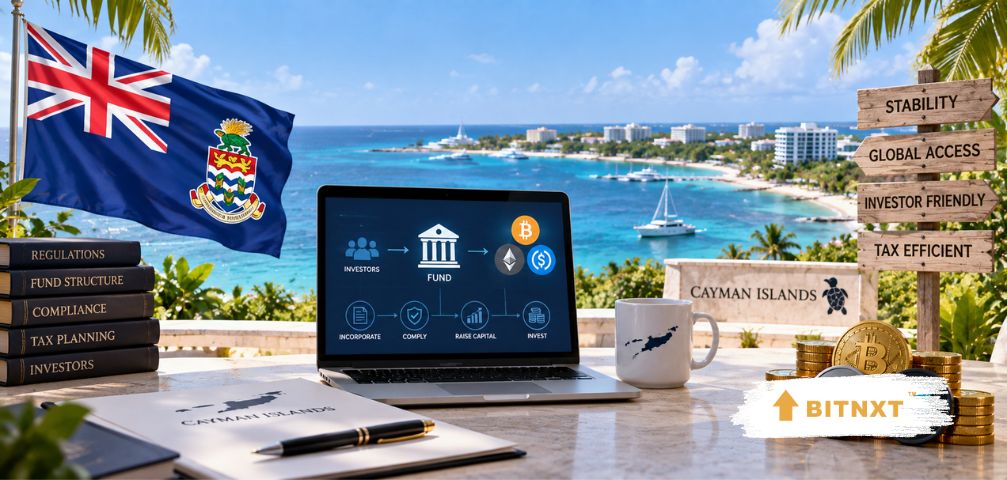
The Cayman Islands remains the default domicile for crypto funds, with CIMA regulating more than 30,000 funds overall. The typical structure is a Cayman-domiciled vehicle managed by a team sitting in New York, London, Singapore or Dubai.
The process is well-trodden, but it is also unforgiving about sequence. Several decisions cannot be cheaply reversed once made.
Step one: open-ended or closed-ended?
This is the branch point, and everything downstream follows from it.
Open-ended | Closed-ended | |
|---|---|---|
Definition | Investors have a right to withdraw or redeem their interests on notice. | Investors have no right to redeem on notice; capital is locked for the fund’s life. |
Governing statute | Mutual Funds Act | Private Funds Act |
Typical use | Crypto hedge funds, liquid token strategies, market-neutral and quant funds. | Venture, token-purchase vehicles with lockups, illiquid or early-stage strategies. |
Registration | Registers with CIMA as a mutual fund. | Registers with CIMA as a private fund, absent an exemption. |
A crypto fund offering monthly redemptions is a mutual fund. A token fund with a four-year lockup is a private fund. Different statute, different obligations, different documents.
One trap worth knowing: the old exemption for funds with fifteen or fewer investors who could appoint and remove the operators has gone. Limited investor funds now register with CIMA like everyone else. Anyone working from older guidance may assume an exemption that no longer exists.
Step two: pick the vehicle
Both regimes accommodate the same menu of structures, and the choice is driven by investor expectations and tax treatment in the investors’ own jurisdictions rather than by Cayman law.
Exempted company — the most common for open-ended crypto funds. Familiar to allocators, straightforward share class mechanics.
Exempted limited partnership (ELP) — standard for closed-ended and US-facing structures, with a general partner as operator.
Limited liability company (LLC) — a hybrid offering partnership-style flexibility with corporate separateness.
Segregated portfolio company (SPC) — useful for multi-strategy platforms where each portfolio needs ring-fenced assets and liabilities. Note that each segregated portfolio generally requires its own annual return.
Unit trust — less common, occasionally preferred for certain Asian investor bases.
Step three: the question most crypto managers get wrong
Does the fund itself need a VASP registration?
Usually not, but the analysis matters. The Virtual Asset (Service Providers) Act regulates the provision of virtual asset services — custody, trading platforms, transfer, issuance — rather than the act of investing in virtual assets. A fund that buys and holds tokens through third-party venues and custodians is regulated as a fund.
You move into VASP territory when the fund or an affiliate starts providing those services to others. And the threshold there rose sharply: since 1 April 2025, virtual asset custodians and virtual asset trading platforms must hold a full VASP licence, with registration no longer available for those categories.
If you… | Likely position |
|---|---|
Invest in tokens via third-party exchanges and a qualified custodian | Fund regulation only — Mutual Funds Act or Private Funds Act. |
Self-custody fund assets using your own infrastructure | Analyse carefully. Custody of your own fund’s assets differs from providing custody services, but the boundary needs advice. |
Provide custody or run a trading venue for third parties | Full VASP licence required since 1 April 2025. Registration is not available. |
Issue or distribute tokens | VASP registration considerations, plus possible Securities Investment Business Act analysis if the tokens are securities. |
Timelines differ substantially: VASP registration typically runs 2–4 months, a full VASP licence 6–10 months. If your model needs both a fund and a licence, sequence them deliberately.
Step four: appoint the people you cannot avoid
These appointments are conditions of registration, not optional polish, and several must be in place before you file.
Role | Requirement |
|---|---|
Auditor | Must be on CIMA’s approved list and have an office in the Cayman Islands. Only approved firms may audit a Cayman-registered fund. An auditor consent letter is filed at registration. |
Administrator | Consent letter filed at registration where one is appointed. In practice, institutional investors expect an independent administrator. |
Custodian | Private funds must appoint a custodian to hold custodial assets in segregated accounts and verify title. Where custody is not applicable, alternative title verification arrangements apply. |
AML officers | Prescribed AML officer details are filed with CIMA — typically an AML compliance officer, a money laundering reporting officer and a deputy. |
Directors or operators | Private funds registered as companies need a minimum of two directors, and at least two natural persons must be named in respect of a general partner or corporate director. |
Registered office | Must be in the Cayman Islands, provided by a person licensed under the Companies Management Act or the Banks and Trust Companies Act. |
The auditor requirement is the one that surprises managers most often. You cannot use your existing accountants unless they are on CIMA’s list with a Cayman presence — and audit capacity in Cayman is finite, so approach firms early rather than after you have set a launch date.
Step five: the offering document
For mutual funds, the offering document or prospectus must comply with the content requirements in CIMA’s Statement of Guidance. It must describe the equity interests offered in all material respects and contain the information a prospective investor needs to make an informed decision.
For a crypto fund specifically, expect scrutiny of how you describe valuation methodology for illiquid or thinly traded tokens, custody arrangements and key-management controls, counterparty exposure to exchanges, and redemption mechanics under stressed market conditions.
That last one deserves care. A monthly-redemption fund holding assets that can gap 30% over a weekend needs its gating and suspension provisions drafted properly, not copied from an equities template.
Ongoing obligations — the part that costs more than setup
Obligation | Detail and consequence |
|---|---|
Annual audit | Accounts audited annually by a CIMA-approved auditor, prepared under an internationally recognised standard such as IFRS or US GAAP. |
Filing deadline | Audited financial statements filed with CIMA within six months of financial year end, together with the Fund Annual Return, which the auditor submits electronically. |
Sub-fund returns | A separate annual return is required for each segregated portfolio, sub-trust, or class maintaining separately presented accounts. |
Penalty | Failure to have accounts audited annually by an approved auditor attracts a penalty under the Private Funds Act of CI$20,000 (around US$24,390), payable by the operator. A comparable penalty applies to valuation non-compliance. |
Valuation | Appropriate valuation procedures applied consistently. CIMA may require verification by an auditor or independent third party where valuation is not performed independently. |
Material changes | Any change materially affecting information previously filed — including a change of registered office — must be filed with CIMA within 21 days. |
Director registration | Directors of mutual funds structured as exempted companies, managers of LLC funds and directors of general partners of ELP funds must register with CIMA under the Directors Registration and Licensing Act, wherever in the world they are located. |
Annual fees | Payable to CIMA and, for partnerships, to the Registrar of Exempted Limited Partnerships. |
Note the director registration point. It applies to directors regardless of location — a London-based director of a Cayman fund still registers with CIMA. Managers routinely miss this.
What it actually costs
INDICATIVE BUDGET Setup — roughly $30,000 to $75,000 for legal fees and formation, higher than BVI or Delaware equivalents. Ongoing compliance — approximately CI$30,000 to CI$100,000 annually for AML officers and regulatory reporting, plus fund administrator fees on top. Plus — annual CIMA fees, registrar fees, audit fees, registered office, and directors. Timeline — launching a fully regulated crypto fund commonly exceeds six months once legal drafting, service provider onboarding and CIMA registration are sequenced. Tax — no Cayman corporate tax. Investor-level tax depends entirely on investor residence. |
For a well-capitalised manager those numbers are immaterial. For a two-person quant shop launching with $5 million they are not, and that is precisely why smaller funds often choose BVI instead. Run the arithmetic honestly before committing: if setup and first-year compliance exceed a meaningful share of your management fee, the domicile is wrong for your stage.
The realistic sequence
Decide redemption terms first. Open-ended or closed-ended determines the statute, the documents and the obligations.
Take structuring advice on investor tax before choosing the vehicle. Cayman law accommodates all the options; your investors’ tax positions will not.
Approach auditors early. CIMA-approved firms with Cayman offices are a finite resource and you need a consent letter.
Analyse the VASP question before building infrastructure. If your model requires a full licence, that is a 6–10 month path running alongside fund registration.
Appoint administrator, custodian and AML officers, and obtain consent letters.
Draft the offering document with genuine attention to crypto-specific valuation, custody and redemption risk.
File with CIMA, then register directors under the DRLA.
Calendar the six-month audit deadline from day one. The penalty for missing it is fixed and payable by the operator.
Common mistakes
Assuming an exemption that no longer exists. The limited investor fund carve-out has gone.
Using existing auditors. They must be CIMA-approved with a Cayman office.
Copying redemption terms from a traditional fund. Crypto liquidity behaves differently and gating provisions need to reflect that.
Forgetting director registration under the DRLA for overseas directors.
Treating self-custody as a purely operational decision rather than a regulatory one.
Underestimating recurring cost. Ongoing compliance typically exceeds formation cost within the first two years.
The bottom line
Cayman works for crypto funds because CIMA already supervises tens of thousands of funds, allocators recognise the structure without explanation, and there is no Cayman-level tax to model. The framework is mature and the questions it asks are the right ones.
What it is not is cheap or fast. Six months and a five-figure setup budget are realistic, ongoing compliance is a permanent cost line, and the audit obligation carries a fixed penalty payable by the operator rather than the fund.
Get the redemption decision right, appoint a CIMA-approved auditor early, and resolve the VASP question before you build anything. Those three things account for most of the avoidable pain.
Important
This article is general information only. It is NOT legal, regulatory, tax, accounting or investment advice, and it is not a substitute for advice from qualified Cayman Islands counsel and your own tax advisers. Fund structuring, registration requirements, exemptions, fees and obligations depend entirely on specific facts including strategy, investor base, redemption terms and corporate structure. Figures cited are indicative third-party estimates that vary in practice, and legislation and CIMA rules change. Establishing a regulated fund without professional advice carries serious legal and financial risk.
Sources
Cayman Islands Mutual Funds Act, Private Funds Act, Virtual Asset (Service Providers) Act and CIMA rules, guidance and statements, plus practitioner guidance from Harneys, Ogier, Mourant, EY, Loeb Smith, Pillsbury, Chambers, CV5 Capital, Consulting24, Gofaizen-Sherle and Crypto Fund Research.
Bitnxt tracks fund administrators, custodians, exchanges and licensed service providers across the Cayman Islands, UAE, UK, EU and Asia. Explore the directory at bitnxt.io.


