


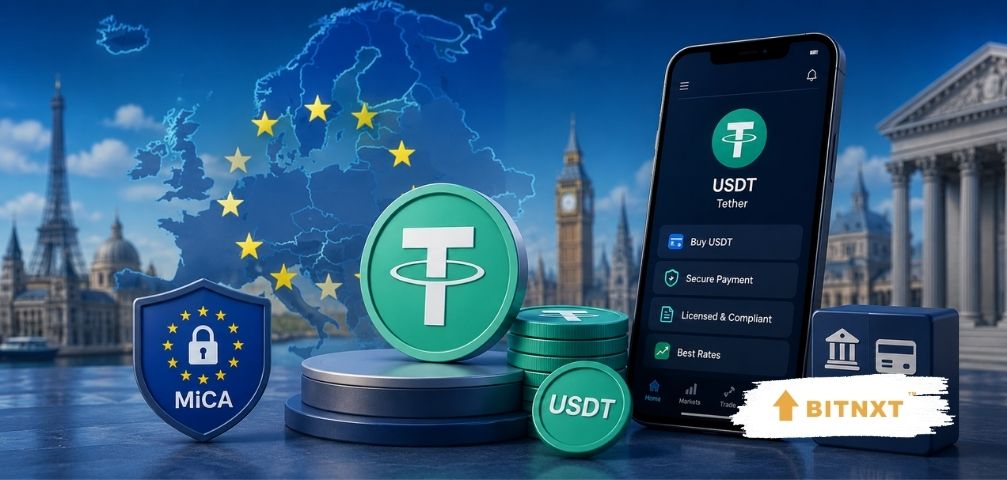
If you've tried to buy USDT (Tether) on a European exchange recently, you probably noticed the buy button is gone. Major platforms like Coinbase, Kraken, Crypto.com, and OKX have delisted USDT for European Economic Area (EEA) users. The good news? You can still buy USDT in Europe — you just need to know where to look.
Why USDT Disappeared From EU Exchanges: The MiCA Effect
The answer comes down to one regulation: MiCA (Markets in Crypto-Assets Regulation). MiCA's stablecoin provisions took full effect on July 1, 2026. Under MiCA, EU-licensed exchanges cannot offer stablecoins whose issuer has not obtained an EU e-money authorization. Tether Limited chose not to pursue that authorization, while Circle (issuer of USDC) did, making USDC and EURC fully MiCA-compliant.
The result was immediate: Coinbase delisted USDT for EEA retail users in December 2024. Kraken followed by March 2026. Binance geofenced USDT pairs for EEA users. Crypto.com, OKX, and Revolut all removed USDT for European clients.
Critical distinction: MiCA regulates venues, not your wallet. Holding USDT in a self-custodial wallet remains fully legal across the EU. ESMA has confirmed there is no restriction on holding or transferring non-compliant stablecoins. The rules target exchanges, not individuals.
The Best Platforms to Buy USDT in Europe (2026)
1. Binance P2P — Best Overall for European Buyers
Best for: Users who want the lowest fees and widest range of payment methods
While Binance geofenced direct USDT trading pairs for EEA users, its P2P marketplace remains one of the most accessible ways to buy USDT in Europe. Binance P2P matches buyers and sellers directly, with the exchange acting as escrow.
Supports 700+ payment methods including SEPA bank transfers, Wise, Revolut, and local EU payment rails
Spreads typically 0%–1% above spot price; Binance charges no trading fee on the P2P leg
Full escrow protection — USDT is locked until the seller confirms your fiat payment
Available in nearly every European country
Fees: 0%–1% spread above spot; no exchange fee on the P2P trade itself
How to buy: Create and verify your Binance account → Navigate to P2P marketplace and select USDT → Choose your payment method (SEPA, Wise, Revolut) → Browse seller offers (aim for 95%+ completion rate) → Open a trade (USDT moves into escrow) → Send fiat to the seller within 15 minutes → Mark "paid" → Seller confirms and USDT releases to your wallet → Withdraw to self-custody.
⚠️ Safety tip: Always use the in-app escrow flow. Never release funds or communicate outside the platform.
2. OKX P2P — Best Alternative to Binance P2P
Best for: Users seeking a Binance P2P alternative with competitive rates
OKX P2P offers similar functionality to Binance P2P with comparable payment method coverage, though with somewhat lower volume on the seller side. For European buyers, it's a solid backup or primary choice.
SEPA and local EU payment support
Escrow-protected trades
Competitive spreads, often 0%–1.5% above spot
Exchange-level KYC required
Fees: 0%–1.5% spread; no P2P trading fee from OKX
3. Bitfinex — Best Centralized Exchange Still Offering USDT
Best for: Experienced traders who want a full-featured CEX with USDT pairs
Bitfinex is one of the few major centralized exchanges that has not publicly committed to delisting USDT for European users. It still offers USDT trading pairs as of 2026, making it a go-to for traders who need deep liquidity and advanced order types.
Deep USDT liquidity — one of the original exchanges for Tether trading
Advanced trading interface with limit, market, stop, and OCO orders
Supports SEPA deposits for European users
Margin trading and lending features for advanced users
Fees: 0.1%–0.2% maker/taker for spot trading; SEPA deposit fees vary
⚠️ Note: Because Bitfinex has not disclosed detailed MiCA compliance plans regarding USDT, there's inherent uncertainty. European users should monitor announcements and consider withdrawing USDT to self-custody.
4. Decentralized Exchanges (DEXs) — Best for Privacy and Self-Custody
Best for: Users who already hold crypto and want to swap for USDT without KYC
If you already own cryptocurrency, decentralized exchanges let you swap directly to USDT without a centralized platform or KYC. Since DEXs are not EU-licensed exchanges, MiCA's stablecoin restrictions don't apply to them.
Top DEXs for USDT:
Uniswap — The largest Ethereum DEX; swap ETH, USDC, or any ERC-20 for USDT
Curve — Best for stablecoin-to-stablecoin swaps (e.g., USDC → USDT) with minimal slippage
1inch — Aggregator that finds the best swap rate across multiple DEXs
PancakeSwap — Leading BNB Chain DEX for USDT on BEP-20
Jupiter — Top Solana DEX for USDT on Solana
Fees: 0.05%–0.3% swap fee + network gas fees
How to swap on a DEX: Connect your self-custody wallet (MetaMask, Rabby, Phantom) → Select the token to swap from and USDT as destination → Choose the correct USDT network (ERC-20, BEP-20, Solana) → Review rate, slippage, and gas cost → Confirm the swap → USDT arrives in your wallet within minutes.
⚠️ Key consideration: DEXs require you to already hold crypto. They don't accept fiat deposits.
5. Card On-Ramps (Paybis, Simplex) — Best for Quick Card Purchases
Best for: Beginners who want to buy USDT with a debit or credit card in minutes
Card on-ramp services let you purchase USDT directly with a Visa or Mastercard. These are particularly useful for European buyers who want a fast, straightforward process.
Paybis — VASP registered in Poland, serves 180+ countries with SEPA and card support. First purchase is 0% fee; subsequent purchases run 1.49% + 4.5–8.5% card processing. 4.1/5 Trustpilot rating.
Simplex — Widely integrated into wallet apps; supports Visa and Mastercard with light KYC for purchases under ~$200.
MoonPay — Popular on-ramp integrated into many wallets and DEXs; supports SEPA and card payments across Europe.
Fees: 1.49%–8.5% depending on the provider and payment method
6. Swiss-Regulated Platforms — Best for MiCA-Free Access
Best for: Users who want regulated infrastructure without MiCA restrictions
Switzerland is not an EU member state and operates its own regulatory framework. Swiss-regulated platforms are not subject to MiCA's stablecoin restrictions, meaning they can still offer USDT to European users under Swiss law.
TrustLinq — Swiss company supervised by SO-FIT (a FINMA-recognised self-regulatory organisation). Supports USDT on both Ethereum (ERC-20) and Tron (TRC-20), alongside USDC, EURC, and RLUSD. Operates under strict Swiss AML requirements.
Swissquote — Swiss online bank with crypto trading services; offers a regulated banking-grade experience.
Choosing the Right USDT Network
Once you've decided on a platform, you'll need to choose which blockchain network to receive your USDT on. Choosing the wrong network can result in lost funds.
Network | Fee | Speed | Best For |
|---|---|---|---|
Tron (TRC-20) | ~$1 | Minutes | Everyday transfers, best value |
Ethereum (ERC-20) | $3–$15+ | Minutes | DeFi, DEXs, large transfers |
BNB Chain (BEP-20) | ~$0.20 | Seconds | Binance ecosystem users |
Solana | ~$0.001 | Seconds | Ultra-fast, ultra-cheap |
Polygon | ~$0.01 | Seconds | Low-cost Ethereum L2 |
Rule of thumb: For most European buyers, TRC-20 (Tron) offers the best balance of low fees and broad compatibility. Use ERC-20 (Ethereum) only if you're interacting with DeFi protocols or DEXs that require it. Always verify that the sending platform, receiving wallet, and any intermediate service all support the same network.
Safety Tips: Protecting Your USDT Purchase
Use self-custody for storage — "Not your keys, not your coins" is especially true for USDT. After buying, withdraw to a wallet you control (Trust Wallet, MetaMask, Ledger, Trezor).
Always use escrow on P2P — Never send fiat outside the platform's escrow system. If a seller asks you to pay directly or mark "paid" before sending money, it's a scam.
Verify the network — Double-check that the sending platform, receiving wallet, and network all match. Sending TRC-20 USDT to an ERC-20 address = permanent loss.
Start small — For your first P2P trade or DEX swap, start with a small amount to verify the process works.
Check seller reputation — On P2P platforms, only trade with sellers who have high completion rates (95%+) and many completed orders.
Beware of "too good to be true" offers — If a seller's USDT price is significantly below market rate, it's likely a scam.
Enable 2FA — Turn on two-factor authentication (Google Authenticator, not SMS) on every exchange account.
Keep transaction records — For tax purposes, keep records of every USDT purchase, including date, amount, price, and platform.
MiCA-Compliant Alternatives: USDC and EURC
If your primary goal is simply holding a dollar-pegged stablecoin, you have fully MiCA-compliant alternatives available on every major EU-regulated exchange:
USDC (USD Coin) — Issued by Circle, which obtained MiCA authorization. USDC is freely available on Coinbase, Kraken, Bitpanda, Bitstamp, OKX EU, and other MiCA-licensed platforms. It's the most direct USDT alternative for European users.
EURC — Circle's euro-pegged stablecoin, also MiCA-compliant. Ideal if you want a stablecoin denominated in euros.
RLUSD (Ripple USD) — A newer MiCA-authorized stablecoin gaining traction on European platforms.
For many European users, switching to USDC is the simplest path forward — it's available on regulated exchanges, benefits from SEPA integration, and carries the same 1:1 USD peg as USDT. However, if you specifically need USDT (for DeFi protocols, international transfers, or merchant payments that only accept Tether), the platforms above remain your best options.
Comparison: Which Platform Should You Choose?
Platform | Method | Fees | Speed | KYC | Best For |
|---|---|---|---|---|---|
Binance P2P | P2P escrow | 0–1% spread | 15–30 min | Full | Lowest fees, SEPA support |
OKX P2P | P2P escrow | 0–1.5% spread | 15–30 min | Full | Binance P2P alternative |
Bitfinex | CEX spot | 0.1–0.2% | Instant | Full | Advanced traders, deep liquidity |
Uniswap / Curve | DEX swap | 0.05–0.3% + gas | Minutes | None | Privacy, self-custody |
Paybis | Card on-ramp | 1.49–8.5% | 5–15 min | Light | Beginners, card purchases |
TrustLinq (Swiss) | Payment infra | Varies | Minutes | Full (Swiss AML) | Regulated, MiCA-free access |
Frequently Asked Questions
Is it illegal to hold USDT in Europe?
No. MiCA restricts licensed EU exchanges from offering USDT, but ESMA has confirmed there is no restriction on holding or transferring non-compliant stablecoins. Holding USDT in a self-custodial wallet is fully legal across the EU.
Why was USDT delisted from European exchanges?
Under MiCA, EU-licensed exchanges cannot offer stablecoins whose issuer lacks EU e-money authorization. Tether chose not to pursue that authorization, so major exchanges were required to delist USDT for EEA users by July 1, 2026.
Can I still buy USDT if I live in the EU?
Yes. While MiCA-licensed EU exchanges have delisted USDT, you can still buy it through P2P marketplaces (Binance P2P, OKX P2P), decentralized exchanges, card on-ramps, Swiss-regulated platforms, and certain centralized exchanges that haven't fully restricted EEA access.
Is USDC a good alternative to USDT?
For most European users, yes. USDC is MiCA-compliant, available on all major EU-regulated exchanges, and carries the same 1:1 USD peg. However, if you need USDT specifically for DeFi protocols or merchant payments, you'll need the platforms listed in this guide.
Which USDT network should I choose?
For most everyday transfers, TRC-20 (Tron) offers the best balance of low fees (~$1) and broad compatibility. Use ERC-20 (Ethereum) only for DeFi interactions or large transfers. Always verify that both sender and receiver support the same network.
Are P2P marketplaces safe?
Yes, when you use the platform's built-in escrow system. The exchange locks the USDT in escrow until you confirm payment, protecting both parties. Never send money outside the platform or mark a trade as "paid" before you've actually transferred the funds.
Conclusion
MiCA undeniably changed how Europeans access USDT, but it didn't make buying Tether impossible — it just changed the playbook. The best platform for you depends on your priorities:
Choose Binance P2P or OKX P2P for the lowest fees and SEPA support
Choose Bitfinex for a full-featured CEX with deep USDT liquidity
Choose decentralized exchanges for privacy and self-custody (if you already hold crypto)
Choose card on-ramps like Paybis for quick, beginner-friendly purchases
Choose Swiss-regulated platforms for MiCA-free, regulated access
Or simply switch to USDC if you just need a dollar stablecoin and don't specifically require USDT
Whatever route you choose, remember the golden rules: use escrow on P2P platforms, verify your network before sending, move USDT to self-custody after buying, and always keep transaction records for tax purposes.
Disclaimer: This article is for informational purposes only and does not constitute financial advice. Cryptocurrency investments are subject to high market risk. Always do your own research and consult a licensed financial advisor before making investment decisions. Regulatory information is current as of September 2026 and may change.


