















BTCBTC$75,543-6.03%|
ETHETH$2,225.23-8.11%|
USDTUSDT$0.99895-0.04%|
BNB$690.6700-3.23%|
XRPXRP$1.2000-8.11%|
USDCUSDC$0.99941-0.03%|
SOLSOL$89.1900-6.90%|
TRXTRX$0.31839-0.37%|
FIGR_HELOCFIGR_HELOC$1.0350-1.01%|
ZECZEC$1,275.07-2.83%|
HYPEHYPE$77.8000-6.98%|
XMRXMR$620.9900-3.26%|
DOGEDOGE$0.07141-6.79%|
USDSUSDS$1.0000-0.02%|
WBTWBT$72.5900-6.69%|
LEOLEO$9.3500-0.06%|
LINKLINK$10.7200-6.93%|
ADAADA$0.18333-7.04%|
BCHBCH$275.2300-2.29%|
XLMXLM$0.15388-7.92%|
NEARNEAR$3.6600-8.89%|
USDEUSDE$0.99878-0.07%|
DAIDAI$0.99999-0.04%|
RAINRAIN$0.00608075+2.62%|
UNIUNI$6.9100-9.21%|
LTCLTC$52.2800-6.27%|
CCCC$0.09822-5.00%|
AVAXAVAX$8.2600-5.59%|
USD1USD1$0.99825-0.03%|
SUISUI$0.85610-7.51%|
BTCBTC$75,543-6.03%|
ETHETH$2,225.23-8.11%|
USDTUSDT$0.99895-0.04%|
BNBBNB$690.6700-3.23%|
XRPXRP$1.2000-8.11%|
USDCUSDC$0.99941-0.03%|
SOLSOL$89.1900-6.90%|
TRXTRX$0.31839-0.37%|
FIGR_HELOCFIGR_HELOC$1.0350-1.01%|
ZECZEC$1,275.07-2.83%|
HYPEHYPE$77.8000-6.98%|
XMRXMR$620.9900-3.26%|
DOGEDOGE$0.07141-6.79%|
USDSUSDS$1.0000-0.02%|
WBTWBT$72.5900-6.69%|
LEOLEO$9.3500-0.06%|
LINKLINK$10.7200-6.93%|
ADAADA$0.18333-7.04%|
BCHBCH$275.2300-2.29%|
XLMXLM$0.15388-7.92%|
NEARNEAR$3.6600-8.89%|
USDEUSDE$0.99878-0.07%|
DAIDAI$0.99999-0.04%|
RAINRAIN$0.00608075+2.62%|
UNIUNI$6.9100-9.21%|
LTCLTC$52.2800-6.27%|
CCCC$0.09822-5.00%|
AVAXAVAX$8.2600-5.59%|
USD1USD1$0.99825-0.03%|
SUISUI$0.85610-7.51%|
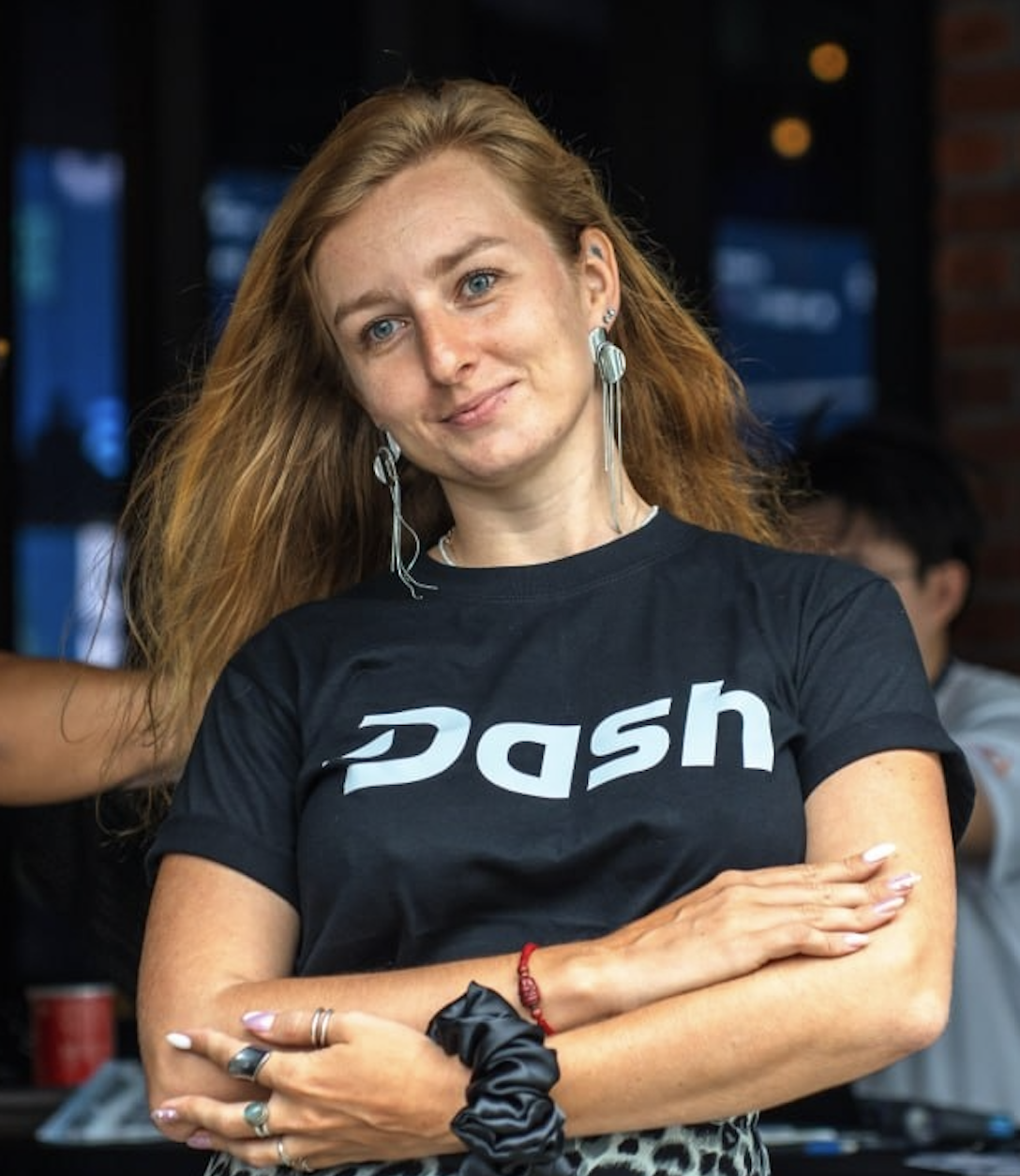
Daria Chernozub

Daria Chernozub

Featured
Global Adoption LeadDash DAODash DAO
Global 18 min readBy Bitnxt Editorial Team

Daria Chernozub, Global Adoption Lead at Dash DAO, discusses digital cash, everyday crypto payments, community-funded governance, optional privacy, Dash Platform, and the practical work of growing real-world adoption.

PaymentsInfrastructure
DashDigital CashCrypto PaymentsDAOPrivacyDash Platform

Interview Summary

Daria Chernozub, Global Adoption Lead at Dash DAO, discusses digital cash, everyday crypto payments, community-funded governance, optional privacy, Dash Platform, and the practical work of growing real-world adoption.

1

About Daria & Dash

Q1.Walk us through your crypto origin story. What pulled you toward Dash?

There’s a funny detail: Dash was actually the first cryptocurrency I ever bought, partly because my name is Dasha.

My journey with blockchain technology started long before I entered Web3 professionally. Back when I was building innovation centers for major banks, blockchain was already one of the technologies we were exploring and using to develop innovative solutions.

My professional Web3 journey later took me to Super Protocol, where I worked on community building and developer relations. I then joined DFINITY’s Global Adoption team and became a co-founder of ICP Hub Turkey.

I was also actively involved in the Solana ecosystem, organizing hackathons, meetups, and other events, while helping early-stage startups gain visibility, build their presence, and grow within the ecosystem.

These experiences shaped my understanding of how technology adoption actually works and how important strong communities are for ecosystem growth.

When I returned to Dash, its combination of digital cash, community-driven funding, and application infrastructure felt like a natural fit.

Q2.Dash has been around since 2014. What's kept you in it this long?

What keeps me here is that Dash has kept evolving without abandoning its purpose. I am not someone who has worked on Dash since 2014, but I value what that continuity has produced. Today we have far more than the payments coin many people remember: a live application platform, native tokens, cryptographic identities, modern mobile wallets and zero-knowledge privacy. The important part is how those pieces reinforce each other. We are not replacing digital cash with a new narrative; we are giving it the surrounding infrastructure it needs to become genuinely useful.

Q3.Tell us about Dash. But start with the money problem you're solving—not the technology.

The problem is that having a digital balance does not necessarily mean having control of your money. You may still depend on an intermediary's opening hours, approval or ability to serve your country. Dash starts with money you can hold yourself and send directly, quickly and inexpensively. But payments also involve people, businesses and information. Dash Platform extends that independence to the application layer: identities, names, data and assets can live on shared infrastructure rather than inside one company's database. The aim is a familiar financial experience without making one company the gatekeeper of the whole relationship.

Q4.Dash calls itself “digital cash you can spend anywhere.” What does that mean in everyday terms?

It means having practical places to use Dash for things you already need. You can send it directly to another person or use services such as Travala and NOMADZ to book travel. Supported merchant-payment routes also connect Dash to everyday purchases, including situations where the merchant receives local currency rather than holding crypto.

We are also working with partners on discounts for customers who pay with Dash. That gives people another reason to use it. Availability and offers vary by service and location, so the goal is to keep expanding useful options and make them easier to find.

Q5.Who is Dash really for today?

For people who want control over everyday payments, for businesses that need to know quickly that a payment is final, and increasingly for builders. A freelancer receiving money from abroad and a developer launching a loyalty programme have different problems, but Dash can serve both. Platform makes that second audience much more important: developers can create native assets and applications rather than only add a DASH payment button. Platform 5.0 also introduces a way for an application to cover network fees for certain actions paid for with tokens, once protocol version 14 is activated on mainnet. For example, a business could configure an action in its app so the customer pays with the app's token and the business covers the network fee. That depends on the app's configuration and the business keeping enough credits available; it is not a blanket promise of fee-free token transfers.

Q6.What moment made you think, “This is actually working”?

A concrete moment was the community backing my first Dash project for Token2049 Singapore in 2025. I proposed a community-led activation, and the network funded it. What impressed me was not just receiving a budget: someone with a useful idea could join the ecosystem and earn support directly, rather than wait for a central organisation to create a position. That is important for adoption. Local opportunities are usually spotted by people on the ground. Dash has a mechanism that can turn their initiative into real work, not just leave it as enthusiasm in a group chat.

2

Payments & governance / Industry Trends

Q1.What are most people wrong about when it comes to crypto payments right now?

They often look at block time instead of asking when a payment can safely move again. With Dash, an InstantSend-locked payment can be spent onward before it is included in a block. That is a much more useful property at a checkout than a fast notification followed by a waiting period. ChainLocks then protect the accepted block history from being replaced by a conflicting version. That is a separate safeguard from locking an individual payment. The other misconception is that a payment is just a blockchain transfer. The recipient's usable balance, conversion costs and ability to spend again are all part of the product.

Q2.Stablecoins have taken over the payments conversation. Threat or opportunity for Dash?

An opportunity—and Dash Platform changes the conversation. You can already build your own stablecoin on Platform using its native token functionality. Issuance, transfers, burning and configurable administrative controls are available without writing a custom token smart contract from scratch. A credible stablecoin still needs credible backing, redemption and liquidity; the protocol supplies the asset infrastructure, not the peg. That lets an issuer offer fiat-denominated value while DASH remains the network's independent native asset. DASH itself is not a stablecoin. The interesting opportunity is to support both needs on the same ecosystem, rather than insist that every payment must use the same kind of money.

Q3.Is there still a need for a coin built purely for payments?

Yes to a payments-first network, but 'purely a coin' no longer describes Dash. Platform is a decentralised backend: it does some of the account and data-storage work an application would normally send to a company's servers. Developers define data contracts, meaning the required fields and validation rules for the records an app stores. They can then build around identities and native tokens. Those capabilities matter because a useful payment product often needs things such as a customer profile or a receipt as well as a transfer function. Platform fees use credits funded with DASH, so a developer does not have to buy an unrelated gas token just to use the application layer.

3

Payments & governance / Masternodes & the DAO

Q1.Dash funds itself from its own block rewards—no investors, no fundraising. How has that worked out?

It has given Dash a way to keep funding serious engineering and adoption across market cycles, instead of having to organise a new fundraising round for every stage of development. Up to 20% of the block subsidy is available to proposals approved by the network. A detail people often miss: unused treasury capacity is not a pile of money accumulating in a foundation account. If it is not allocated, that portion is not created. The system therefore funds work through explicit decisions, not automatic spending. It does not rule out outside investment; it provides an independent, recurring funding mechanism.

Q2.Masternode holders vote on what gets funded. What's the upside, and what's the headache?

The upside is that the people deciding on funding have capital exposed to the network's long-term outcome. They also operate masternodes: servers that help provide network services. Regular masternodes support InstantSend and ChainLocks; evonodes additionally run Platform. The collateral is not money handed to Dash Core Group or lent to a company; operators retain control of it. The difficult part is attention and judgement: engineering, business development and local adoption require different expertise. Good governance therefore needs understandable proposals and evidence of delivery. But voters still need to read the proposals and judge the results.

Q3.Has the community ever voted against something you believed in?

Yes. A proposal we supported was put to a vote but did not receive enough net support to meet the funding threshold, so it was not funded in that cycle. That is disappointing when you believe in the work, but it is a real part of a community-funded system. I can disagree with the result and still respect the process. It also makes us look again at the proposal: were the objectives clear, was the budget justified, and did we explain how the community could assess the results? The response should be to understand the objections and improve the proposal, not assume that funding is owed to us.

4

Privacy & products / Privacy

Q1.Dash added optional shielded transactions using Zcash's technology. Why go that route?

Because privacy is not where I want us to invent cryptography just to have our own version. Orchard and Halo 2, used by Zcash, let the network verify payments without publishing the sender, recipient or amount. They do not require a trusted setup, so users do not have to trust that somebody destroyed secret setup material.

Sam Westrich and the team combined this with Dash Evolution's consensus and data architecture. Dash reports roughly one-second deterministic settlement: once the network commits a payment, it is final under its consensus rules, rather than becoming progressively more certain as more blocks arrive. It also reports loading encrypted notes in about 20 seconds. Notes are private records of funds that the wallet reads with its keys; synchronisation is catching up with those records so it can show the right balance. These are published performance figures, not a guaranteed time on every device.

The DASH-backed Platform balance means credits funded by locking DASH on the Core chain, not a separate speculative currency. Shielding moves that value into an optional private pool. Transfers inside the pool hide the parties and amounts; entry and exit amounts remain visible. It does not make every ordinary DASH payment private. For me, the practical test is whether someone can open the wallet, see their funds and make a private payment without a long wait.

Q2.Dash got labelled a “privacy coin” and delisted in some places, even though privacy was always optional. How do you deal with that?

By explaining what Dash actually does today, rather than fighting over a label. The old CoinJoin feature and the new zero-knowledge shielded pool are different technologies. Our materials for partners need to reflect that progress. Privacy has ordinary commercial uses: a supplier should not learn your entire revenue history because you paid one invoice. At the same time, exchanges need accurate integration information and must apply their own obligations. Expanding native cross-chain routes also makes access less dependent on any single listing. We should make the technology easier to understand and use, not pretend its privacy capabilities do not exist.

Q3.Can a coin be private and still be welcome on exchanges?

Yes, privacy functionality and exchange access can coexist, although each venue must assess its rules and jurisdiction. A public exchange deposit interface and an optional private payment experience are different parts of a system. The important work is to understand exactly what the exchange receives, what records it can maintain and what its obligations require. 'Private' does not mean 'no responsibilities', just as regulated banking does not mean publishing every customer's account statement. Optionality creates integration choices; it is not an automatic legal exemption. The useful conversation is about those concrete choices, not a blanket label.

5

Privacy & products / Products & Strategy

Q1.What are you building right now that excites you most—and why?

DashPay on both Android and iOS, together with the Platform applications it can connect people to. Usernames and integrated swaps make the wallet useful beyond sending to an address string. The iOS releases also bring a shielded balance, where users can hold and transfer funds privately. On Android, DashConnect lets you scan a QR code and connect your DashPay username to a participating application without creating another password-based account. I like being able to use the wallet to prove control of an account and connect to an app, rather than setting up a separate login each time.

Q2.Dash now has usernames, identities and its own app platform. Why does a payments coin need all that?

Because making the payment decentralised is only half the job if the application still depends entirely on one company's database. Dash Platform provides identities, meaning accounts controlled with cryptographic keys, along with usernames, structured application data and native assets. Developers access it through a decentralised API, the interface apps use to request data from the network. An app can check cryptographic proofs that a response matches the network's recorded state, rather than simply trusting whichever server answered.

For example, a developer could build a membership app that stores a member profile and membership status on Platform. Its data contract defines which fields those records must contain and what values are valid. Another compatible app could read and verify the same record instead of keeping an unrelated copy in its own database.

There is also a practical privacy benefit in DashPay's contact design: a username does not have to become one permanent public payment address. Contacts exchange encrypted payment information, readable with the appropriate keys, which enables fresh addresses. A Platform identity is an account you control with keys, not automatically a passport identity. Ordinary Core payments still work without a username.

Q3.Which feature has grown faster than you expected?

I would highlight how quickly DashDEX has expanded in what it can do. It is becoming more than a 'swap my coins' feature: it helps connect the asset you hold with the asset you need to send or receive. Supported Maya and NEAR routes sit inside the wallet experience instead of requiring a separate exchange workflow. For example, on a supported route I could send from my DASH balance while the recipient receives the asset they need. The available assets, quote and timing still depend on the route.

6

Adoption & market reality / Real-World Use

Q1.Dash built a substantial merchant network in Venezuela. What helped that adoption?

A real need met a strong local implementation. Currency instability and the need to move value made alternatives relevant, while Dash's speed and low fees suited small everyday purchases. But the decisive work was human: local teams trained merchants, built communities and provided support through Dash Help. There were even affordable phones sold with the Dash ecosystem preloaded. That connected access, education and places to spend instead of treating them as separate campaigns. The lesson is that a payment network grows through both sides of the transaction: customers need useful places to pay, and merchants need customers who know how.

Q2.What's the biggest barrier stopping a normal shop from accepting crypto?

Usually it is the fear of adding another operational problem. A shop needs a clear price, a reliable payment confirmation, usable proceeds and a straightforward refund process—not a new technical hobby. Dash can provide fast settlement, while the chosen payment service can handle conversion where the business wants local currency. The overlooked issue is staff confidence: the owner may understand crypto, but the person working the till must also know what 'paid' looks like and what to do when something goes wrong. Good integration makes crypto another manageable payment option rather than a special event.

7

Adoption & market reality / The Hard Questions

Q1.Dash was once a top-five coin and isn't anymore. What's your honest take on that?

Good technology does not automatically create demand, bring in users or produce a higher market valuation. Dash's lower ranking is something we have to acknowledge, not explain away with a list of features. At the same time, I do think today's Dash is a stronger technical product: InstantSend and ChainLocks strengthened payments, while Platform, native tokens, usernames and optional shielded payments give people more ways to use it. That progress matters, but it does not prove that we have done enough on adoption. We still need to turn the capabilities into products people choose, use and return to.

Q2.If the tech is as good as you say, why hasn't the market noticed?

I do not think there is one proven explanation. My impression is that Dash's older reputation still shapes how some people see it, but that is my view, not an established explanation for its market performance. Better communication can help, but it is not a substitute for demand or regular use. We need to make the newer features easy to try, help developers build useful applications, and look at whether people come back after the first payment or demo. Even if that work succeeds, it does not guarantee a particular market price. What we can assess is whether the products are becoming more useful and more widely used.

8

Adoption & market reality / Regulation & Compliance

Q1.How has regulation shaped where and how Dash operates?

It shapes how we choose partners and enter markets. Being able to transfer DASH on the network is not the same as being licensed to operate an exchange, provide custody or settle merchant payments in a particular country. Those activities need the right local arrangements. Dash's structure is useful here: it is a network with multiple contributing organisations, not one company trying to operate every service worldwide. Local teams can work with suitable providers while the underlying payment and application infrastructure remains shared. The practical aim is to find a workable route for each use case instead of assuming one integration model fits everywhere.

Q2.Where do you draw the line between privacy for users and compliance for businesses?

A business may have duties to identify customers or keep records; that does not mean everybody else should see those customers' financial lives. The information required for a specific obligation and the information exposed publicly are different questions. Privacy also matters when a wallet checks its balance. BLAST, short for Blockchain Layered Address Sync Tree, is a way for a wallet to catch up with network data without sending a server an exact list of its addresses. It requests broader groups of records and works out locally which ones belong to it. That makes it harder for the server to link those addresses to one wallet. It does not hide everything or replace shielded payments; it reduces information leaked while the wallet updates.

9

Lessons & the future / AI & Emerging Tech

Q1.AI agents paying and getting paid in crypto—real near-term use case or hype?

A real use case, especially for small, clearly defined purchases such as paying to use an online service or renting computing power. Dash offers fast payments, while Platform can give an agent a key-controlled account and records it can verify. Think of an agent paying for a service and checking the receipt against the network's recorded data, rather than taking another bot's word for it. I would start with a small allowance and a clear list of permitted recipients. The software that signs payments must enforce those limits independently of whatever the AI is told in a prompt; I would not give it unrestricted access to a wallet.

10

Lessons & the future / Failures & Lessons

Q1.What lesson should Dash take most seriously?

The need for clear business objectives. I personally push for that, especially in a DAO, where people can have very different and sometimes competing views of what matters most. A vote can approve a budget, but the work still needs a clear purpose: who it should benefit, what outcome we are trying to achieve and how we will know whether it helped.

For adoption work, I want us to look beyond the announcement or the event itself. Did the partnership become useful? Did people try the product and come back? Did developers keep building? Those questions give the discussion a practical reference point and help us decide where to put the next round of effort.

11

Lessons & the future / Advice & Influence

Q1.What's the one thing a business should check before accepting any cryptocurrency?

Who controls the money after the payment—and can the business complete the entire journey? Test a real small sale, including any conversion, accounting and refund. With Dash, verify the payment through the wallet or integration, not a screenshot. Also understand a useful consequence of final settlement: a refund is a new payment authorised by the merchant, not a reversal of the original transaction. That can give a business greater control over payment disputes, but it means customer service must be designed deliberately. A good payment method should make the business simpler, not just make the transfer cheaper.

Q2.What advice would you give a project thinking of copying the Dash model?

Start by deciding what your DAO needs to achieve and which decisions genuinely require a community vote. Dash shows how a network can fund independent contributors through public proposals and masternode voting. But copying the voting mechanism alone will not give you a clear strategy or reliable execution.

Make the scope, budget and expected outcomes understandable. Give contributors responsibility for delivery, ask them to report what happened, and use that evidence when deciding what to fund next. Leave room for different ideas while keeping a shared view of the results you want. That is the part of the model I would encourage another project to think through carefully.

12

Lessons & the future / Looking Forward

Q1.Where do you see Dash in the next 5 years?

By 2031, I would like people to encounter Dash through useful products rather than through an explanation of blockchain architecture. A business could issue its own asset, a customer could use it through a familiar application, and payments could connect to the asset each side prefers. I am particularly interested in extending strong privacy to more of those applications and assets. Native tokens are already available, and the optional private pool holds DASH-backed credits. Extending privacy to more assets also requires the relevant protocol features to be activated and supported by wallets. I would like to see people using those tools in products they come back to.

Q2.What's your message for the Bitnxt community?

Revisit Dash as it exists now, not as you remember it from a previous cycle. Try a small payment, explore the mobile wallet, and look at what Platform lets developers build. For users, the combination of speed, control and privacy is worth experiencing directly. For builders, the interesting discovery is that you do not have to start by creating another blockchain or writing every token function yourself. There is already payment infrastructure, native asset functionality and an application data layer to work with. Try something small and tell us where it was useful or where you got stuck.

Q3.Where can our readers find you and Dash?

You can reach me on Telegram at @chernozubdb and on X at @DariaChernozub. For Dash, start with dash.org and @Dashpay. The website links to the Android and iOS wallets, and docs.dash.org is the starting point for developers. For a deeper look, explore the Dash Platform documentation and the public dashpay repositories on GitHub. The documentation and public repositories are useful places to check how a feature works and what has actually been released.

Rapid Fire Round

Q

Private by default or open by default?

As a principle, I want people's finances to be private by default and the public treasury to be transparent. That is my view of how finance should work, not a claim that every Dash transaction is private by default.

Q

Dash or stablecoins for a daily coffee?

Dash for my coffee. A stablecoin on Dash Platform is an interesting option for the business building the checkout.

Q

Masternode or miner?

Both. Proof-of-work miners secure Core; masternodes add services, and evonodes also run Platform.

Q

Payments coin or app platform?

Payments-first infrastructure—with an application platform that makes the money more useful.

Q

Monero or Zcash?

Respect to both. But my favourite today is Dash's own zero-knowledge privacy experience: strong shielding combined with Dash's speed and usability.

Q

One word to describe the future of digital cash?

Everyday.

By Bitnxt Editorial TeamLast updated Nov 3, 2026

Want to be featured on Bitnxt?

Share your crypto journey, startup, product, investment insights, trading strategies, or blockchain innovation with thousands of readers worldwide.

  • Increase brand visibility
  • Build authority & credibility
  • Improve SEO with a permanent interview page
  • Reach crypto investors
  • Connect with potential partners
  • Showcase your products & innovations
  • Share your founder's vision
  • Reach media & journalists
  • Attract new customers
  • Grow your community
  • Build your personal brand
  • Gain long-term organic exposure

Bitnxt uses cookies to run the site, understand how it is used, and measure ads. You can accept or decline below, and change your choice any time in our Privacy Policy.