





























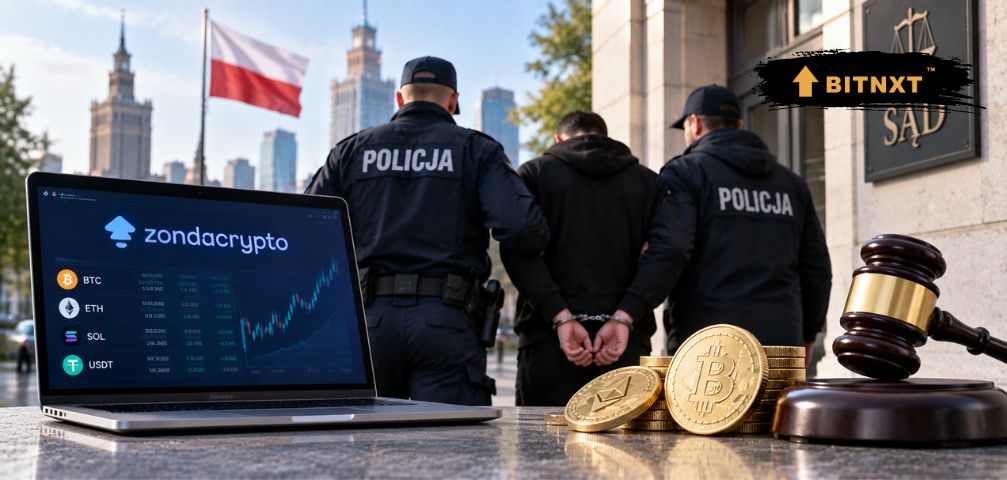
Poland has charged a fifth suspect in the Zondacrypto collapse, and the arrest reads like a man trying to leave the story behind. Roman Z., a former business partner of missing founder Sylwester Suszek, was detained in Silesia by cybercrime and Katowice police before a planned flight to China, with police seizing valuable watches and Zondacrypto operational documents in searches. He faces two charges, including fraud, denied the allegations, and submitted a statement. His defense says the China trip was business, with a return ticket for Sept. 13.
The scope of the failure keeps growing. Over 3,600 customer complaints had been filed by June 2026, with losses now exceeding 350 million zlotys, about $94 million, ten times the early 35 million zloty estimate. The exchange, founded in 2014 as BitBay and rebranded in 2021 with more than a million users, suspended BTC deposits in March, halted trading in April and went offline April 23. The ZND token lost nearly all value. Authorities have secured over 100 million zlotys in assets and froze 4 million euros in one account, still far short of the losses.
The Case Keeps Pulling in Bigger Names
Roman Z. is not a random catch. He was accused in a 2019 case of leading an organized criminal group and laundering 28 million zlotys through BitBay, the same platform. His path crosses the investigation's central mystery: Suszek disappeared March 10, 2022, in Czeladz, and prosecutors merged his missing-person inquiry with the fraud case in August. Three others, Rafal Z., Jaromira W. and Anna P., are detained. The charges reach the top of Polish sport: Olympic committee president Radoslaw Piesiewicz is accused of paid influence and favoring creditors, allegedly withdrawing his full funds on advance information, while ex-CEO Przemyslaw Kral allegedly bought a 40,000 euro Patek Philippe before meeting Piesiewicz in Monaco. Every suspect, including Roman Z. and Piesiewicz, remains innocent until convicted.
The cross-border hole matters as much as the arrests. Estonia's FIU revoked the operating license of BB Trade Estonia OÜ on June 29, months after Polish red flags, the same lag that let Orionx users in Chile discover a 7M euro custody gap too late and exchanges game EU licensing differences. A regulator in one EU state cannot see what another state's prosecutors see, a gap Polish lawmakers were still fighting over when the veto override failed.
Watch the recovery math. Secured assets cover under a third of losses, so the real question for victims is the next seizure, not the next charge. And watch whether prosecutors charge anyone for the withdrawals made with advance knowledge: that is where an exchange collapse becomes a corruption case.


