



























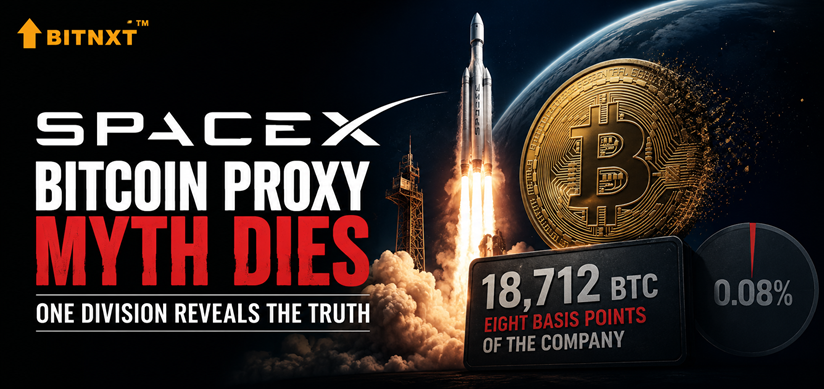
Since SpaceX completed the largest IPO in history on June 12 and promptly broke below its offer price, a particular headline genre has attached itself to the stock: every move in SPCX gets narrated against the 18,712 Bitcoin sitting on the company's balance sheet. The stock falls, and the coins are in danger. A dormant wallet moves $88 of test dust, and a selloff looms.
The framing has a name — the Bitcoin proxy, a listed stock functioning as leveraged BTC exposure from day one — and it has migrated from trading desks to research notes to the passive-flow analysis around the company's Nasdaq-100 inclusion. It survives on one number. It dies on one division.
The Arithmetic
SpaceX disclosed 18,712 BTC in its S-1, acquired at a cost basis near $661 million, roughly $35,300 per coin, marked at about $1.29 billion on the March 31 balance-sheet date. At Bitcoin's current price near $63,000, the position is worth approximately $1.18 billion. The company, after a 48% collapse from its $225.64 June peak to about $117, is worth roughly $1.56 trillion.
Divide those numbers and the position is 0.076% of the company — between seven and eight basis points. For scale, SPCX's average daily move since listing has exceeded 3%, which at current valuation is roughly $47 billion of market value, about forty times the entire coin stack, swinging on ordinary sessions for reasons unrelated to crypto: a Starship abort, an AI-sector rotation, a lockup headline, an analyst note. If Bitcoin doubled tomorrow, it would add roughly eight basis points to net asset value — an amount the stock routinely gains or sheds in the first minute of trading. If Bitcoin went to zero, the damage would be smaller than one scrubbed launch.
What an Actual Proxy Looks Like
The honest comparisons finish the job. Strategy — the archetype the proxy language borrows from — holds Bitcoin worth more than its entire enterprise value, with an mNAV below 1. Its stock isn't Bitcoin-correlated; it's Bitcoin-constituted. Tesla holds 11,509 BTC against a roughly trillion-dollar valuation, about eleven basis points, and a decade of trading history shows TSLA moving on cars, margins and Musk, with Bitcoin as a quarterly footnote. SpaceX sits below Tesla on that scale.
The category error is treating membership on the largest-corporate-holders list, where SpaceX genuinely ranks high in absolute coins, as equivalent to balance-sheet materiality, where it ranks nowhere. A big number inside a vastly bigger number is a small number.
The same division embarrasses the causation stories running both ways. SPCX's collapse has named, boring, equity-native causes: profit-taking from a euphoric debut, a failed Starship V3 test flight, an unpopular AI acquisition, a 911.5 million share lockup approaching, and a valuation that reached 109 times trailing revenue just as the market began repricing AI-adjacent growth. Bitcoin's weakness has its own macro drivers. The two declines share a risk regime, not a mechanism.
You might also like: Michael Saylor Rallies BlackRock, Coinbase and Fidelity Behind a $15M Bitcoin Quantum Defense — Months After Calling the Threat Overhyped
Why the Myth Is Immortal Anyway
If one division kills the frame, why does it keep walking? Because the myth is load-bearing for everyone who repeats it, and none of the load is analytical.
For the crypto industry, SpaceX-as-holder is a legitimacy asset of the highest grade — and the honest framing buried in the S-1 is that the coins are material relative to SpaceX's cash, roughly 6% of treasury, not its capitalization. The leaderboard needs SpaceX on it, and leaderboards don't publish a basis-points column. For content economics the math is simpler still: SPCX is among the most-watched tickers on earth, Bitcoin is crypto's protagonist, and any sentence containing both outperforms any sentence containing either — which is how an $88 transaction commanded a news cycle. For wallet-tracking firms, SpaceX is the franchise client. And for traders, the proxy frame licenses a story trade that briefly creates the very correlation it claims.
Where SpaceX Actually Touches Crypto
Strip away the treasury myth and three real interfaces remain, each stranger than eight basis points.
The first is the shadow market — crypto venues that traded SpaceX before SpaceX was tradable. Hyperliquid's SPCX perpetual launched pre-IPO against an implied valuation, ran to an all-time high of $228.74, tracked the listed stock's collapse tick for tick, and hosted positions the equity market cannot: one whale ran a 40x-leveraged $60 million Bitcoin short against a 10x $14 million SpaceX short, a pure risk-regime trade executed entirely on crypto rails. The tokenized version, SPCXx, trades offshore at a $28.7 million market cap, down 46% from its peak. Crypto built the only infrastructure through which global retail could touch the IPO of the decade.
The second is the tokenized-equity reckoning. Multiple platforms sold pre-IPO SpaceX exposure — mirror tokens, contingent notes, SPV claims — at implied valuations up to $1.6 trillion. The listing was the stress test: some products converted, some paid out against reference prices the broken IPO has since undercut, and some were scrapped entirely, with platforms unable to secure allocations refunding buyers. A $117 stock against vintages sold at $1.35–$1.6 trillion means late buyers of tokenized SpaceX lost money on the most successful IPO in history.
The third is the disclosure precedent. The S-1 converted the most speculated-about private Bitcoin position into an SEC-filed fact — and revealed the true stack was more than double the on-chain estimate, with roughly 10,427 BTC invisible in custodial accounts that wallet-tracking cannot see. That gap is a landmark case study in the limits of on-chain analysis. Combined with Tesla, Musk-controlled entities now disclose 30,221 BTC across two public balance sheets.
The Index Backdoor, Sized Honestly
One strand of the narrative deserves separate treatment because it contains a real mechanism at a scale its retellers never compute. SpaceX's Nasdaq-100 inclusion generated roughly $4.3 billion in passive demand by JPMorgan's estimate, and every dollar bought a claim on all the company's assets, coins included. QQQ holders do, strictly speaking, own Bitcoin through SPCX.
Now size it. Eight basis points of $4.3 billion is about $3.3 million of look-through Bitcoin exposure across every fund tracking the index. A QQQ investor with $100,000 holds, through SpaceX, a few dollars of Bitcoin — less than a coffee app's round-up feature.
The honest version of the index story isn't exposure; it's normalization, and there it has real content. Index membership means the Bitcoin line survives every rebalance without any active manager's decision, appears in fiduciary look-through disclosures, and gets audited and footnoted by administrators who a decade ago would have escalated it to a risk committee. The meaningful corporate-Bitcoin question was never whether giant companies would bet themselves on the asset — Strategy exists for that — but whether the line item could become boring enough to pass every committee precisely because it's immaterial. Eight basis points, held wordlessly and filed routinely, is what boring looks like at the moment of its creation.
What to Watch
Four things. September 2 brings the first earnings report to mark the Bitcoin line at fair value in public, potentially with management's first-ever explanation of why the coins exist. The December lockup releases 911.5 million shares — the genuine overhang that coverage will almost certainly misattribute to Bitcoin contagion. The shadow-market basis between SPCX equity, the Hyperliquid perp and tokenized versions is a live measure of what crypto rails price that Nasdaq doesn't. And any actual treasury motion would matter — not for SPCX, where the sums are marginal, but as a signal to every corporate-treasury imitator watching what the biggest name on the holders list does under pressure.
There's a final wrinkle worth noting: the ratio isn't a constant. A severe further equity repricing paired with a Bitcoin supercycle would push the coins toward seven-tenths of a percent — still small, but an order of magnitude toward mattering. That scenario, though, requires the exact configuration in which SPCX holders would have far larger problems than their look-through coin exposure. The more realistic path runs the other way: SpaceX's revenue compounds through Starlink while the position stays static at 18,712 coins, meaning the default trajectory of the ratio is toward zero. The proxy myth, examined closely, is a bet against SpaceX dressed as a bet on Bitcoin.
Source: Based on feature reporting and analysis by crypto.news (Olivia Stephanie), drawing on SpaceX’s S-1 filing, JPMorgan estimates and market data. Figures reflect data available at the time of the original report and change continuously. This article is for informational and educational purposes only and is not investment advice.


