





























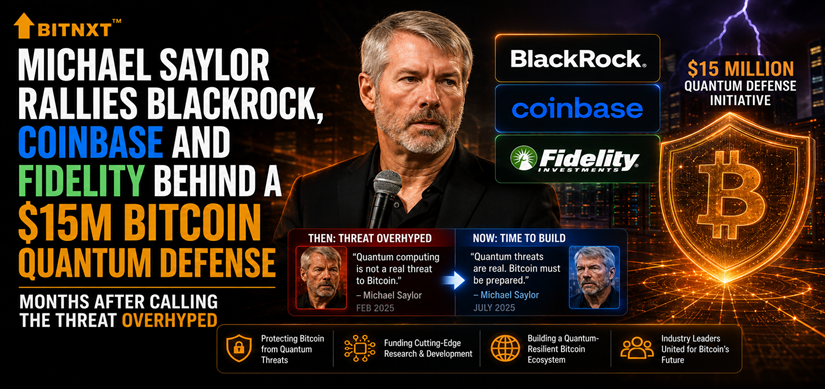
Wall Street's biggest Bitcoin holders have decided the quantum question is worth $15 million. Michael Saylor's Strategy announced the Bitcoin Security Consortium on July 23, bringing together eight other financial and crypto firms in a three-year pledge to strengthen the network's long-term security — with quantum readiness as the opening priority.
The founding roster spans nearly every layer of the institutional Bitcoin market: Anchorage Digital, ARK Invest, BlackRock, Block, Blockstream, Coinbase, Fidelity Digital Assets and Galaxy Digital. BlackRock, Fidelity and ARK issue spot Bitcoin ETFs; Anchorage and Coinbase provide custody; Block, Blockstream and Galaxy run infrastructure and financial-product businesses. Between them, they represent an enormous share of the institutional capital exposed if Bitcoin's cryptography were ever broken.
A Notable Reversal
The initiative is striking partly because of who is leading it. Saylor spent much of this year publicly dismissing quantum fears — telling the Coin Stories podcast in February that he didn't think the quantum narrative was Bitcoin's greatest security threat, and arguing at a Mizuho investor event in April that the risk was theoretical and likely decades away. His position was that any genuine breakthrough would trigger coordinated upgrades across banking, internet infrastructure and crypto simultaneously, and that Bitcoin wouldn't be uniquely exposed.
Convening a consortium to fund quantum defense doesn't contradict that timeline argument — preparing early is entirely consistent with believing the danger is distant. But it does mark a shift from rhetorical dismissal to institutional action, and it puts Strategy's name at the front of an effort it once suggested the market was overweighting.
Nine Checkbooks, Not One Fund
The structure is deliberately decentralized. Rather than pooling the $15 million, each founding member will independently choose which developers, researchers and organizations receive its share — coordinating through the consortium while retaining full discretion over funding decisions.
Brink Executive Director Mike Schmidt will coordinate daily operations in a volunteer capacity. Addressing independence concerns directly, Schmidt said on X that he receives no compensation and continues running Brink separately from any consortium member, committing to a year in the role — possibly two — while describing it as a seat that should rotate over time, with his commitment being to Bitcoin rather than to the group.
Crucially, the consortium disclaims any role in protocol governance. Schmidt stated the group will not adopt collective positions on Bitcoin upgrades, leaving members to direct funding independently while developers use the network's existing review process. That boundary is the arrangement's central design question: whether nine of the largest institutional Bitcoin holders can fund security research without their money becoming a de facto vote on the protocol's direction.
You might also like: Coinbase Pitches Canada on Becoming Its Only Financial App — Stocks, ETFs, Crypto and Prediction Markets in One Account
The $461 Billion Exposure
The technical concern is specific. A sufficiently powerful quantum computer could break the elliptic curve cryptography protecting Bitcoin wallets — and while no existing machine can perform such an attack, the coins most at risk are already identifiable.
CryptoQuant research cited by Galaxy estimated roughly 6.9 million BTC could become exposed, valued at about $461 billion at the time of the announcement. Citi reached a similar figure, calculating that between 6.5 million and 6.9 million BTC may already have public keys visible on-chain. Lost wallets compound the problem: their owners cannot migrate coins to quantum-resistant addresses, and Quantus has warned that quantum development may be advancing faster than earlier estimates — potentially leaving dormant holdings without any practical migration route.
The urgency argument is about deployment time rather than attack time. Galaxy has noted that rolling out post-quantum protections would require years of cooperation among Bitcoin Core developers, exchanges, wallet providers, infrastructure companies and users — which is why preparation has to begin well before the threat is proven.
Twenty Million and a Price Discount
The consortium isn't the only money moving. Galaxy Digital had already opened applications for a separate $5 million Bitcoin Quantum Readiness Initiative funding quantum-resistant signatures, wallet migration tools and independent security audits — bringing roughly $20 million across the two disclosed programs, though the commitments remain distinct.
Markets have already priced some of the anxiety. Capriole Investments founder Charles Edwards estimated in early June that Bitcoin traded at a 28% “quantum discount” against his projected path toward $120,000, with BTC near $62,099 at the time — attributing the gap to investor concern over slow progress on post-quantum signature planning among Core developers. Prediction markets are calmer: Polymarket puts the probability of quantum computing breaking Bitcoin by December 2027 at just 14%.
With Bitcoin trading near $65,101 as the announcement landed, the consortium's real test won't be the dollar figure. It will be whether independently directed grants produce usable security tools — without nine of Bitcoin's largest institutional stakeholders quietly acquiring influence over a protocol none of them controls.
Source: Reporting via crypto.news (Lawrence Mondal), with additional context from Strategy’s announcement, Galaxy Digital, CryptoQuant, Citi, and prior coverage from The Block, DL News and BeInCrypto. This article is for informational purposes only and is not investment advice.


