





























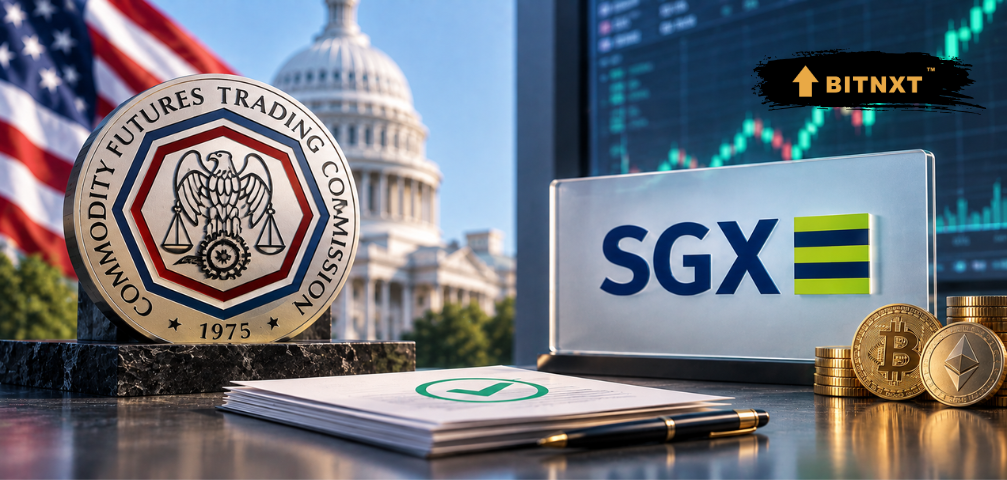
The CFTC has opened SGX perpetual futures to U.S. institutions, and the market at the center of the ruling has already traded $5.8 billion. Under Regulation 48.10, America's derivatives regulator granted Singapore Exchange foreign board of trade relief for its Bitcoin (BTP) and Ether (ETP) perpetual futures, letting qualified U.S. institutional participants trade straight into the exchange's Singapore order books without SGX registering as a U.S. domestic exchange. The venue has processed roughly 400,000 lots since the contracts launched in late November 2025, averaging about 1,300 contracts a day, a $19 million notional. U.S. clients can start onboarding now, with services expected to begin within one to two months.
"Under the Regulation 48.10 ruling, we have obtained CFTC authorization to open our crypto products to U.S. institutional access," KC Lam, head of crypto derivatives at SGX Group, told CoinDesk. "Previously, U.S. participants couldn't trade these contracts but now they can." The distinction from every offshore perps venue American firms already use informally is that this pipeline is regulator-approved end to end, the same legal framework CFTC-recognized foreign boards use for commodities and rates.
Why the FBOT Model Matters for SGX Perpetual Futures
The mechanics deserve a closer look, because Reg 48.10 relief is a genuinely different strategy from what U.S. regulators have allowed so far. The alternative path, the one most venues take, is to build a U.S. subsidiary, register it, and fragment liquidity into a domestic order book that trades Asian hours poorly. The FBOT route connects U.S. institutions directly to the existing Asian book. Wall Street desks gain exposure to Asian liquidity pools during Asian trading hours, exactly the segment of the global crypto market day where U.S. venues are thinnest. It also deepens the U.S.-Singapore institutional corridor that banks have been building all year, and it lands in a jurisdiction whose regulatory credibility is already established, the same depth that won Gemini a full Singapore MPI license from MAS. For the CFTC, the deal is transparency in exchange for access: a recognized foreign board operating under its home regulator's supervision, with clearing members standing between the exchange and client risk.
Lam frames the exchange's role in traditional futures-market terms. "By routing trades through clearing members who act as an intermediate risk buffer, we mirror the proven infrastructure of traditional futures and commodities markets," he said. That clearing-member buffer is the load-bearing wall of the whole structure, and it is what separates this venue from the offshore platforms U.S. institutions have been trading on through legal gray zones for a decade.
Margin Calls Instead of Liquidations, and No Stablecoin Collateral
The risk engine is the product pitch. "Unlike crypto-native venues where sudden volatility can trigger auto-liquidations, our traditional risk framework uses margin calls and top-up collateral, to prevent involuntary position closures during market spikes," Lam said. On Binance or Bybit, a violent wick liquidates the position and the loss is realized before the trader can react. At SGX, the clearing member issues a margin call and the position survives if the account is topped up. For pension funds and macro desks that cannot operationally tolerate forced closures, that difference is the entire decision. The cost is capital: traditional margining demands higher maintenance buffers than auto-liquidation engines, and SGX explicitly rejects stablecoins as eligible collateral, citing de-pegging risk during extreme volatility, a constraint that pushes crypto-native hedge funds holding USDC or USDT treasuries toward converting before they can trade.
Now the honest scale check. A $19 million average daily notional is a rounding error next to offshore crypto perps, which turn over tens of billions daily, and modest even against the U.S. spot ETF complex. Bitcoin at 83% of volume and 66% of open interest means Ether adoption on the venue remains thin. And the 2-to-4-week onboarding and 1-to-2-month clearing-member ramp means the first measurable U.S. flow will not appear until late autumn. Perpetual futures were invented offshore precisely because U.S. rules had no room for them; the new generation of perps venues is proliferating while regulated alternatives catch up, and compliant SGX perpetual futures at $19 million a day only pressure the offshore giants if U.S. institutions actually show up with size.
What to watch is concrete. SGX's pipeline includes dated futures and options for Bitcoin and Ether, then a disciplined expansion into other major crypto assets, per Lam. The signal that this is working is not the CFTC press coverage; it is whether U.S. clearing members go live on schedule inside two months, and whether average daily notional on these contracts doubles or triples once American desks are live. Wall Street now has a legal bridge to Asian crypto liquidity. The traffic is the open question.


