





























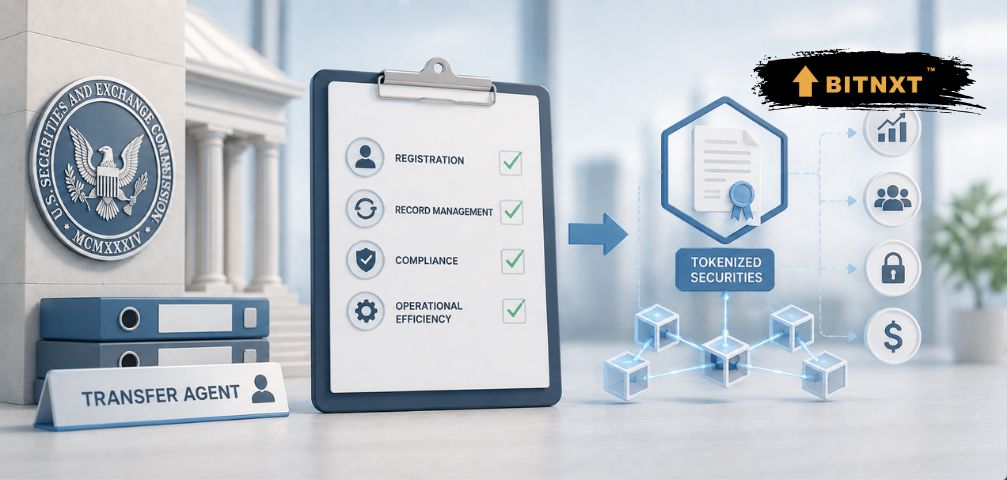
The SEC has proposed the first transfer agent rule overhaul in more than four decades, updating requirements written for paper stock certificates so they cover the blockchain-based recordkeeping systems now entering regulated U.S. markets — a change that could define how tokenized securities prove who actually owns what.
Most of the commission's transfer agent requirements date from the late 1970s and early 1980s, when investors commonly held paper certificates and firms processed ownership changes manually. Transfer agents maintain an issuer's official ownership records, register securities transfers, monitor authorized issuance and often process dividends, interest payments and fund redemptions. As the SEC noted in the proposal, "market participants are actively seeking to bring blockchain-native, or 'onchain,' transfer agents into the U.S. market" — with systems for distributed-ledger shareholder records, tokenized fund administration and cross-chain interoperability.
Digital records get real standards
The proposed amendments to Rule 17ad-7 would require transfer agents using electronic recordkeeping to install controls protecting the integrity, availability, reproducibility, redundancy and continuity of their records. Records would need protection against unauthorized alteration, deletion or destruction, and firms would have to maintain an audit trail identifying who accessed, changed or deleted a record, with the date and time of each action or attempted action. For regulatory examinations, systems must produce records immediately in human-readable and reasonably usable electronic formats, with recovery controls for damaged, altered or lost information.
Although the framework applies to blockchain systems, the SEC described its approach as technology-neutral — the rules would not prescribe one type of database or require transfer agents to adopt distributed ledgers. Recent registrations show why the standards matter: Injective Institutional Services secured transfer agent registration in August, and Superstate registered its blockchain-based transfer agent in March 2025 to support tokenized funds. Neither registration exempts the firms or their products from federal securities laws.
Transfer agent safeguards extend to cyber risk
The transfer agent overhaul also rewrites Rule 17ad-12, replacing requirements centered on physical certificates with a risk-management framework covering both paper and uncertificated securities. Registered transfer agents would adopt written policies protecting securities and funds from theft, loss, misuse, damage and unauthorized access, and would have to identify, monitor and reduce material custody, operational and cybersecurity risks. Client and issuer funds would need to sit in a separate bank account designated as a "for the benefit of" account — keeping customer assets outside the firm's general estate during insolvency. Business continuity plans, tested and updated periodically, form another pillar.
The scale is large: of 253 transfer agents that filed Form TA-2 for the 2025 reporting year, 152 acted as recordkeeping transfer agents and 126 provided paying-agent services, together distributing about $5 trillion in dividends and interest. Third-party reliance is already common — 44% of transfer agents used a service company for at least part of their work in 2025 — and the proposal makes clear that using an outside technology provider does not remove the registered agent's regulatory duties, while new reporting gives the SEC visibility into those arrangements.
The tokenized ownership question
For investors, the proposal addresses the most contested issue in tokenization: a token's presence on a blockchain does not by itself determine legal ownership of the underlying security. Transfer agents remain responsible for the official shareholder register, which governs voting rights, dividends, stock splits, tender offers and insolvency claims. Two industry groups warned the SEC in July that tokens created without an issuer's approval may not provide the same rights as issuer-backed shares — Continental Stock Transfer & Trust and the Securities Transfer Association asked the regulator to distinguish securities tokenized by an issuer from products created by unrelated platforms that merely track a stock price.
The proposal also introduces requirements for restrictive legends — the notations that limit whether a security can be transferred — and paying-agent services, both of which acquire new complexity when shares move as tokens. Public comments remain open for 60 days after Federal Register publication, and the proposing release is available through the SEC's official site.
The transfer agent overhaul lands amid a remarkably active stretch for the commission, which has simultaneously proposed a standalone crypto offering framework and signed a market integrity pact with the FDA. The common thread is unmistakable: the SEC is building plumbing rules for a market where securities increasingly live onchain — and it is doing so before Congress finishes legislating, not after. Tokenized equities are coming to market worldwide, and whoever controls the ownership records controls the trade.


