





























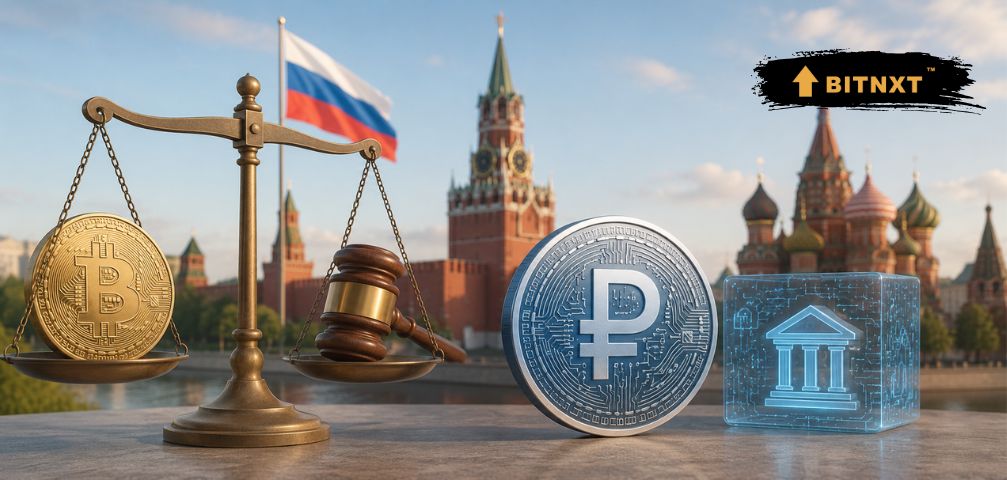
What the law actually says
The legislation, formally titled "On Digital Currencies and Digital Rights" and signed by President Vladimir Putin on Aug. 4, creates a supervised market for cryptocurrency trading, custody and cross-border settlement, with the Bank of Russia licensing and overseeing exchanges, brokers, management companies and organized trading venues. Non-qualified retail investors face a knowledge and suitability test before trading, then may purchase up to 300,000 rubles — roughly $3,700 — of approved crypto per year through each licensed intermediary. Qualified investors pass a separate assessment and trade without limits.
The Bank of Russia proposed three assets for regulated retail trading: bitcoin, ether and USDT, selected for market capitalization, trading volume and at least five years of price history. Every other token remains off-limits to ordinary buyers on licensed platforms. Market participants have a transition period through July 1, 2027 to obtain licenses. Crypto holdings are now classified as property with gains subject to income tax, and residents must declare all foreign crypto wallets to tax authorities.
The retail cage
The 300,000 ruble annual cap is a constraint, not an on-ramp. A Russian retail investor wanting meaningful exposure would need accounts at multiple intermediaries, each requiring a separate suitability test, to build a position a single offshore trade could fill. The cap applies per intermediary, not per investor, creating a workaround the law does not close. Peer-to-peer trading — an estimated 80% of Russia's crypto activity — remains technically legal but unregulated.
SberCIB Investment Research projects regulated exchanges will capture roughly 20% of the country's estimated 18 trillion ruble annual crypto market in the first year, reaching about 4 trillion rubles ($46.4 billion), with the share climbing to 7.5 trillion by 2029. Russia became Europe's largest crypto market by inflows, recording $376.3 billion between July 2024 and June 2025 according to Chainalysis data — volume that moved through Telegram-based OTC desks, peer-to-peer platforms and offshore exchanges accessed through VPNs. The new law creates a legal alternative without shutting down the existing one.
Sanctions and the cross-border off-ramp
The most consequential provision has nothing to do with retail. The law permits Russian exporters and importers to settle cross-border contracts in cryptocurrency without transaction limits, while domestic crypto payments remain fully banned. The dual-track structure codifies what was already happening: Russia spent 2024 and 2025 running informal crypto-facilitated trade estimated at roughly $11 billion per year to circumvent Western sanctions on energy exports. Putin himself said bitcoin "has the right to exist and can be used as a means of payment," framing the law as pragmatic acceptance.
Critics call the unlimited cross-border channel a sanctions-evasion off-ramp, and the numbers give the concern weight. Earlier projections anticipated exactly this scale, and the framework now puts a regulatory veneer on flows that previously operated in legal ambiguity.
Digital ruble arrives with fraud crackdown
The digital ruble became mandatory for Russia's 12 systemically important banks and large retailers with annual revenue above 120 million rubles, with full rollout to all banks by September 2028. On the same day, the Bank of Russia blacklisted 2,600 crypto wallets linked to suspected scams after more than 1 billion rubles flowed through them in the first half of 2026. The central bank found 74% of identified pyramid schemes used crypto.
Three policies launched together tell one story: the state wants to know what citizens hold, move retail speculation into a licensed and surveilled channel, and give industry a state-free rail for cross-border trade. Whether the contradictions hold together is now the question for the world's largest country by landmass. G20 governments pledged clearer digital asset rules this year; Russia's version shows how differently those rules can look in practice.


