






























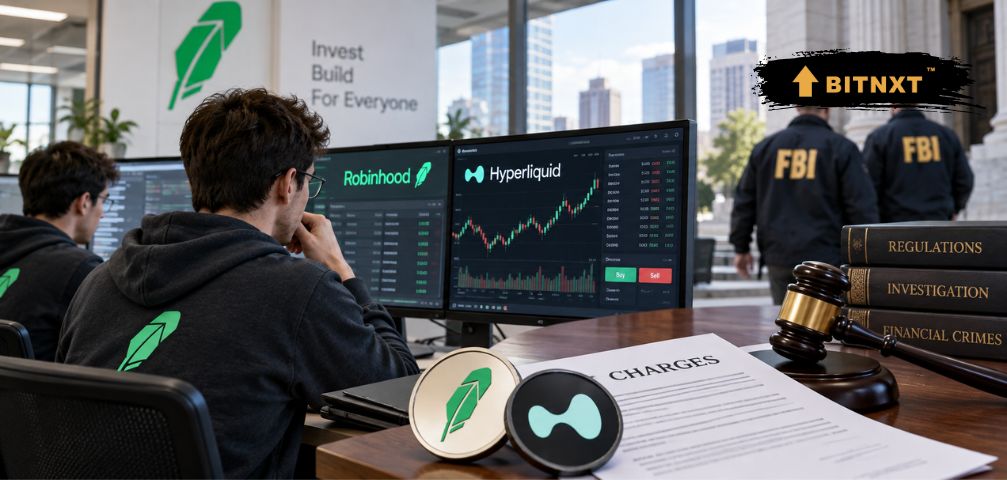
Two Robinhood software engineers thought decentralized perpetual futures would launder their insider edge into legal profits, and federal prosecutors just explained, in criminal charges, why that theory is wrong. The U.S. Attorney's Office for the Southern District of New York and the FBI announced charges on September 15 against Hefu Chai, 36, and Huaisong Xiang, 30, alleging the pair exploited confidential Robinhood Crypto listing schedules between 2025 and 2026, opening perpetual futures positions on the decentralized platform Hyperliquid before official listing announcements and closing them into the post-announcement price surges, generating over $50,000 each in illicit profits. Each defendant faces one count of commodities fraud, up to ten years, and one count of wire fraud, up to twenty, with Chai scheduled in the Northern District of California and Xiang before SDNY Magistrate Judge Ona T. Wang. Robinhood customer funds were unaffected, and the company is presumably reading its own access logs this week.
The doctrinal sentence belongs to U.S. Attorney Jamie McDonald: "Misappropriating confidential information to trade in the derivatives markets for personal benefit is illegal" — regardless of where the trades were placed.
The Anatomy of the Robinhood Insider Trading Case
The scheme's design reveals what the defendants understood about markets and misunderstood about law. Spot tokens on centralized exchanges require KYC and leave an identity trail, so the pair allegedly routed their trades through Hyperliquid's decentralized perpetuals, using protocol features to position ahead of listings without an account in their name, a laundering instinct that treated venue anonymity as legal immunity. The DOJ's theory collapses that distinction in one stroke: the crime is not where the order matched, it is the misappropriation of confidential information from their employer, and the fact that the instrument was a synthetic derivative rather than the underlying token makes it commodities fraud, not an escape hatch, an extension of insider-trading doctrine into DeFi that the industry has long feared and never quite believed would arrive this directly. The precedent now sits alongside the regulatory normalization of Hyperliquid's fee regime as the second data point that the venue's users are fully visible to federal prosecutors, and it validates the enforcement posture that 2026's chain-forensics era has made routine: pseudonymous wallets are traceable, and trading on stolen information through them just adds wire fraud to the charge sheet.
What the Case Exposes About Exchanges and Enforcement
The corporate security angle deserves more attention than the indictment's framing gives it. Two mid-level engineers accessed listing schedules confidential enough to move prices, which means the information architecture at Robinhood Crypto, a NYDFS-licensed platform, allowed ordinary technical staff to see market-moving secrets, and every exchange in the industry now has to ask the same question about its own listing pipelines, the same insider-information perimeter problem the sector brushes off until an arrest makes it concrete. For decentralized venues, the case is the clearest statement yet that DeFi is not a jurisdiction: an on-chain order book with no CEO still has counterparties whose trades can be read, timed, and subpoenaed, and the FBI's assistant director for the case said the action demonstrates that employees who abuse insider information "for profit" will be prosecuted, full stop. The measured caveats: these are allegations, the defendants are presumed innocent, and $50,000 each is a small scheme compared to the bigger structural fights Robinhood is in, but small schemes are how doctrine gets made, and this one will be cited in every enforcement manual by year-end.
What to Watch
Watch whether Robinhood discloses access-control changes or names the pair in securities filings, which would signal the company treating this as a control-failure rather than a rogue-employee story; watch whether the SEC files a parallel civil case, extending the misappropriation theory to tokens the courts have not yet called securities; and watch how Hyperliquid responds, if it is anything, because the venue now carries the distinction of being the first DEX named in a DOJ insider trading indictment. The lesson of the case is short enough for a lock screen: the blockchain remembers everything, and so does the FBI.


