






























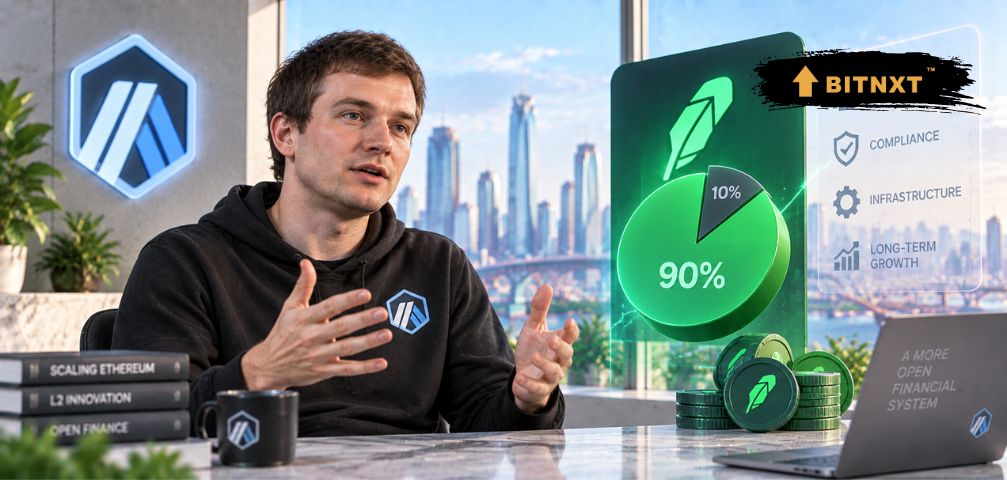
"Robinhood chose Arbitrum so they could be a landlord and not a tenant." Steven Goldfeder, co-founder of Offchain Labs, posted that line on Sept. 5 in defense of Robinhood Chain's fee structure against Solana co-founder Anatoly Yakovenko, and in one sentence he explained the entire app-chain thesis better than any whitepaper has: the point of owning your own rollup is that you keep the rent.
The dispute started with Yakovenko's argument that on Solana, Robinhood would not pay infrastructure middlemen. Goldfeder's reply laid out the actual deal: under Arbitrum Orbit's expansion program, Robinhood retains roughly 90% of net protocol revenue generated on its chain, with 10% remitted to Arbitrum, split eight points to the Arbitrum DAO treasury and two to the Developer Guild. On Solana, Robinhood would retain zero, subsidizing user gas out of pocket while validators and stakers collect everything. The landlord metaphor is doing heavy lifting, but the economics are accurate.
"I have a ton of respect for @toly but this is a ridiculous take. On Arbitrum, Robinhood keeps 90% of gas fees. On Solana they would retain 0 and any gas fees they subsidized would come out of pocket. Robinhood chose Arbitrum so they could be a landlord and not a tenant." — Steven Goldfeder (@sgoldfed), September 5, 2026
The Robinhood Chain fee math, honestly stated
Three caveats before the thesis gets treated as proven. First, the 90% applies to net protocol revenue, after Ethereum L1 blob fees and infrastructure costs, not to gross fees collected from users; Goldfeder's own framing requires the deduction. Second, the revenue is concentrated: on-chain research by Bitquery found Robinhood Chain gas prices spiked 25-fold over 11 days, driven by a small group of high-frequency whale wallets, with memecoin launchpad Pons, the GMGN trading bot and Uniswap driving the majority of activity. ARK's finding that most flow comes from existing degens rather than new Robinhood customers lands here with force: the landlord's tenants are currently a handful of bots. Third, the 90-day gas subsidy that made all this activity free ends Sept. 29, and when users start paying real gas, both the volume and the revenue face a cliff no fee-share structure can absorb.
Who is actually the landlord here?
Yakovenko's implicit counter deserves its due: Robinhood is a landlord on its own chain but a tenant of Ethereum's data availability layer, paying for every blob its sequencer posts, and a tenant of Arbitrum's Orbit stack, governed by the DAO it pays rent to. The choice is not between paying rent and owning free property. It is between paying rent to Ethereum plus a 10% share to Arbitrum, or paying 100% of fee value to Solana validators while being one app among thousands. For a fintech that wants tokenized equities to settle on infrastructure it controls, the Orbit math wins even with the subsidy distortion.
The market context makes the argument urgent beyond two founders trading barbs. Robinhood Chain's volume records and Pons's fee machine made this the loudest launch of 2026, and every major fintech watching is deciding whether to build a chain, an app, or nothing. Sept. 29 is the experiment's control day: when free gas ends, we learn whether the landlord has tenants who pay rent, or just squatters who came for the free utilities. Until then, take both founders' confidence with the discount each applies to the other's chain, and watch the post-subsidy fee prints, because they settle this argument in the only court that matters.


