





























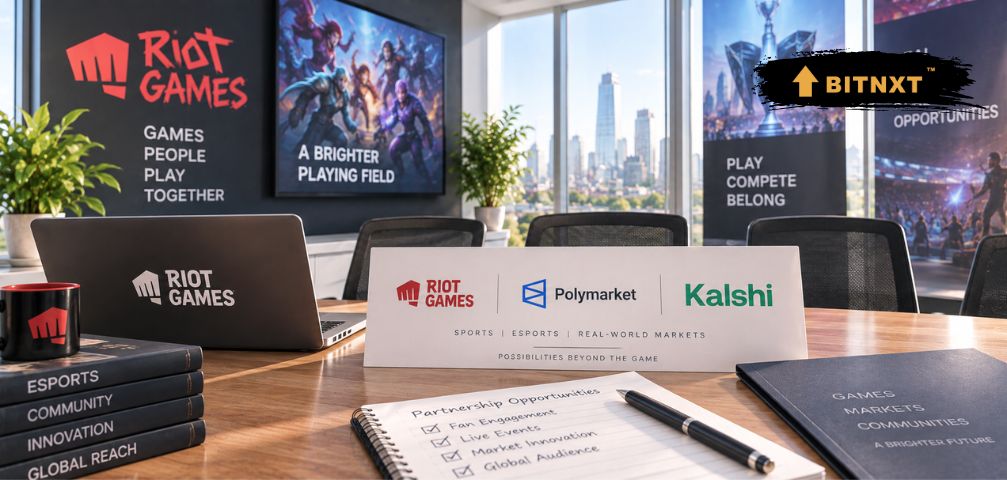
Riot Games is in sponsorship talks with Polymarket and Kalshi, and the reason the gaming giant is at the table is a number it cannot ignore: $10.7 billion. That is how much was bet on League of Legends and Valorant matches in 2024 according to Sportradar data cited by Riot, and almost all of it flowed through unregulated bookmakers, meaning the publisher of the world's biggest esports earns nothing from the betting volume its competitions generate while carrying the match-fixing risk that volume implies. Per Bloomberg, the talks with the two U.S. prediction market operators are private and preliminary, focused on potential commercial deals across Riot's competitive ecosystem ahead of October's League of Legends World Championship, and Riot has committed to nothing. "Prediction markets are an emerging space that we're evaluating with a focus on safeguarding competitive integrity, potential value for teams, impact on the fan experience, and alignment with our broader ecosystem goals," Riot spokesperson Joe Hixson said.
What the Riot Games Prediction Markets Talks Are Really Selling
Two structural facts shape these negotiations. First, the data gate: any approved sponsor must source official live match data through GRID Esports, and Polymarket already partnered with GRID in June for server-direct feeds, so a deal converts grey-market betting into licensed, publisher-controlled data revenue, monetizing an activity Riot cannot stop and currently does not touch. Second, the volume wave the sponsors bring: combined monthly volume across Kalshi, Polymarket, and Polymarket US hit a record $50.59 billion in July, and the sports segment is where that money is heading, from Kalshi's institutional election-market expansion to the LeBron James partnership and now esports. Sponsorships supply up to 60% of esports team revenue by some NewZoo estimates, and Riot's franchise system means a category sponsorship lifts entire leagues, which is why both operators are bidding: esports audiences are the youngest, most digital-native demographic in betting-adjacent media, and prediction markets are in a land grab for their attention and liquidity.
Integrity and the Legal Minefield
Now the two things that could kill it. Integrity: esports match-fixing is a documented, persistent problem, and prediction markets, where anyone with inside knowledge of a team's scrim form or roster change can trade it, would need the surveillance stack Kalshi runs, its proprietary Poirot system plus Solidus Labs, IC360, and Whorton, and Polymarket's Vergence AI built with Palantir and TWG AI, to police a publisher's own competitive ecosystem. Riot's games are global, and regional integrity incidents become global market events. Legality: the sector is under active legal fire in the United States, with Washington state's preliminary injunction against Kalshi sports markets from July, Baltimore's August lawsuit against Kalshi, Polymarket, Coinbase, Robinhood, and Webull, and the NFL deliberately holding back from prediction market sponsorships over exactly this uncertainty, the same caution that has regulators worldwide weighing integrity versus access. A Riot deal before the legal fog clears would be the boldest publisher move yet into that fog.
Watch for an announcement before the Worlds championship in October, and for the integrity-disclosure terms: if a deal requires operator-funded surveillance and Riot data escrow, the esports prediction market era starts. If talks leak again with no deal, the state lawsuits won.


