





























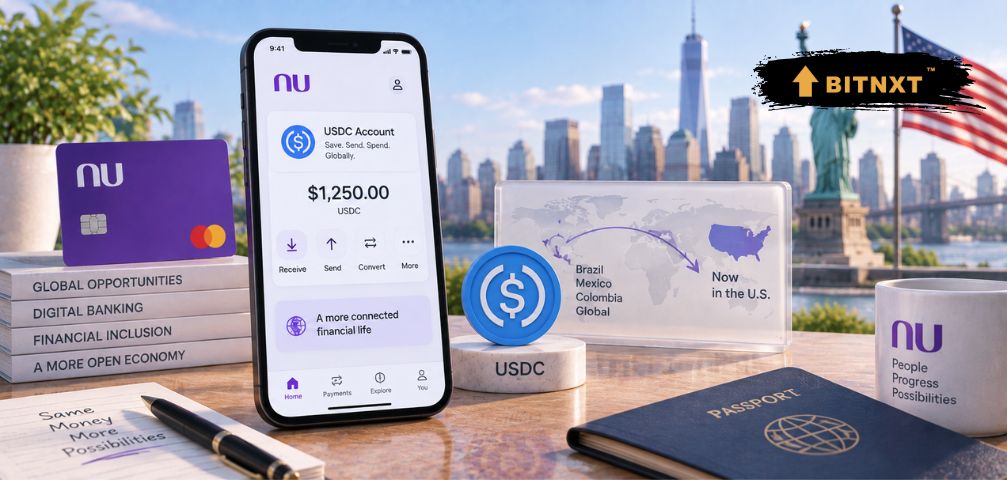
Nu, the NYSE-listed parent of Nubank, launched U.S. accounts on September 10, and the Trojan horse is yield. The Nu Account, offered through partner Lead Bank, pays 3.50% APY daily interest, rising to 4.50% on balances up to $10,000 for users with an account, a credit card, and three transactions in the prior 34 days, alongside a $0-annual-fee Mastercard World Elite metal credit card with 1.5% cashback, or 2.0% for qualifying users. The parallel Nu Global international account, live across 35+ countries in Europe and Latin America, is the more structurally interesting product: deposits convert into Circle's USDC and EURC stablecoins, paying daily yields of 3.50% APY on USDC and 2.20% APY on EURC, with a virtual Mastercard carrying $0 FX fees and BTC and ETH trading built in. "USDC and EURC are coming to Nu Global," Circle confirmed on X, calling it "integrating Circle stablecoins into its new multi-currency digital account... fast money movement across 35+ countries."
The company behind the launch is not a startup experiment. Nu serves more than 140 million customers, over 60% of Brazilian adults, runs Mexico's largest digital bank and Colombia's fourth-largest financial institution by deposits, and just posted its first $1 billion-plus quarter: $1.06 billion in net income, up 49% year over year on a currency-neutral basis, on $5.88 billion of revenue, up 39%, with risk-adjusted net interest margin expanding from 9.9% to 12.4%.
Why Nu Global Is a Stablecoin Distribution Machine
The strategic read is that Nu has become one of the largest stablecoin distribution channels in the world overnight. A 140-million-customer bank converting retail deposits into USDC and EURC, and paying yield on them, does more for stablecoin adoption than most crypto companies achieve in a decade, and it lands in the exact market where stablecoin wallets are already competing as money hubs and Circle is acquiring cross-border rails like Tazapay. The U.S. structure is the patient part: Nu applied for its own "Nubank, N.A." charter in September 2025, received conditional OCC approval on January 29, 2026 with 12 months to capitalize and 18 to open, and is targeting a full bank launch in 2027, per U.S. CEO Cristina Junqueira, who called the launch a "multi-decade journey" in founder David Vélez's framing. Lead Bank carries the FDIC insurance and the regulatory weight until then.
The Yield Fine Print
Now the part that regulators and readers should both note: the Nu Global stablecoin yields, 3.50% on USDC, 2.20% on EURC, are not FDIC-insured deposits, and the mechanics of the yield, who generates it, who bears the reserve risk, what happens in a redemption squeeze, were not disclosed. Stablecoins in a bank app get bank-app trust from users who do not read the distinction, and that is both the adoption engine and the regulatory question. There is also a competitive squeeze risk: the yield is a customer acquisition cost that compresses Nu's own 12.4% margin story if usage scales, and the pending Fed and FDIC approvals for the national charter could change the stablecoin product's shape mid-flight, in a year when even the Federal Reserve itself is studying stablecoins' place in money stock.
Watch the OCC charter's capitalization milestones and whether USDC balances in Nu Global get a public attestation. When 140 million customers meet stablecoin yields, someone will ask exactly whose money is doing what.


