


























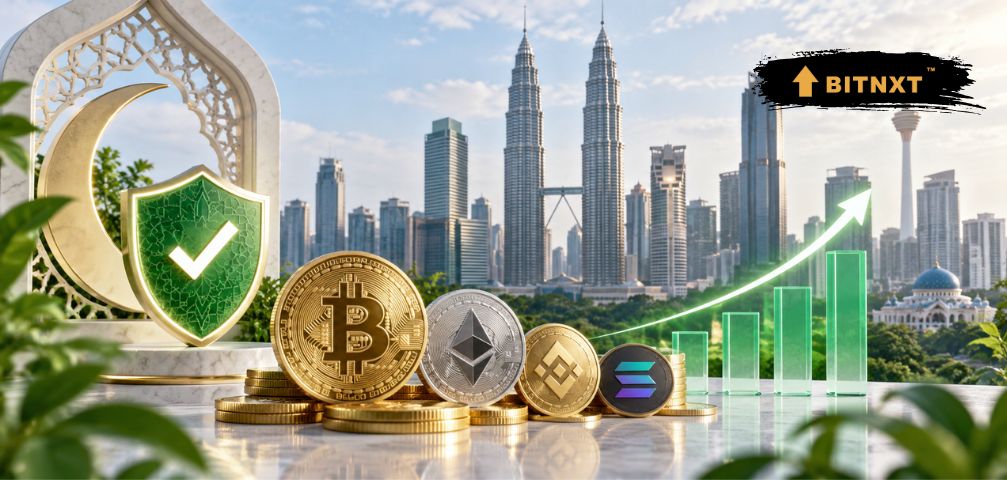
Malaysia's regulated crypto exchanges traded RM17.14 billion, more than $4 billion, in 2025, up 23% from RM13.93 billion the year before, and Fitch Ratings says the country has become one of the most open Islamic-finance markets for regulated digital assets because it paired licensing with a national Shariah framework. The rating agency's September 16 analysis counted ten regulated digital-asset businesses by mid-2026 across three categories, five Digital Asset Exchanges, two initial exchange offering platforms and three custodians, and the Securities Commission Malaysia's own data independently confirms the trading figure. The number that contextualizes it: regulated crypto trading equals only about 2.5% of Malaysia's domestic equity market turnover, so the growth story is real but the scale is still small.
The investor base grew roughly 29% from 2024, 23 digital assets are listed on recognized exchanges, and stockbrokers now offer digital-asset futures access alongside fund managers running crypto strategies, per the regulator's annual report.
The Shariah Screening Layer That Makes Malaysia Different
Malaysia's framework is the only one of its kind at national scale: the SC's Shariah Advisory Council resolved in 2020 that regulated digital currencies can qualify as mal, property, under Shariah, making investment and trading permissible on SC-registered exchanges when requirements are met. Bitcoin, Ether, XRP and Litecoin received Shariah-compliant status at the July 2020 meeting, Bitcoin Cash followed in 2021, later decisions covered Solana, Cardano, Chainlink, Uniswap, Avalanche, Polkadot and Stellar, and from March 30, 2026, exchanges offering additional currencies as Shariah-compliant must obtain the council's endorsement under revised Islamic capital-market rules. That combination, a formal licensing structure plus a functioning religious-interpretation layer, is what Fitch identifies as Malaysia's comparative advantage, and it stands out against the divided global picture the agency documented: the UAE's Higher Shari'ah Authority deemed Bitcoin permissible in 2025 and VARA-supervised entities handled nearly $680 billion of 2025 transaction volume with over $2.5 billion in assets under management, echoing the MENA volume explosion we tracked earlier this year, while Bahrain licensed its first stablecoin issuer and Qatar concentrated on asset-backed infrastructure. The contrast with the UAE's state-backed stablecoin retail pilots is instructive: Malaysia built jurisprudence, the Gulf built commerce.
What Fitch Actually Concluded
The rating agency's sober read deserves the emphasis it gave: Islamic banks have yet to generate material revenue from direct crypto trading, brokerage, custody or financing, and Fitch expects cryptocurrency products within Islamic finance to "continue developing gradually in some jurisdictions," not uniformly, because Shariah interpretations differ and neither AAOIFI nor the IFSB has issued formal crypto guidance, which "limits harmonisation across jurisdictions." Bank participation in Malaysia remains largely confined to services provided to the regulated operators themselves, and the agency flagged the risk side honestly: deeper bank participation generates fee income but exposes Islamic banks to operational, liquidity, compliance, reputational and Shariah-compliance risk. The May 2026 revision of the SC's DAX rules, streamlined product introduction plus higher client-asset protection, governance and financial-resource requirements, shows the regulator tightening the frame as the market grows, and DAX operators join the Financial Markets Ombudsman Service during 2026, giving retail investors formal dispute resolution for the first time. Enforcement continues in parallel: the SC has acted against four unregistered exchanges and worked with Google to restrict promotion by unauthorized operators, while Bybit's $8 million investment into regulated exchange Hata, which processed RM1.04 billion in 2025 volume, shows offshore capital buying its way into the licensed perimeter rather than fighting it.
The Stablecoin Track Runs Separately
The more consequential Malaysian experiment may be the one not counted in the RM17.14 billion. Bank Negara Malaysia's Digital Asset Innovation Hub is testing ringgit stablecoins and tokenized deposits through three initiatives confirmed in February, covering wholesale domestic and cross-border payments and tokenized-asset settlement, with Shariah considerations examined in some tests, an asset-tokenization working group that includes Maybank, CIMB, AmBank, Hong Leong, RHB, Kenanga, MIDF and Standard Chartered, and clarity promised by end of 2026. The central bank's framing is deliberate: this is experimentation with tokenized money, not permission for unrestricted bank crypto trading, and the distinction between a payment-system pilot and a retail speculation license is exactly the line Islamic-finance regulators must hold.
What to Watch
Watch the end-2026 ringgit stablecoin clarity from Bank Negara, which converts the tokenization pilots into policy or shelves them; watch whether the SC's Shariah endorsement regime expands the compliant asset list, since each addition reopens a distribution channel Islamic markets cannot access elsewhere; and watch whether Islamic banks convert their operator-services exposure into direct participation, the inflection Fitch says has not happened yet. Malaysia proved a regulated Islamic crypto market can grow 23% a year. The next proof is whether its banks can profit from it.


