





























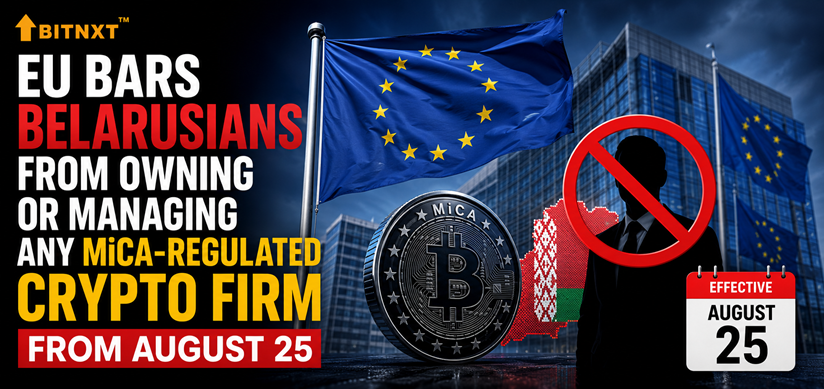
The European Union has significantly widened its crypto sanctions against Belarus, moving from a narrow restriction on custody services to a blanket prohibition covering every category of regulated crypto business in the bloc. Under Council Decision (CFSP) 2026/1847, adopted Thursday, Belarusian nationals and residents will be barred from owning, controlling, or managing EU-based crypto exchanges and other MiCA-regulated service entities from August 25.
The underlying legal instrument entered into force on July 24, with the expanded crypto provision taking effect a month later — giving affected firms a narrow window to review their ownership and governance structures.
From Custody to Everything
The scope change is the substance of the story. The previous restriction applied only to companies providing crypto wallet, account, or custody services. The amendment broadens it to cover “any other crypto-asset services” falling within MiCA's regulatory categories.
That matters because MiCA's service definitions are expansive. They cover operating trading platforms, exchanging crypto assets, executing and transmitting client orders, placing crypto assets, providing transfer services, and offering investment advice or portfolio management. The prohibition therefore reaches deep into market infrastructure and client-facing financial functions rather than stopping at retail wallets.
Under the amendment, Belarusian nationals and residents are barred from two things specifically: owning or controlling an EU-based entity providing those services, and holding positions on its governing body. The second prong is the one compliance teams will feel most immediately — board composition is a slower thing to change than a client list.
The Timing Is Not Accidental
The expansion lands weeks after MiCA's transition period closed on July 1, the deadline by which crypto firms operating in the bloc had to hold proper authorization or wind down operations. That sequencing compounds the pressure: firms that spent the past year securing MiCA licenses must now also verify that their shareholders and directors don't fall foul of a sanctions rule that didn't exist when they filed.
For operators, the practical risk has shifted. It is no longer only whether a provider holds MiCA authorization, but whether its ownership and governance structure can survive sanctions screening — two compliance regimes that now have to be satisfied simultaneously.
You might also like: The SpaceX Bitcoin Proxy Myth Dies on One Division: 18,712 Coins Are Eight Basis Points of the Company
Part of a Wider Squeeze
The Belarus measure sits inside a much broader EU effort to close crypto pathways it views as supporting Russian sanctions evasion. On the same day, within its 21st sanctions package against Russia, the bloc extended a transaction ban to 14 crypto-related service platforms outside the EU, and introduced a mechanism allowing it to prohibit dealings with any foreign crypto provider used for evasion. That builds on a June 11 proposal targeting 11 platforms.
It also follows April's 20th sanctions package, which barred EU persons from transacting with crypto service providers and DeFi platforms established in Russia and Belarus, and blacklisted the ruble-pegged stablecoin RUBx alongside a pre-emptive block on the digital ruble — the first time a major jurisdiction named a sovereign stablecoin and CBDC in sanctions.
Other jurisdictions have moved in parallel. The UK sanctioned Huobi Global S.A., the Panamanian entity behind HTX, on May 26 over alleged support for Russia-linked financial networks involving A7 and Garantex. HTX denied wrongdoing, saying regulatory compliance remains a priority and that it adheres to the frameworks of the jurisdictions where it operates.
What Firms Should Do Now
The pattern across these measures is worth naming: the EU is using sanctions as both a direct instrument — blocking specific providers and transactions — and an indirect governance lever, restricting who may control or manage regulated entities. The second approach is harder to circumvent, because it targets the corporate structure rather than the transaction flow.
For EU-regulated crypto firms, the immediate task is a review of controlling interests and board membership against the August 25 deadline. A licence that satisfies MiCA is no longer sufficient on its own if the cap table or the boardroom doesn't clear the sanctions test.
Source: Based on Council Decision (CFSP) 2026/1847 and reporting via Cointelegraph, CoinDesk, Chainalysis and TRM Labs. This article is for informational purposes only and is not legal advice; firms should consult qualified counsel on sanctions compliance.


