






























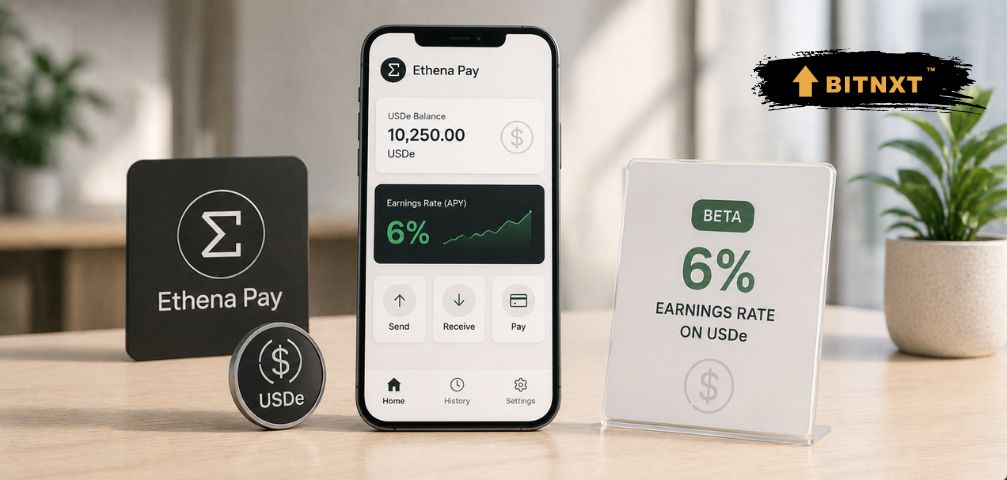
Ethena Pay has launched in beta, offering annual reward rates of up to 6% on USDe balances alongside a Visa payment card and self-custodial mobile wallet. The platform brings Ethena’s synthetic dollar into everyday payments across 49 countries, with Avalanche providing the underlying settlement infrastructure. The app initially opens to an early-access group of 400 users, with additional participants expected to be added weekly throughout September. Available on iOS, Ethena Pay combines a self-custodial crypto wallet with bank transfers, fiat on-ramps, and a Visa card. Users can hold balances in USDe and send payments to other users through usernames or payment tags rather than lengthy blockchain addresses.
How Ethena Pay balances and rates work
Users receive fiat through assigned International Bank Account Number details or transfer crypto directly; either way, the balance appears as USDe. Withdrawals to external bank accounts convert into the recipient's local currency. Transfers between app users carry no fee, and U.S. dollar, euro and British pound bank transfers are free, while other bank transfers cost between 0.05% and 0.1%.
The rewards structure splits across Standard, Pro and VIP tiers. Standard users can receive up to 5% on eligible balances capped at $5,000, Pro users up to 6% on $15,000, and VIP users 6% on as much as $50,000. Rather than paying a separate 6% on top of USDe's existing rate, Ethena Pay uses a "Daily Boost" that tops balances up to the advertised tier rate — shrinking if the USDe base rate rises, growing if it falls. The boost is paid in USDe within 24 hours after each accrual day and requires at least one qualifying card transaction per calendar month. Standard membership is free, while Pro requires $2,000 in locked ENA or 10 referrals and VIP requires $10,000 or 50.
The fine print matters: Ethena Pay's terms describe the Daily Boost as a discretionary promotional incentive, not interest, yield or a deposit product — and balances are not covered by FDIC or any other government-backed deposit insurance. Ethena Pay Ltd., a Malta-registered software company, states it does not operate as a bank, broker-dealer, investment adviser or money services business, with third-party providers supplying the financial services.
Self-custody meets daily spending
Under the self-custodial design, private keys, seed phrases and recovery details stay on the user's device — Ethena Pay says it cannot access customer assets or restore wallets, which shifts both control and responsibility to the user. The beta is available across Latin America, the Caribbean, Asia, the Middle East, Africa and Oceania, including Brazil, Mexico, Australia, Japan, Singapore, the United Arab Emirates, Kenya and South Africa. The U.S., EU, U.K. and Canada remain excluded, subject to local eligibility rules.
The yield engine behind the app connects directly to Ethena's broader balance sheet. The company and FalconX opened a $1 billion facility in August that uses part of USDe's backing portfolio to finance overcollateralized institutional loans, and institutional lending already accounted for $310 million — 6.9% of USDe's backing — in early July, alongside roughly $2 billion in DeFi lending and $1.2 billion in liquid stablecoins. Yield-bearing dollar accounts are becoming a competitive product category, and Ethena is importing its DeFi-native rate directly into a consumer app.
The strategy mirrors a broader convergence. MEXC's Global Card pairs USDT spending with cashback, and U.S. X Money accounts offer 6% yields on conventional rails — the same number Ethena advertises, delivered through a synthetic dollar. With stablecoin card infrastructure under active attack, the market will judge Ethena Pay on two things: whether the 6% holds, and whether self-custody at consumer scale proves as simple as the App Store screenshots promise.


