





























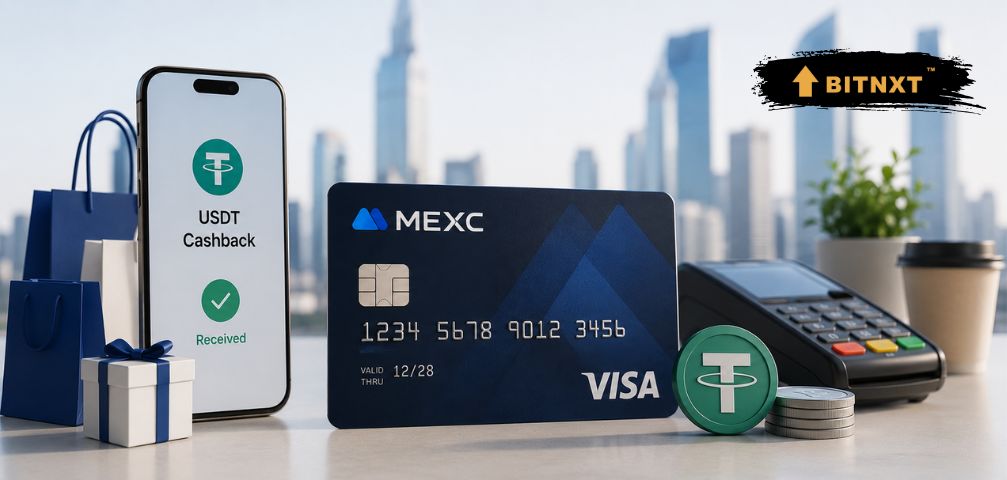
A tiered cashback machine
The card's rewards program pays cashback in USDT based on a user's VVIP status and M-Score, which MEXC calculates from activities such as trading, Earn subscriptions and platform tasks. The Standard level pays 4% with a monthly cap of 100 USDT, Premier users receive 6% capped at 300 USDT, and Elite users can earn 10% up to 800 USDT per month. A user's rate is determined by their VVIP level on the final day of each calendar month, with cashback distributed to the spot account on the 15th of the following month. Refunded and reversed purchases can affect the final reward, and some merchant categories are excluded from earning.
Alongside spending rewards, MEXC offers a separate flexible savings product through MEXC Earn for cardholders, paying an annualized return of up to 7% on subscribed USDT with no lock-up period. The rate applies to USDT subscribed to the Earn product rather than automatically to money available for card purchases, and returns are calculated separately from spending cashback. Yield-bearing stablecoin products keep spreading, and MEXC is packaging spend and save together.
CEO Vugar Usi described the card as part of the exchange's effort to cover more financial activities beyond buying and selling crypto. "We want users to see digital assets not simply as an investment tool, but as part of a complete financial journey, from saving and yield-generating products to principal-protected solutions and, ultimately, everyday spending," Usi said, adding that the card lets users keep assets in digital form until payment time.
Crypto cards are booming
The launch lands on a clear growth curve. According to an August analysis by a16z crypto using Paymentscan data, monthly crypto payment card volume reached $759 million in July, compared with $306 million a year earlier — and less than $1 million when the tracker started in October 2023. Nearly 9 million purchases were recorded in July, up from about 5.2 million, leaving the average purchase at roughly $86. Stablecoins account for most of the activity: USDC and USDT together represented 84% of tracked crypto card spending.
Competitors are building similar bridges between stablecoins and card networks. Fold started issuing its Bitcoin Credit Card to waitlist users in May with a 1.5% base reward, Western Union launched its Stablecard with Rain in August across 37 markets — targeting more than 60 by year-end — and Visa has been piloting stablecoin spending models with WeFi across Europe, Asia and Latin America. The infrastructure behind these cards has also become an attack surface, a risk the sector can't ignore as volume scales.
Limits, verification and the U.S. question
For cardholders making larger payments, MEXC has set the maximum purchase at 80,000 USDT per transaction and the daily spending limit at 1 million USDT — considerably higher than its separate APAC card. Applicants must complete MEXC's advanced identity verification, after which the roughly one-to-two-minute application produces a virtual card usable immediately without waiting for a physical version. The Global Card sits alongside the APAC product and a co-branded card with ether.fi rather than replacing either, and MEXC expanded its RealStocks tokenized equities product earlier in August with recurring investment features tied to stocks like Nvidia and Tesla.
Despite Visa's large U.S. network and growing domestic competition, the Global Card is not available to American users. MEXC's eligibility documentation places the United States on its application blacklist alongside China, India, Indonesia, Turkey and Russia, with eligibility based on proof of address. The exclusion separates MEXC's launch from cards available in the U.S., where MetaMask rolled out its Mastercard-linked debit card across 49 states in February. Major exchanges are racing to add regulated services market by market — and for the world's largest consumer economy, MEXC is keeping the door closed.


