





























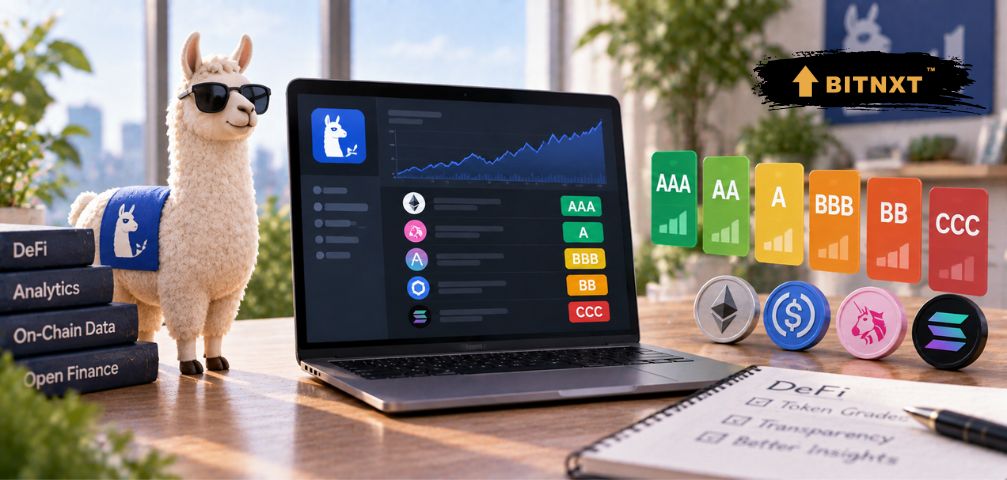
DeFi has a credit rating agency now: DefiLlama and token advisory platform Forgd have launched institutional token grades covering 128 of 149 listed tokens on a AAA-to-CCC scale — with Uniswap holding the dashboard's only AAA at a composite score of 60.80, and an explicit warning that the top grade describes current conditions, not guaranteed returns.
The Universal Token Rating dashboard grades assets by combining what a project discloses with what trading data shows. Uniswap leads with disclosure and performance scores of 7.87 and 7.72 respectively; Meteora follows at AA with 58.48, and Curve DAO ranks third at 53.32. The two component scores range from zero to 10 and — crucially — are multiplied rather than averaged to produce the composite out of 100, meaning a token cannot reach AAA if either component falls below six even with a perfect score on the other axis.
Why multiplication defines the token grades
DefiLlama Head of Research Ryan Celaj explained the design logic: "We're multiplying a project's disclosure and performance scores deliberately, because they are both necessary conditions for credibility. And 'necessary' is the key word. It's not that performance and disclosures both factor in. They're required." A project scoring 10 on disclosure and 2 on performance lands at 20 — where an average would have flattered it. The threshold structure (AAA begins at 60, AA at 40, with narrower bands below) makes the top grades deliberately rare, and the letter format was chosen because institutional traders already read the AAA-to-CCC scale fluently. Celaj is careful about the analogy's limits: the grades do not estimate default probabilities and are not equivalent to traditional credit ratings — they grade observable market and disclosure quality, not solvency.
Uniswap founder Hayden Adams celebrated the result for UNI, calling it "the result of a neutral, unbiased ratings system" and dismissing years of criticism as "crypto Twitter psyops and fud" — a reminder that graders inherit the politics of everything they rank. The protocol's commercial momentum has been the industry's strongest this month, and the AAA lands as validation of exactly that trajectory.
What the token grades actually measure
The performance side examines liquidity, spreads, venue coverage and market-maker conduct — and the market-maker piece is where Forgd's involvement bites. CEO Shane Molidor said her platform monitors more than 500 market-maker engagements through reports and API data, measuring depth, uptime, adherence to targets and each provider's record across mandates. The system separates persistent liquidity from volume temporarily propped up by token loans, options or incentives, and checks how liquidity behaves during volatility, token unlocks and the period after launch incentives end. "We do not determine sustainability from the disclosed contract alone," Molidor said — private terms don't hide observable market behavior.
The disclosure side rewards verifiable information and punishes absence: missing data counts against the score, and projects cannot pick and choose. "The downside is that some ratings will appear artificially low until a project provides the necessary disclosures," Molidor acknowledged. "But the upside is that for projects, there is no downside to being transparent, and no upside to selective disclosure." Material disclosures stale for more than 60 days draw a penalty, verifiable events like unlocks and listings enter automatically, unreliable venues are excluded, and exceptional single metrics are capped so one strength cannot cancel persistent weakness. Governance attacks and tokenomics failures are precisely the events a disclosure-and-performance lens is built to catch early — and exploits remain the sector's costliest grading criteria in practice.
The honest limit is the one both executives volunteer: AAA does not mean risk-free, and the grades say nothing about whether a token's price will rise. What the system offers instead is standardization — a single, continuously updated, methodology-published reference point for the institutional question that has slowed every DeFi allocation: not "is this asset good" but "can this market be measured." For an industry whose 2026 losses are dominated by preventable failures, that is the more useful product.


