




























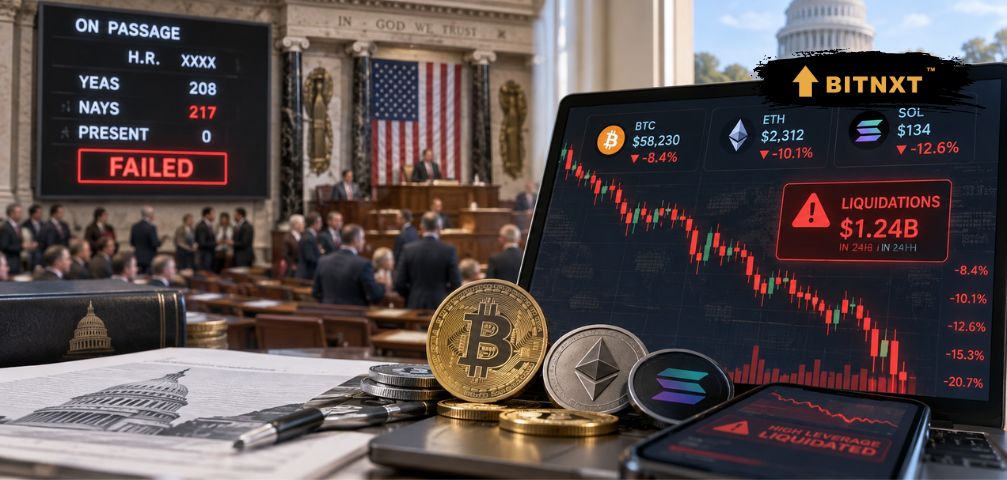
Crypto's leverage class paid the bill for the Senate's failure. Within 24 hours of the CLARITY Act's cloture vote collapsing 49-50 on September 15, exchanges force-closed $571 million in long futures positions, the biggest long wipeout since August 22, with more than $300 million of it liquidated in a single 20-minute window after the vote failed, as one widely shared alert put it: "$300,000,000 longs have been liquidated in just 20 minutes after the US Senate fails to pass the Clarity Act." Bitcoin longs lost roughly $190 million and Ether longs roughly $190 million, with XRP longs down about $30 million and Solana longs about $22 million, while short liquidations totaled only around $100 million. BTC fell 2% to about $75,834, erasing the run toward $80,000, and ETH slipped 1.5% to about $2,483. The equity market told the same story with leverage attached: Coinbase and Circle shares dropped as much as 10%.
The vote itself failed 49-50, eleven votes short of the 60 needed, with all voting Democrats opposed and four Republicans, Collins, Hawley, Moran, and Tillis, defecting.
The Anatomy of a $380M Long Liquidation Cascade
The data explains what the headline number leaves out. A liquidation cascade is a mechanical event: falling prices trigger forced closes, which force more selling, which triggers more closes, and the 20-minute, $300 million burst is textbook cascade dynamics, the same leverage physics we have watched all cycle, from the positioning discipline CryptoQuant warned about when it called the recovery a bear-market reflex to the pattern visible when Bitcoin's approach to $82K failed into a similar leveraged wall. What makes this event analytically interesting is its asymmetry: prediction markets had priced the bill's passage at barely one in ten, as we tracked in the cloture odds gap, yet long positioning was heavy enough that the expected outcome still produced the cycle's worst long flush in a month, meaning traders were either positioned for a surprise pass or, more likely, were running leverage that could not survive a 2% dip regardless of the news. Both readings indict the same practice.
What the Wipeout Actually Signals
The honest interpretation splits into market and policy layers. For the market: the flush has a cleansing read, the weakest leverage is now cleared and spot held $75,000, and a punitive read, every headline risk, legislative or macro, now lands on a derivatives market that is structurally over-levered, and with the Fed decision a day away, the same positioning could cascade again on a hawkish dot plot. For policy: the reaction's severity versus the vote's expectedness shows how much the market had quietly built its Q4 case on regulatory clarity, and the immediate pivot of attention to administrative paths, SEC and CFTC rulemaking under existing authority, is the industry's actual next catalyst now, a point Coinbase CEO Brian Armstrong made within hours: "The SEC and CFTC have the tools they need to create clear rules under existing authority." The procedural footnote matters for expectations: failed cloture is not a bill's death, H.R. 3633 remains on the Senate calendar, and Tillis's vote-with-recommit is the procedural tell that both parties intend to keep negotiating, but any revival now competes with the midterm calendar, which markets read as 2027 at the earliest.
What to Watch
Watch funding rates and open interest over the next 48 hours, since the real signal is whether new longs re-lever immediately or the flush cools positioning ahead of the Fed; watch Coinbase and Circle's share recovery, the cleanest public proxy for institutional regulatory sentiment; and watch the SEC's next rulemaking step, because the market just demonstrated it will trade on agency action the way it once traded on congressional headlines. The Senate voted no, and 20 minutes later the leverage did the rest.


