





























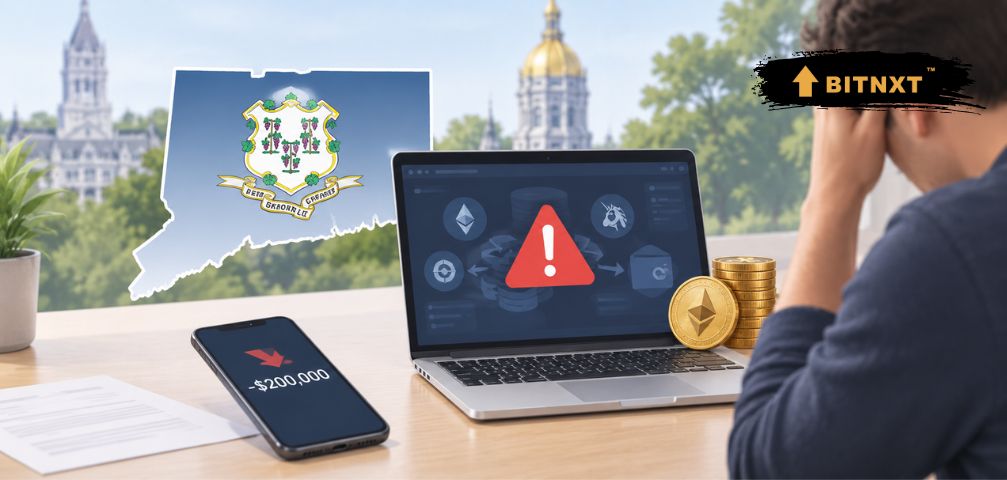
Connecticut has issued a blunt DeFi warning after a resident lost access to $200,000 deposited through an unregulated offshore exchange — a consumer alert that names seven prominent decentralized trading platforms, cites leverage as high as 250x, and lands as US regulators intensify their focus on the perimeter between decentralized branding and centralized control.
Attorney General William Tong and state Banking Commissioner Jorge Perez said a person claiming to know the resident persuaded them to deposit $200,000 into an unregulated decentralized finance exchange. The office did not identify the person, the platform, or when the transfer occurred — but the money is unrecoverable, and the resident is now the centerpiece of the state's cautionary tale. "This isn't innovation, it's exploitation," Tong said. "Do research before handing over any money and know what protections are in place if things go wrong."
What the Connecticut DeFi warning targets
The alert identifies GMX, Gains Network, dYdX, Aevo, Drift Protocol, Vertex Protocol and Hyperliquid as examples of offshore DeFi platforms operating outside US regulatory safeguards — while explicitly not accusing any of the seven of receiving the resident's money. The substance of the warning is structural: some services call themselves decentralized because traders interact through wallets and software, but parts of their operations may still depend on corporate entities, management teams and centralized administrators. State officials argue that operators with centralized control can alter pricing systems, remove products, suspend trading or stop withdrawals — and that wallet-only onboarding, without the identity checks used by registered US financial companies, creates exposure to money laundering, sanctions evasion and transfers tied to state-backed hacking groups.
Leverage is the alert's sharpest edge. Many offshore platforms offer perpetual contracts with leverage of 50x, 100x or as much as 250x — at 100x, a price move of roughly 1% against a position can consume the trader's entire starting margin before fees. The warning also covers perpetual products tracking Apple, Tesla, Nvidia, SpaceX, foreign currencies and commodities, noting that customers may mistake synthetic price exposure for ownership of the referenced shares. No such contract grants stockholder rights, dividends, voting power or a legal claim on the company's assets. The CFTC's own guidance, cited in the alert, advises Americans to use registered exchanges — where perpetuals now trade under federal oversight at capped leverage — and notes that offshore venues with extreme leverage sit largely outside its jurisdiction.
The cross-border pattern behind the alert
Connecticut's warning fits an escalating international pattern. The alert estimates, citing web-traffic data, that 22.6% of Hyperliquid's traffic comes from the United States — despite the platform nominally blocking US users — because some traders bypass restrictions through VPNs or public APIs. The UK's Financial Conduct Authority listed Hyperliquid as unauthorized in May 2026, warning British users they would have no access to the Financial Ombudsman Service or the Financial Services Compensation Scheme. Singapore's Monetary Authority added the platform to its Investor Alert List over unauthorized derivatives activity. Neither warning connects Hyperliquid to the Connecticut loss, but together they describe a single message from three regulators on three continents.
The backdrop is a fraud environment whose numbers dwarf individual losses. The FBI's 2025 Internet Crime Report recorded $7.2 billion in reported US losses from cryptocurrency investment fraud, and US and UK authorities just launched joint operations against scam infrastructure. The crypto industry's own breach record — 5,411 customer records exposed at Pocket Bitcoin being only the latest example — keeps proving the same asymmetry the alert is built on: when something goes wrong on an unregulated offshore venue, there is usually no one to call. Connecticut has already prohibited crypto kiosks statewide since January 2026; the DeFi warning extends the same protective logic to wallets and perps. The industry's response will define the next regulatory fight — the platforms argue their code is neutral infrastructure, while regulators increasingly argue that whoever controls withdrawal switches is a financial institution, whatever the marketing says.


