





























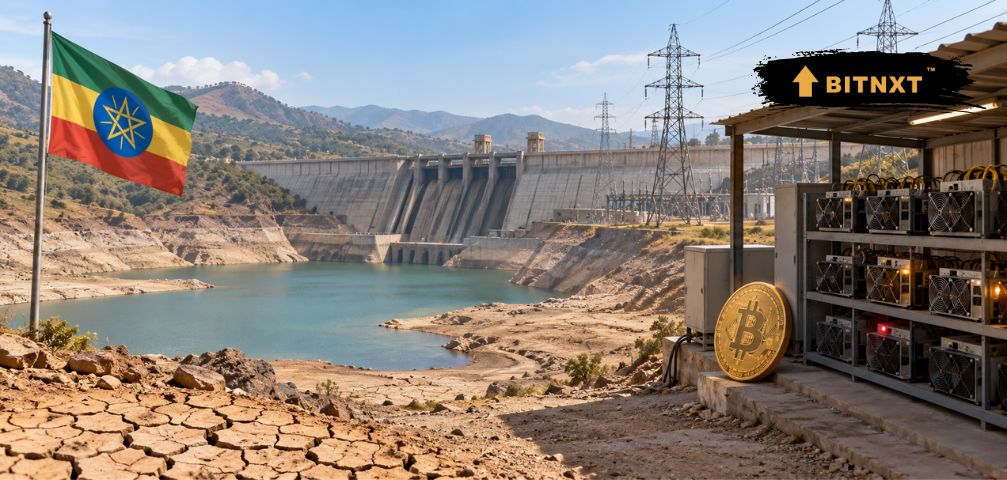
Ethiopia has cut power supplied to Bitcoin miners to 23% of contracted levels, and the reason is not regulation but weather: reservoir inflows have dropped 20% as El Niño intensifies dry conditions across East Africa, forcing state-owned Ethiopian Electric Power to prioritize households and manufacturers over the industry that had become its fastest-growing customer. EEP CEO Ashebir Balcha said the utility staged the cuts deliberately, first to 75% of contracted deliveries, then 50%, then 23%, with a reassessment scheduled for October, and further reductions or restrictions on electricity exports to neighboring countries remain possible if water levels do not recover. The scale of the exposure is what makes this more than a local story: Bitcoin miners consumed almost one-third of Ethiopia's electricity output and generated 35% of EEP's revenue during the last fiscal year, per Bloomberg, meaning the state utility is now rationing its single most important growth customer to keep the lights on.
The cuts land on an industry already squeezed from every other direction, and they arrive as the world's hydro-heavy mining geography gets a stress test it did not schedule.
How Ethiopia Became a Mining Hub and Why It Stumbled
Ethiopia's rise as a mining destination was built entirely on cheap hydropower. Miners were consuming roughly 600 megawatts in October 2024 against about 5,200 MW of installed national capacity, hydropower supplying most of it, and the country expanded generation further around the Grand Ethiopian Renaissance Dam while international operators piled in, including Abu Dhabi-listed Phoenix Group, which raised its Ethiopian capacity to 132 MW in April 2025 after adding a 52 MW facility. The Cambridge Centre for Alternative Finance's energy research, which found hydropower overtaking natural gas as the largest reported electricity source for Bitcoin mining, attributed part of that shift specifically to better survey coverage in hydro-rich markets such as Ethiopia, and the country has been the emblem of that migration. The same concentration that made Ethiopia attractive, one big river system, one cheap power source, one state buyer, is what made it fragile: a 20% inflow drop translated directly into a 77% delivery cut to miners because there was no diversified grid to absorb the shortfall. That is the pattern energy-security planners have warned about in other mining geographies, visible in the Russian regional shutdowns where grid strain forced mining bans and the Mexican enforcement wave against grid-tied mining, except Ethiopia's version is a weather event, not a policy choice.
The Mining Economics That Made the Cut Deeper
The timing of the power cuts could hardly be worse for the operators holding Ethiopian contracts. Bitcoin has lost more than 35% over the past twelve months, the April 2024 halving cut the block subsidy from 6.25 BTC to 3.125 BTC, and economist Saifedean Ammous, author of The Bitcoin Standard, argued in a widely shared post that Bitcoin's price would need to rise more than 18.92% annually just to keep the dollar value of newly mined coins growing, before dollar depreciation. "Given this decline in mining rewards, it would be expected that bitcoin mining would slow down, or even contract," Ammous wrote, calling his thesis that global mining electricity use and capital spending peaked in 2024-2025 a testable hypothesis. The operational data supports the strain: miner revenue hit $1.086 billion in May but hashprice had fallen nearly 18% in a month by then, public miners sold more than 32,000 BTC in the first quarter of 2026, exceeding their full-2025 sales, and hashprice sat in the high-$20s per petahash by midyear, below the roughly $35 breakeven estimated for older machines. A miner running hardware at 23% of contracted power in that environment is not mining at the margin, it is idle capital.
Why AI Data Centers Decide What Happens Next
The strategic question for every affected operator is whether to wait for the rains or pivot the infrastructure, and the industry's answer in 2026 has been decisively the pivot. Public Bitcoin miners had secured more than $70 billion in AI and high-performance computing contracts by June, nine public miners spent $5.11 billion on capital assets in the first half of the year while reporting $341.2 million of AI and HPC revenue, and CleanSpark's 20-year Georgia AI data center lease, expected to generate $6.6 billion, is the template: power agreements, land, cooling and data-center infrastructure are exactly the assets AI tenants need, and a curtailed Ethiopian site is a building with cheap power claims and idle racks. VanEck data cited by Miner Weekly put the projected AI-infrastructure capital need for public miners near $50 billion, which tells you where the sector thinks its next dollar of revenue lives. For Ethiopia itself the calculus is starker: the country courted miners as anchor customers for expanded generation, and if El Niño persists through the October reassessment, the government must choose between export revenue, domestic supply, and the industrial policy that made mining a third of EEP's income.
What to Watch
Watch the October reservoir reassessment, which determines whether deliveries recover or the cuts deepen; watch whether operators with Ethiopian exposure, Phoenix Group among them, disclose curtailment impacts or announce AI conversions of the same sites; and watch whether other hydro-dependent mining jurisdictions, the ones Cambridge data flagged as the hydropower surge's core, face the same El Niño arithmetic this season. Ethiopia sold miners its water cycle. This year the water cycle stopped performing.


